
Anthropic acquires Stainless for $300M, boosts Claude's developer tools
Serge Bulaev
Anthropic has acquired Stainless for more than $300 million, which may help improve Claude's developer tools and integration abilities. The move appears to give Anthropic more control over important SDK and connector technology that developers use, possibly making it easier and faster for companies to build with Claude. Analysts suggest this could mean AI companies are now competing more on developer experience and tool integration than just on AI model performance. There may be benefits for developers, like simpler onboarding and fewer technical issues, but there are also concerns about security and compatibility. The success of this deal seems to depend on how well Stainless and Anthropic work together going forward.
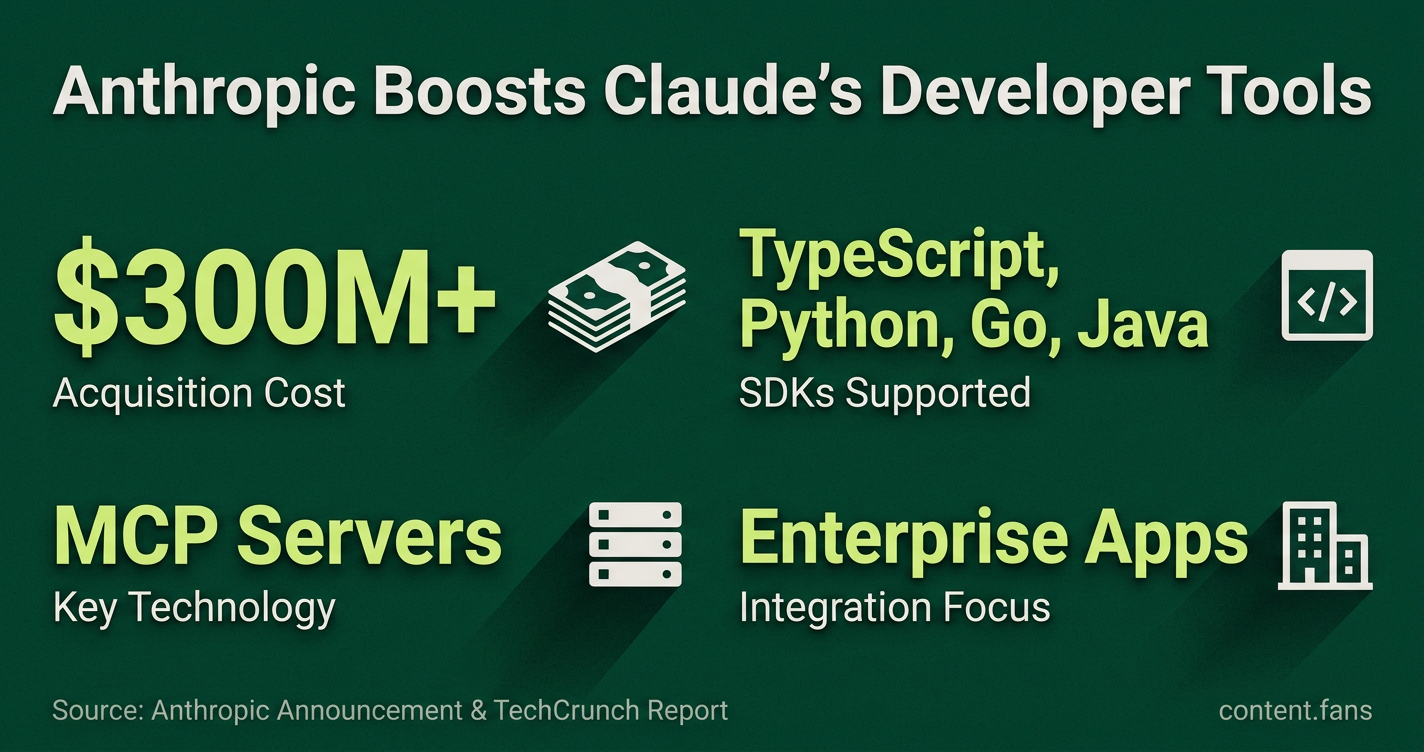
Anthropic acquired Stainless for a reported at least $300 million, bringing critical SDK and connector technology in-house. The move, confirmed in an Anthropic announcement, represents a significant investment in developer tools. A TechCrunch report highlights the deal's strategic importance, noting that competitors like OpenAI and Google also used Stainless's tools.
This acquisition concentrates ownership of widely used SDK and connector technology within a single AI model provider. Industry analysts suggest this signals a strategic pivot from competing on model benchmarks to controlling the crucial integration layer that enables AI agents to perform practical tasks in real-world applications.
Why Anthropic bought Stainless
Anthropic acquired Stainless to gain direct control over the developer tools essential for integrating its Claude AI models into enterprise applications. By owning the company that has always produced its SDKs, Anthropic aims to improve reliability, accelerate development, and offer a more seamless experience for developers.
According to Anthropic, Stainless has been responsible for creating "every official Anthropic SDK since the earliest days of our API." The acquisition gives Anthropic direct control over the libraries, command-line interfaces (CLIs), and MCP servers that developers rely on. Katelyn Lesse, Anthropic's Head of Platform Engineering, emphasized that "agents are only as useful as what they can connect to," positioning the deal as a way to evolve Claude from a chatbot into a practical workforce assistant. This tighter control over SDK generation "improves reliability and consistency," according to reporting from Infoworld, which helps Anthropic attract enterprise clients who prioritize stable tooling over cutting-edge model features.
What Stainless adds to Claude's stack
Stainless specializes in converting a single API specification into native-feeling, multi-language SDKs for TypeScript, Python, Go, and Java. Its technology also provides CLI tools and MCP servers, which create structured schemas for AI agent functions. Anthropic designates the Model-Context Protocol (MCP) as its standard for allowing Claude to securely connect with external systems like databases and SaaS applications.
Key technologies Stainless contributes include:
- Language-specific SDK generators that cut integration code
- CLI scaffolding for automation and DevOps workflows
- MCP server templates that publish machine-readable tool definitions
Anthropic confirmed to TechCrunch that it will phase out its hosted Stainless services but will permit existing customers to retain their generated SDKs. This move allows the newly integrated team to focus on developing features specifically for Claude.
Competitive ripples across AI tooling
As Infoworld notes, with AI model performance becoming more uniform, vendors are now competing on "developer experience, orchestration layers, and ecosystem connectivity." The Stainless acquisition enables Anthropic to provide a fully integrated stack, from the model to the agent protocol. This strategy could solidify Anthropic's market position among enterprise customers. Competitors must now decide whether to develop their own SDK tools, find neutral third-party alternatives, or promote open standards to prevent vendor lock-in. This positions Anthropic with significant control over a technology its rivals also used, potentially sparking further acquisitions in the AI tooling space as other platforms move to secure their own developer pipelines.
Stakes for developers in 2025
For developers integrating LLMs, AI tools can improve productivity by automating tasks like code generation, documentation analysis, and assistance with decision-making. A tighter alignment between these tools and Claude's function-calling capabilities could lead to lower latency and more reliable agent performance.
However, potential challenges include governance issues. Infoworld raises concerns about API sprawl and inconsistent security from autogenerated connectors, suggesting enterprises will need to implement stricter oversight. The ultimate success of the acquisition hinges on execution. A smooth integration could establish Claude as the standard for agent-based infrastructure, while any stumbles might push developers toward open-source alternatives, testing the true value of a proprietary tooling layer in the competitive AI market.
Q1: What is Stainless and why did Anthropic make this significant acquisition?
Stainless is a developer-tooling company that builds high-quality SDKs, CLI tooling, and MCP servers from a single API specification. According to Anthropic's announcement, the platform has "powered every official Anthropic SDK since the earliest days of our API" and is already used by hundreds of companies to generate language-native libraries. The substantial price tag shows how strategic developer plumbing has become: owning the layer that turns an API into ready-to-use code lets Anthropic tighten the entire Claude-to-product integration loop and reduce reliance on third-party tooling that competitors such as OpenAI and Google also depended on.
Q2: How will the purchase improve Claude's ability to connect to external tools?
By bringing Stainless in-house, Anthropic gains full control over the connectors, SDKs, and MCP servers that Claude needs to interact with real-world data and applications. The new setup will let Claude:
- auto-generate client libraries in TypeScript, Python, Go and Java that feel native to each language
- reuse battle-tested MCP servers for agent workflows instead of building ad-hoc integrations
- deliver lower latency because generated SDKs are optimized for fast, reliable network calls
Anthropic's post frames this as a move from chat-first to work-first AI, where the model can "do the work" rather than just describe how it might be done.
Q3: What competitive advantage does the deal give Anthropic over OpenAI and Google?
The transaction internalizes a tool that both OpenAI and Google relied on, giving Anthropic leverage over a shared developer touchpoint. Industry observers note that this positions Anthropic with significant control over technology its competitors also used. More importantly, Anthropic can now prioritize new SDK features and MCP extensions for Claude first, forcing competitors either to build replacements or accept slower iteration cycles on integrations.
Q4: What exactly is MCP and why does it matter for AI agents?
MCP (Model-Context Protocol) is an open standard that gives AI agents a structured, discoverable way to call tools and fetch live data. Stainless already generates MCP servers from an API spec, so developers no longer need to hand-write connector code. This is critical because industry research supports that poor or ambiguous tool schemas can lead to errors and that tool-enabled agents are more effective when they have clear, machine-readable schemas. By baking MCP server generation into Claude's platform, Anthropic ensures every new external service is immediately callable with clear schemas, boosting real-world reliability.
Q5: How will developers experience the change over the next 12 months?
Anthropic has already stated it will wind down the hosted Stainless product, but existing customers keep rights to their generated SDKs. For Claude developers, the integration is expected to bring improvements in SDK quality, development speed, and tool connectivity. The company aims to reduce integration complexity and improve the developer experience when connecting Claude to external systems and APIs, though specific timelines and features will be announced as development progresses.