
Andrej Karpathy Joins Anthropic To Accelerate Claude Pre-training
Serge Bulaev
Andrej Karpathy, a former OpenAI founding member, is reported to be joining Anthropic's pre-training team to focus on AI-assisted research. His goal may be to use Anthropic's Claude model to make the process of training new AI models faster. Reports suggest Karpathy will build a group to help Claude improve itself, but it is unclear how much can be automated and how much human review is still needed. Experts say that while this approach could help researchers a lot, final decisions likely must be made by humans. Anthropic has not shared detailed plans or a start date for Karpathy's new team.

Andrej Karpathy is joining Anthropic's pre-training team, a significant move for the AI industry reported on May 19, 2026. The former OpenAI founding member will lead an effort focused on AI-assisted research. This strategic hire positions a leading deep-learning expert to demonstrate that Anthropic's own model, Claude, can drastically shorten the expensive, months-long development cycles required to create next-generation AI.
What the Sources Agree On
Reports from TechCrunch state that Karpathy will report to Nick Joseph, Anthropic's Head of Pre-training. His mandate is to "immediately build a new group with a specific mandate: use Claude to speed up the research that produces the next version of Claude." This focus on using AI for self-improvement is corroborated by Let's Data Science, which confirms his team will target the large-scale training runs that establish a model's fundamental capabilities.
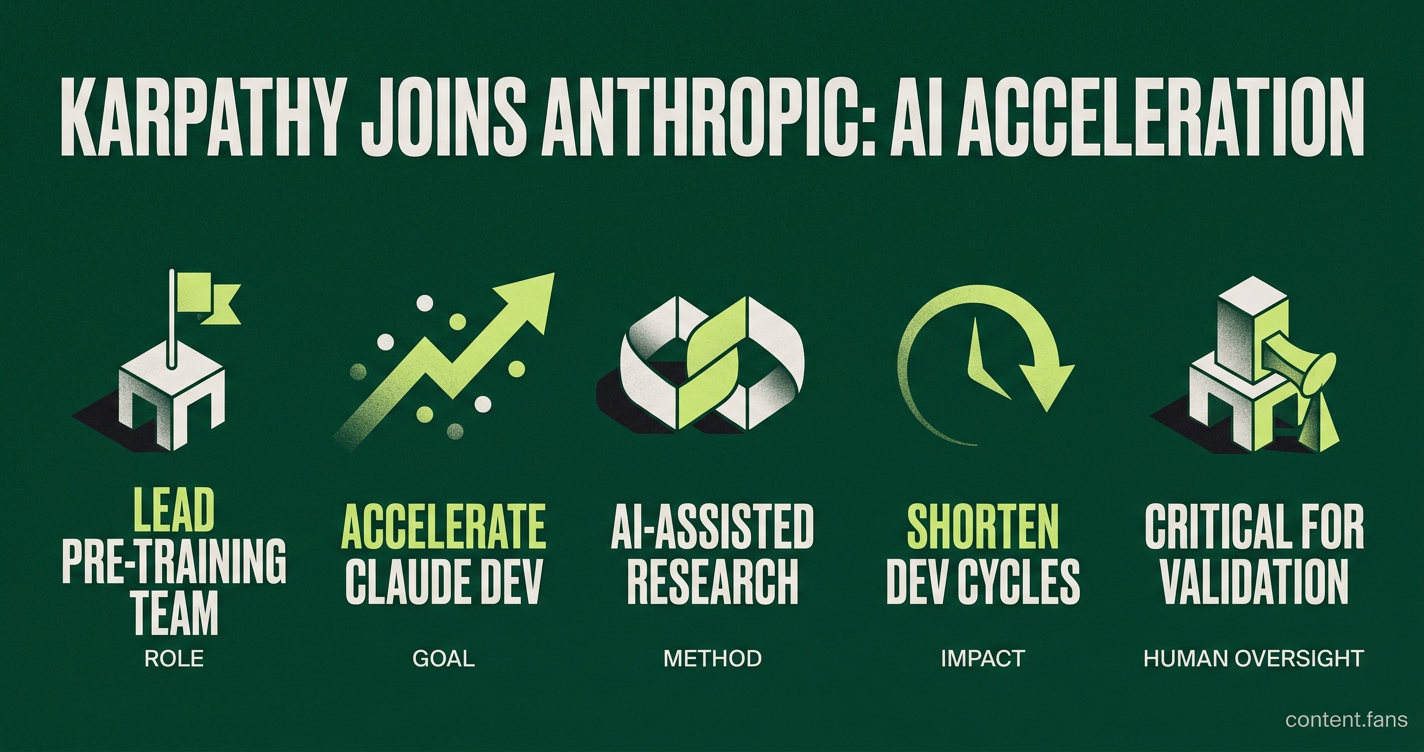
Andrej Karpathy will build and lead a new team within Anthropic's pre-training division. The group's core mission is to leverage the Claude AI model to accelerate the research and development pipeline for future versions of itself, targeting the costly and time-intensive pre-training stage.
How the Recursive Workflow May Function
- Claude drafts hypotheses on architecture or data mixes.
- Automated scripts launch short training shards and return metrics.
- The agent filters results, highlights promising variants, and suggests next steps.
- Human researchers validate the shortlist before full-scale runs.
This iterative loop aims to significantly increase researcher productivity. However, experts note that human validation remains a critical bottleneck. According to industry reports, while AI can match human judgment on key decisions, it still requires human oversight for final verification, suggesting final sign-off must be made by humans.
Karpathy's Track Record
Karpathy is a founding member of OpenAI, former Director of AI at Tesla, and an AI researcher/educator with Stanford CS231n ties. His extensive background in large-scale AI systems aligns with Anthropic's strategy of using system-level experts to combine engineering discipline with AI-native tools. An internal memo cited by Tech Times states the lab believes its own model "can substitute for a significant part of researcher time," though it does not claim full autonomy.
Open Questions
- Will the AI-driven process yield genuinely novel architectural changes or just incremental improvements?
- Can automated systems reliably detect subtle model failure modes before costly, large-scale training runs?
- What level of human oversight will be necessary to prevent the amplification of biases within training data?
Anthropic has not yet released specific implementation details or a launch date for Karpathy's new team. However, the high-profile hire signals that leading AI labs now view recursive self-improvement not as distant speculation, but as a practical and immediate path forward.
What exactly will Andrej Karpathy do inside Anthropic?
He will build and lead a new team that sits in Anthropic's pre-training organization, reporting to pre-training head Nick Joseph. Their single mandate is to use Claude to speed up the research that produces the next version of Claude, concentrating on the massive, compute-heavy training runs that give models their base capabilities.
Why is "pre-training" considered the highest-leverage place to apply AI assistance?
Pre-training is the most expensive and consequential stage of frontier-model creation - it sets the ceiling for everything that follows. Anthropic's bet is that even modest efficiency gains in data selection, mixture tuning, or architecture choice can save significant GPU-hours and unlock noticeably smarter models. Early autoresearch pilots inside Anthropic already flagged 20 issues human reviewers missed in a two-day window, suggesting the upside is real and immediate.
How does this differ from normal "AI writing code" stories?
The loop is recursive and research-focused: Claude will propose experiments, edit training code, launch short runs, evaluate results, and keep only the statistically solid changes - all without human keystrokes. Conventional coding copilots help engineers; Karpathy's group wants Claude to act as the engineer, shrinking iteration cycles from weeks to hours.
What evidence exists that AI-driven research can out-perform human review?
- According to industry reports, automated review systems are showing promise in matching human acceptance predictions on peer-review datasets while surfacing extra failure modes.
- Independent users of Karpathy's open-source autoresearch agent report overnight bug finds that teams had overlooked for months, including a training-script error that silently hurt convergence.
- Anthropic's internal two-day pilot run found 20 model defects that escaped senior researcher eyes, providing the confidence to scale the program.
Could this approach trigger run-away capability jumps?
Most observers see "lossy self-improvement" rather than an intelligence explosion: models speed up experiments but still hit validation, compute, and data bottlenecks. The near-term forecast is faster, cheaper iteration cycles, not autonomous overnight leaps. Still, recent coding benchmarks have shown significant improvements, so even linear acceleration could make Claude-Next arrive ahead of an un-assisted schedule.