
Amazon AWS expands AI shopping assistant tech to other retailers
Serge Bulaev
Amazon is now offering its AI shopping assistant technology, which powers Alexa for Shopping, to other retailers. AWS says retailers can use this technology within about 60 days and keep control of their own data and branding. Some retailers, like Kate Spade's parent company, have already started using these tools, but most are still testing them. Analysts suggest this move might help smaller retailers compete on recommendations but could also make them more dependent on AWS. Retailers are considering costs, data control, branding, and how easy it would be to leave AWS before widely adopting this technology.

Amazon is now making its powerful AI shopping assistant technology, refined through products like Alexa for Shopping, available to other retailers via Amazon Web Services (AWS). This move extends the code and models from Amazon's own storefront, allowing merchants to deploy sophisticated conversational AI. Industry reports suggest Amazon is shifting from a retail competitor to also being a key technology supplier in the emerging agentic commerce race.
The announcement comes as retailers increasingly explore conversational search and AI-driven product discovery. By packaging its internal tools, Amazon aims to monetize its AI investments while setting a technical standard for how shopping assistants interact with customers, giving outside merchants access to mature Q&A and recommendation capabilities without building them from scratch.
What Amazon is offering
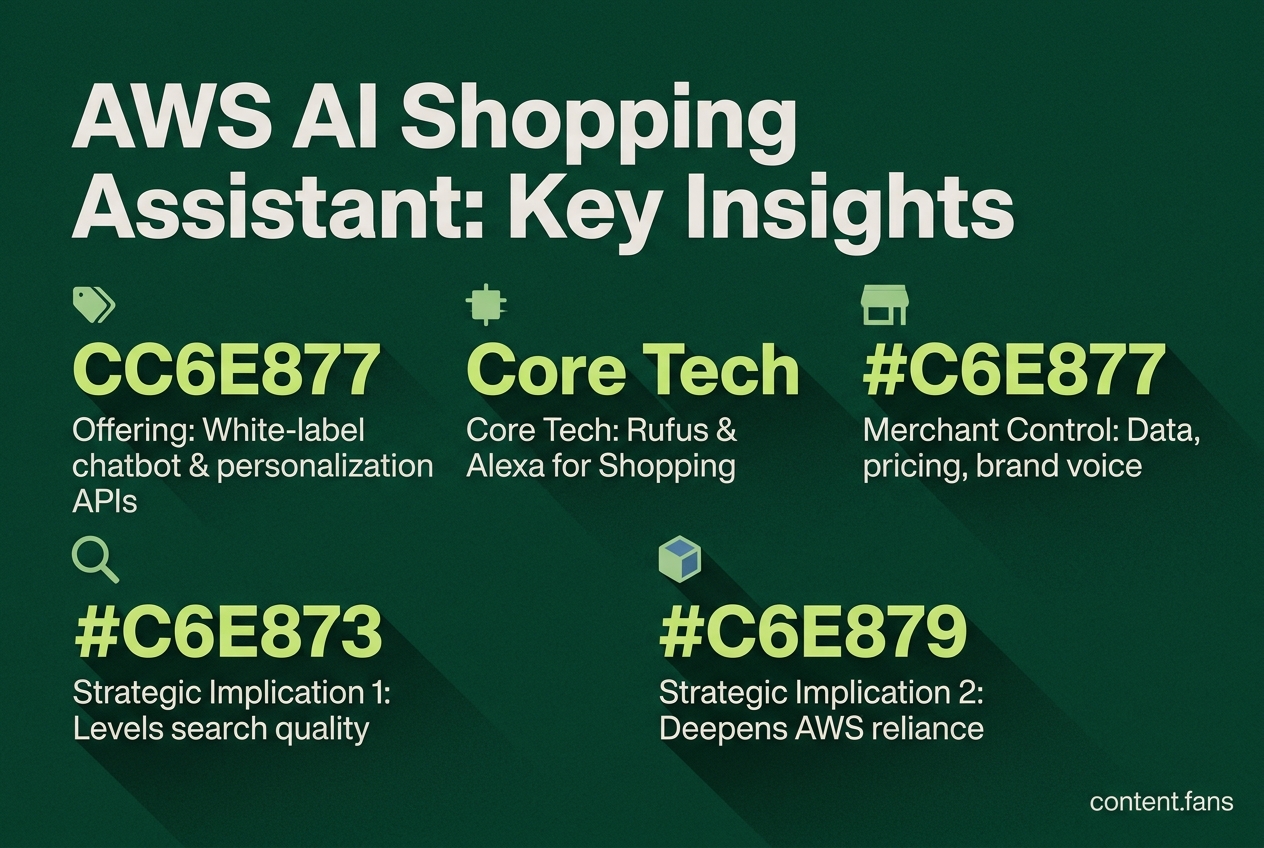
AWS offers retailers a suite of AI tools to build a custom shopping assistant. This includes a white-label chatbot for product questions and personalization APIs for recommendations, using the same mature technology that powers Amazon's own conversational commerce features like Rufus and Alexa for Shopping.
AWS currently lists two primary commerce-focused bundles:
- Agentic Shopping Assistant - A white-label chatbot trained on a merchant's specific catalog, inventory, and business rules to handle product questions, cross-selling, and order status inquiries.
- Retail Personalization APIs - A collection of services for embeddings, vector search, and real-time ranking that mirror the systems behind Amazon's own Rufus and Alexa for Shopping.
No supported source in the provided results confirms the claimed Amazon Business suite and November 2025 U.S. availability.
Early adoption and cautious interest
Several retailers are exploring early adoption of these AI tools, though widespread adoption is still in the testing phase. AWS emphasizes that merchants retain full control over customer data, pricing, and brand voice to allay concerns about sharing sensitive information with a direct competitor.
A short adoption snapshot:
- Deployment approach: Retailers are piloting the technology in phases
- Typical deployment time: AWS claims streamlined implementation timelines
- Data separation: merchants choose storage region and define access policies
Strategic implications and risks
Analysts see this move creating two distinct competitive effects. First, it gives smaller merchants access to advanced algorithms, potentially leveling the quality of search and recommendations across the industry. Second, it deepens reliance on AWS, which could increase switching costs and create vendor lock-in. Retail CIOs are therefore focused on a key question: how easy it would be to leave AWS. They are asking for details on exporting data, migrating workflows, and ensuring platform independence.
There is also a potential policy dimension. As Amazon's algorithmic tools become more widespread, regulators may scrutinize whether they influence market-wide pricing or recommendation patterns, concentrating market logic within a single ecosystem.
How retailers are evaluating the offer
Retailers are weighing the significant benefits of AI assistants against the long-term risks of dependency on a major competitor's cloud platform. Key evaluation criteria include:
- Total cost of ownership versus building an in-house LLM infrastructure.
- The ability to fully brand the assistant and integrate unique promotional logic.
- Data residency and governance capabilities to comply with regional privacy laws.
- A clear and viable path to exit the platform without a complete architectural redesign.
This careful evaluation framework helps explain why adoption is cautious and measured rather than ubiquitous, as brands balance immediate gains with long-term strategic independence.
What is Amazon selling to outside retailers, and how mature is it today?
Amazon is bringing its own retail-grade AI stack to market as a white-label product offered through AWS. The headline item is the AWS Agentic Shopping Assistant that lets any brand embed an AI concierge on its site. Early adopters are testing the tool to roll out AI-powered features built on Amazon's infrastructure via Amazon Bedrock. Retailers keep control of product catalogs, pricing rules, and customer data; Amazon provides the inference, orchestration, and conversational templates it already refined on its own storefront.
How does this change Amazon's role in the retail ecosystem?
Amazon is shifting from pure rival to rentable engine. Instead of only competing for end-shoppers, Amazon now monetizes its R&D by selling the same AI muscle that powers Rufus and Alexa for Shopping. That creates a dual identity: Amazon remains the world's largest marketplace while also acting as a technology vendor to any retailer that wants a head start in agentic commerce - the emerging battle for who owns the shopping conversation.
What capabilities do retailers gain without building in-house?
Retailers can plug in end-to-end conversational commerce without hiring ML teams or training large models. The AWS package includes:
- product-question answering that pulls from live inventory feeds
- personalized recommendations driven by shopper history and real-time session data
- guardrails and safety inherited from Amazon's consumer system
- streamlined implementation timeline, a speed that would be impossible for most internal builds
Early deployments show how the stack can be branded entirely under the retailer's visual identity while still benefiting from Amazon's backend scale.
What are the main lock-in and data-governance concerns?
AWS tells retailers they retain ownership of both data and business rules, yet several risks remain:
- data gravity - once catalogs, embeddings, and conversation logs sit in one ecosystem, moving workloads becomes expensive
- model portability - fine-tunes and prompt pipelines may not export cleanly to another cloud
- pricing uncertainty - feature deprecation or tier changes could raise costs mid-contract
Retailers should verify deletion SLAs, audit-log depth, and whether orchestration scripts can run outside AWS before signing.
How might this reshape competitive dynamics across retail?
The move lowers the barrier to deploy sophisticated AI, meaning smaller retailers can suddenly offer discovery and recommendation quality that once belonged to tech giants. At the same time, Amazon's stack may set interface standards: if shoppers start expecting a Rufus-like experience everywhere, retailers that stay on legacy search risk appearing outdated. Experts call this the agentic-commerce race - less about who has the lowest price and more about who controls the assistant layer that surfaces products in the first place.