
Altimetrik: 77% of Leaders Revise AI Plans Towards Growth
Serge Bulaev
According to Altimetrik, 77% of business leaders have changed their AI plans to focus on growth and innovation rather than just cutting costs. Akshay's approach suggests starting with customer value and then looking for efficiency, using AI as a partner for business expansion. The process is broken into three steps: individual skills, team practices, and full business integration. However, the report notes that many companies may still struggle with real implementation, data risks, and system compatibility. These findings suggest that strong rules and clear goals are important to turn AI efforts into real business results.

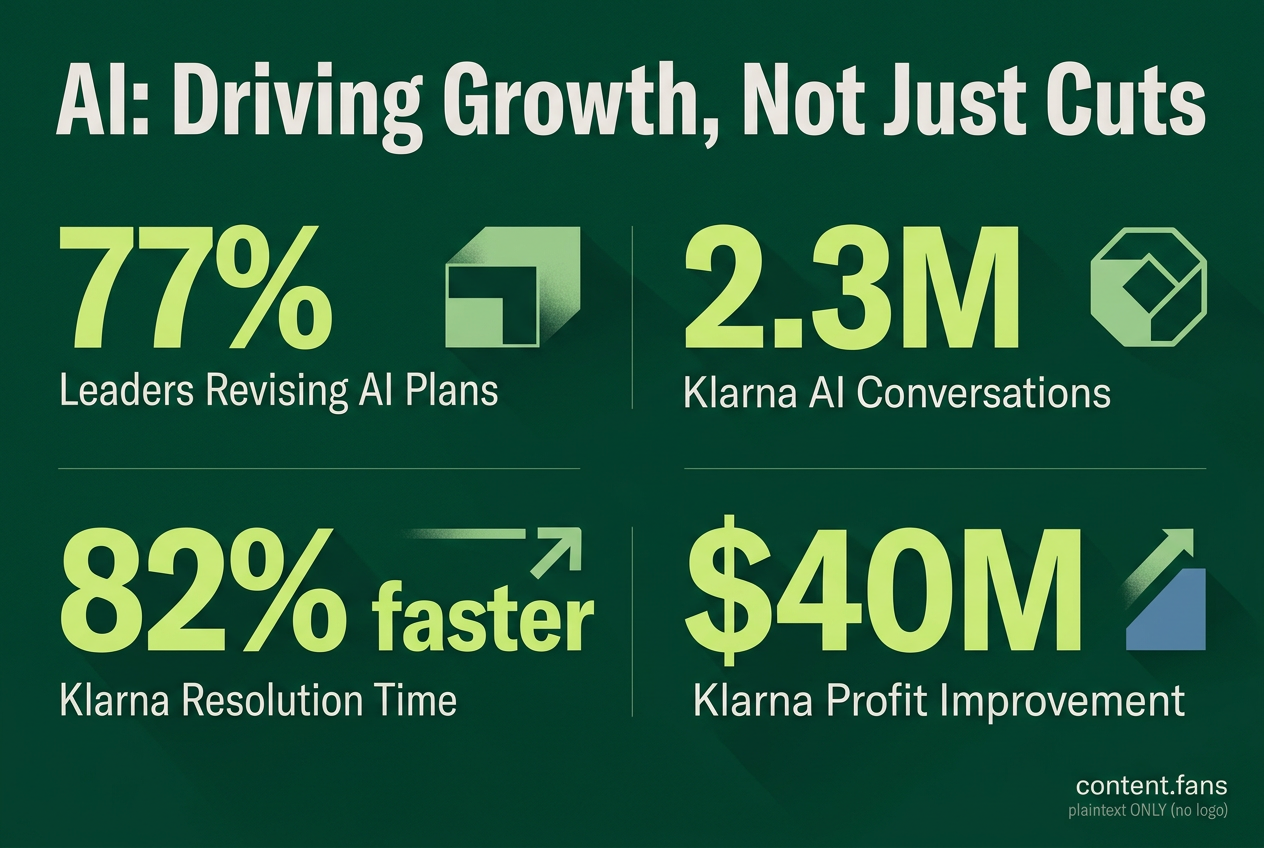
A new study reveals a crucial pivot in corporate strategy: 77% of leaders are revising their AI plans to focus on growth and innovation, according to a Thoughtworks study (Rachel Laycock, CTO at Thoughtworks). This shift moves beyond using AI for cost-cutting and instead treats it as a powerful engine for business expansion. Leaders are urged to avoid two critical errors: ignoring AI's potential or using it merely as a tool for layoffs. The forward-thinking approach is to prioritize customer value, allowing operational efficiencies to follow as a natural consequence of growth-oriented strategies.
To navigate this transition, a proposed three-horizon framework helps guide strategic AI adoption.
Horizon 1 - "AI for Me"
This initial phase focuses on individual empowerment. Employees learn to leverage AI for core tasks like drafting content, summarizing information, clarifying complex topics, stress-testing ideas, and adjusting communication tone. These early, personal wins build foundational skills and confidence while revealing initial challenges in data access and governance.
A strategic AI implementation framework begins with individual skill-building before scaling to team-based workflows and finally integrating AI into core business operations. This phased approach prioritizes personal productivity, followed by standardized team practices, and culminates in linking AI agents directly to revenue-generating and customer-facing activities.
Horizon 2 - "AI for My Team"
The second horizon scales AI adoption to the team level. Groups collaborate to create standardized prompt libraries, quality assurance checklists, and peer review protocols. Developing these shared playbooks ensures consistency in customer interactions and operational outputs. Companies that successfully formalize these team-based practices have reported significant increases in experimentation velocity.
Horizon 3 - "AI for the Business"
In the final stage, AI is fully integrated into the business's core revenue and growth loops. For example, Klarna's AI assistant handled 2.3 million conversations in its first month (February 2024), resolving issues in under 2 minutes versus 11 minutes for humans (82% faster), doing the work of ~700 full-time agents, and driving a projected $40M profit improvement. Similarly, enterprise-level AI deployments at companies like Walmart have been linked to significant e-commerce growth.
Metrics that emphasize ambition
To support a growth-oriented strategy, leaders must shift from tracking cost-cutting KPIs to measuring metrics that signal a true competitive advantage. Key performance indicators should include:
* Cycle time from idea to shipment
* Customer resolution time and satisfaction scores
* Experiment velocity (number of tests launched per month)
* Hours reallocated from administrative tasks to high-value product development
Akshay Trikha encapsulates this growth-first mindset in a LinkedIn Pulse essay:
"If your AI strategy ends at efficiency, you'll get efficiency. If it starts with customers, you'll get growth."
Common pitfalls still slowing progress
Despite the clear potential, several common pitfalls hinder successful AI implementation. Researchers warn that many organizations create ambitious "AI wishlists" that lack operational substance, with many executives admitting their strategies are more for show than action. Other significant risks include 'shadow AI' - the use of unapproved tools creating data leak vulnerabilities - and persistent integration challenges with legacy systems.
Overcoming these challenges requires pairing ambition with robust governance. By establishing clear data boundaries, implementing strict verification standards, and focusing on growth-oriented metrics, organizations can successfully transform isolated AI experiments into a source of compounding competitive advantage.
What are the two main failure modes companies face when implementing AI?
Akshay identifies two critical failure modes that derail AI initiatives: ignoring the AI revolution entirely and betting only on human labor, or focusing narrowly on using agents to cut workforce costs without increasing ambition. The first leaves companies competitively obsolete, while the second makes them efficient but stagnant - what Akshay warns as: "You'll become very efficient, but if you're not figuring out how to grow, that's tough."
How should leaders reframe their approach to AI agents for sustainable growth?
Rather than viewing AI agents as cost-cutting tools, leaders should raise ambition and pursue growth enabled by agents. Akshay's recommended mindset shift moves from "We're implementing AI to improve efficiency" to "We're scaling the business without scaling headcount - not to cut jobs, but to handle the growth that's coming." This growth-focused approach prioritizes new revenue streams, expanded efficiency opportunities, and customer-centric value creation.
What is the three-step framework for implementing AI strategically?
Akshay outlines a progressive implementation path: "AI for Me" (personal productivity through drafting, summarizing, and stress-testing), "AI for My Team" (shared workflows with prompt libraries and QA checklists), and "AI for the Business" (customer and growth loops with clear data boundaries and accountability). This framework emphasizes building momentum first, then scaling to organizational transformation rather than top-down mandates.
What metrics should replace efficiency-focused KPIs when measuring AI success?
Growth-oriented organizations should track competitive advantage metrics rather than cost savings alone. These include cycle time reduction (idea to shipped), customer resolution time and satisfaction, experiment velocity (tests per month and time-to-insight), and time reallocation from administrative work to customer-facing activities. According to industry reports, a growing number of business leaders have shifted their AI strategies from efficiency to growth and innovation.
What organizational changes are required to support growth-focused AI adoption?
Success demands C-suite ownership of AI as a growth driver rather than delegation to cost-cutting initiatives, plus a cultural evolution where AI colleagues are viewed as growth partners. Companies must commit to longer-term investment cycles that allow AI capabilities to mature and compound. This strategic adoption and iterative experimentation stands in contrast to reflexive cost-cutting or denial - the hallmarks of organizations that fail to capture AI's transformative potential.