
AI Workflows: New Design Focuses on Modular Pipelines, Observability
Serge Bulaev
The text explains that building reliable AI workflows may need modular pipelines with clear steps such as preprocessing, generation, and monitoring. Each stage appears to have its own rules and ways to handle errors, which helps teams quickly find and fix problems. Reports suggest that having guardrails and letting humans review uncertain cases is important, especially for sensitive areas like medicine or finance. Observability tools and tracking certain metrics, like accuracy and safety, may help teams monitor quality and quickly respond if things go wrong. Keeping runbooks and monitoring tools up to date might support ongoing reliability and improvement.

Designing reliable AI workflows requires a shift from clever prompting to disciplined engineering. For teams shipping generative AI at scale, this guide details how to build production-grade systems using modular pipelines and robust observability, turning theoretical Level 5 concepts into sustainable, high-traffic code.
Modular pipeline design
A modular AI pipeline breaks down complex tasks into distinct, manageable stages like data preprocessing, context retrieval, generation, and monitoring. This separation allows teams to isolate and resolve failures quickly, as each component has a clear, independent contract for inputs, outputs, timeouts, and error handling.
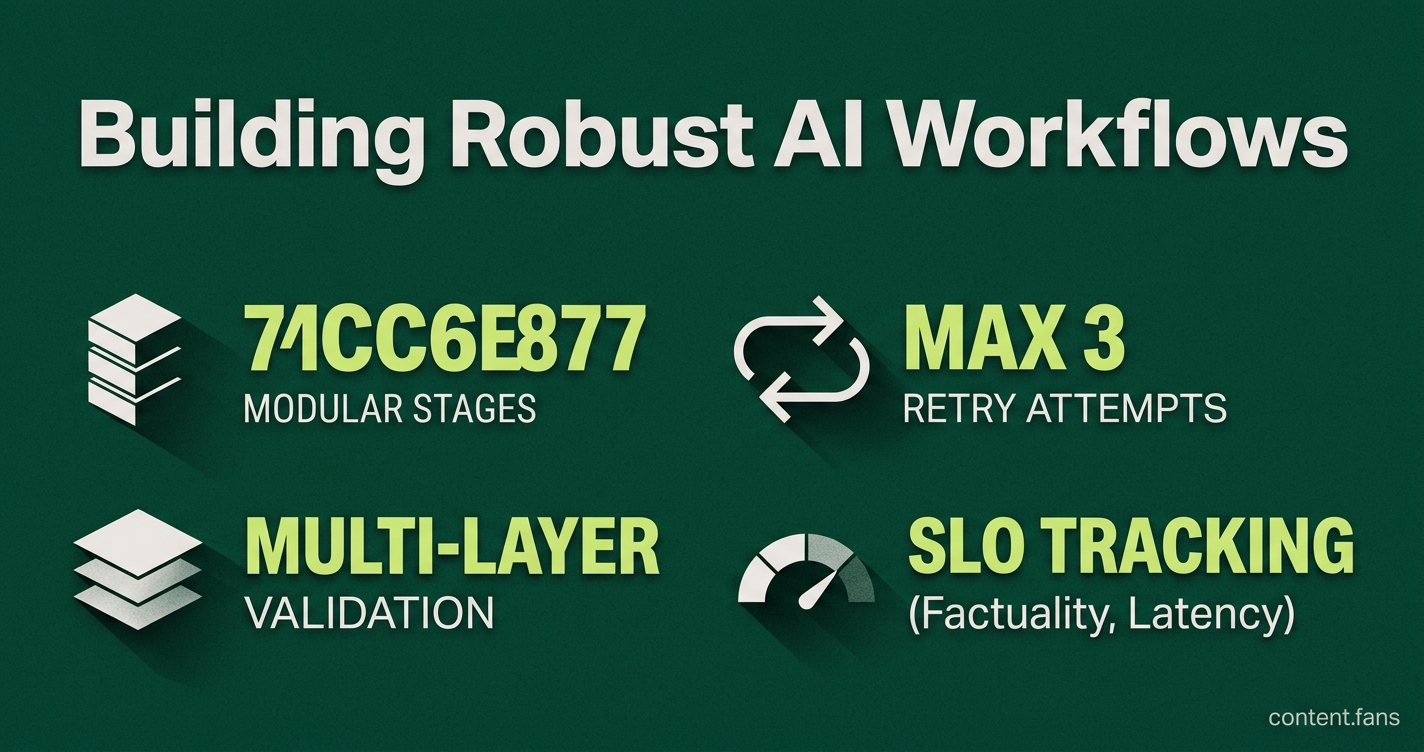
The dominant pattern for production systems divides work into multiple specific stages: ingress, preprocessing, context retrieval, generation, postprocessing, action, and monitoring. Correlated logs, metrics, and traces can help localize failures and diagnose regressions. Each stage operates under a strict contract defining its schema, timeout budget, and retry policy. Using deterministic components for non-generative steps ensures that behavior is reproducible for later validation.
All retry logic must be idempotent. Standard patterns include:
- Simple exponential backoff with a maximum of three attempts
- Compensating transactions that reverse partial side effects
- Queue-based redelivery for long-running tasks
The choice of pattern depends on whether the downstream call is read-only or mutative.
Guardrails and human escalation
Effective AI workflows implement multi-layer validation. Initial schema checks reject malformed data, while business-rule filters block policy-violating outputs. When a model's confidence score drops below a set threshold, the workflow escalates the task to a human reviewer. This human-in-the-loop gate is critical for high-stakes domains like finance or medicine, preventing irreversible errors.
Observability and SLO tracking
True AI observability involves correlating logs, traces, metrics, and user feedback across the entire stack, from orchestration to the model and vector database. Teams should instrument workflows using OpenTelemetry, capturing details like prompt hashes, model versions, and latencies in each span. Exposing trace IDs through orchestrators like Prefect or Airflow enables on-call engineers to diagnose a production error back to the exact causal prompt in seconds.
Service Level Objectives (SLOs) apply SRE principles to model quality. A standard set of SLOs tracks key metrics like factuality, hallucination rate, safety violations, and latency. For instance, an SLO might mandate high factuality over a rolling window with a low hallucination budget. If the error budget is exhausted, automated responses can trigger, such as routing traffic to a more stable model or increasing the human review sampling rate. This treats workflow health as a continuous, dynamic metric, not a static launch target.
LLM Observability and Tooling
While orchestrators manage retries, dedicated LLM observability platforms like Arize or LangSmith provide deeper insights. These tools capture token-level traces and perform automated evaluations on live traffic. Teams integrate them with OpenTelemetry to create a unified trace graph, linking application performance dashboards directly with model behavior dashboards.
Vector database telemetry is also critical, tracking metrics such as match score distribution, retrieval latency, and source freshness. Integrated observability platforms can then automatically alert teams when embedding drift causes match scores to degrade past a historical baseline.
Finally, operational runbooks codify the entire reliability strategy. These documents must include rollback commands, SLO breach escalation paths, and links to live error budget dashboards. Versioning runbooks with the application code ensures that reliability controls evolve in lockstep with new features, providing a clear audit trail.
What exactly is a "Level 5" AI workflow and why does reliability matter now?
A Level 5 workflow is the layer where engineering rigor transforms a promising model or agent into a deterministic, repeatable production system. At this stage the focus shifts from single-model accuracy to system-level reliability - measured through Service-Level Objectives (SLOs) such as high factual accuracy or effective harmful-prompt blocking over a rolling window. Teams that reach Level 5 typically record significantly fewer production incidents within one quarter because every stage is traceable, testable, and reversible via automated rollback.
How should I break the AI workflow into modular, deterministic stages?
A common pattern divides the pipeline into multiple inspectable layers:
- Ingress - Auth + strict input schema
- Pre-processing - normalization, risk classification
- Context retrieval - vector search bounded to approved corpora
- Generation - versioned prompt + deterministic temperature
- Response validation - structure check, policy rules, confidence score
- Action gate - human-in-the-loop approval for irreversible side effects
- Monitoring - structured traces, latency, cost, drift
Each module exposes a typed interface and has its own unit + regression tests. This isolation lets teams retry or hot-swap a single stage without touching the rest of the graph.
Which orchestration and observability tools fit modern AI stacks?
- Orchestration: Apache Airflow or Prefect handle retries, DAG wiring, and canary roll-outs.
- LLM tracing (LangChain apps): LangSmith provides prompt/response replay, token-cost tracking, and eval-to-guardrail rules.
- Full-stack telemetry: OpenTelemetry plus Arize, Galileo, or Braintrust unify infra, model, and vector-DB metrics in one pane.
These tools are being adopted by teams at major organizations for multi-agent production workloads, significantly reducing mean-time-to-repair (MTTR).
How do I set realistic SLOs for AI output quality and performance?
Start with four-line SLO definitions:
| SLI | Target | Window | Scope |
|---|---|---|---|
| Factuality | High threshold | Rolling window | English customer-support bot |
| Hallucination | Low threshold | Rolling window | same scope |
| P99 Latency | Reasonable limit | Short window | live traffic |
| Availability | High uptime | Rolling window | all endpoints |
Derive the thresholds from baseline data, then review with product, risk, and legal stakeholders to lock in the error budget. Teams using this template report faster stakeholder sign-off compared to ad-hoc SLAs.
Where should human-in-the-loop gates be placed and how often do they trigger?
Apply human review when:
- Confidence score falls below a calibrated threshold.
- Task involves high-stakes or irreversible action (payments, medical advice).
- Prompt is ambiguous or out-of-domain according to a lightweight classifier.
In practice, a small percentage of traffic is escalated; this covers a significant portion of potential harm while keeping reviewer load sustainable. Escalations are surfaced as editable drafts to the reviewer, and the final decision is logged back into the trace for continuous retraining.