
AI-Native Retailers Cut Costs Up To 70% With Intelligent Automation
Serge Bulaev
AI-native retailers may cut operational costs by 20 to 70 percent using intelligent automation, according to recent case studies. Companies like Amazon, Walmart, and Alibaba report large savings and faster operations after using AI for tasks such as picking, sorting, and route planning. However, many projects do not succeed because poor or messy data often stops progress. Some experts suggest that appointing special leaders, called AI champions, might help companies improve their results by focusing on good data and choosing the right technology.

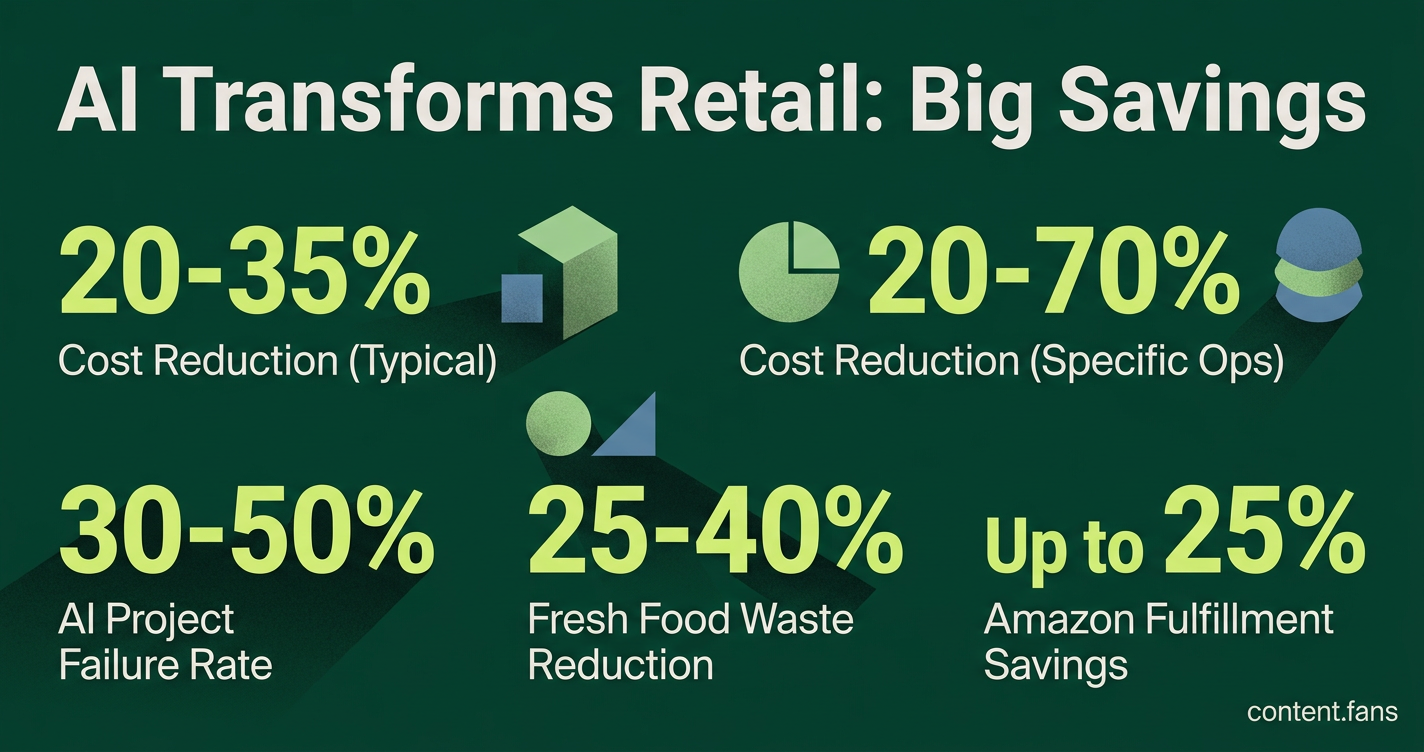
AI implementation typically reduces operational costs by 20-35% across retail operations, with specific routine operations seeing savings of 20-70%. While leading brands like Amazon and Walmart report significant savings, a substantial percentage of AI projects fail to launch, often due to poor data foundations.
This report analyzes the proven cost reductions, examines the data-related challenges that cause most projects to fail, and explores the vital role of "AI champions" in ensuring success.
Intelligent automation helps retailers cut costs
Leading retailers use intelligent automation to optimize core operations, from warehouses to customer service. AI-driven robotics accelerate fulfillment, machine learning optimizes inventory and delivery routes, and conversational AI reduces support expenses, leading to double-digit cost reductions and faster service across the board.
Case studies from industry leaders highlight tangible savings. For example, Amazon has reported fulfillment cost reductions of up to 25% in some facilities using AI-guided robots through advanced robotic automation. Walmart has implemented machine learning for inventory optimization and route efficiency, achieving significant cost reductions and mileage savings across its operations.
Other major players report similar gains:
- Alibaba: Has implemented conversational AI and warehouse robotics to reduce costs and improve fulfillment speed significantly.
- Various retailers: Using AI-powered replenishment have reported fresh food waste reductions of 25-40%.
- Target: Deployed predictive analytics to reduce costly clearance events and improve turnover.
Industry reports confirm these trends, finding that top-performing AI deployments can achieve substantial cost reductions across key areas like customer service.
Data foundations make or break automation
Despite the potential for significant savings, many retail AI initiatives fail. Industry reports typically cite stall rates of 30-50% for AI/ML projects before production. The primary culprit is not flawed AI models but fragmented, low-quality, or incomplete data.
Gartner emphasizes that poor data quality is a primary reason for AI project failure. Common data issues include siloed inventory systems, inconsistent metrics across departments, and poor data governance. Models trained on such flawed data can generate risky recommendations, transforming expected savings into new operational liabilities.
AI champions bridge the gap
To overcome these data hurdles, leading retailers are appointing "AI Champions." These executives are tasked with enforcing data discipline and accelerating AI adoption across the organization. Their core mandate is to bridge the gap between pilot projects and scaled, successful deployments.
According to a UK government framework, the priorities for this role include speeding up AI uptake, building internal skills, measuring ROI, and ensuring digital link trust. Industry research confirms that companies with AI Champions achieve faster results, especially in high-impact areas like demand forecasting. Their success comes from prioritizing data hygiene first, then aligning technology with clear business goals - a proven formula for avoiding common pitfalls.
How much can retailers realistically cut operational costs today?
Across recent case studies, best-in-class deployments deliver significant cost reductions in core operational categories.
- Customer service shows substantial savings through chatbots and voice AI.
- Fulfillment and logistics demonstrate meaningful reductions at major retailers - for example, Amazon has reported fulfillment cost reductions of up to 25% in some facilities after deploying AI robots.
- Inventory holding costs drop significantly when AI forecasting is scaled across store networks.
Sources: Industry case studies and retail analysis reports.
Why do most AI retail projects still fail?
A significant percentage of AI initiatives never reach meaningful production, primarily because of poor data foundations rather than flawed algorithms.
Typical red flags:
- Fragmented product, customer, or store views across channels.
- Only a small portion of enterprise data actually used to drive value.
- Inconsistent metric definitions between departments.
Industry analysts warn that data quality is critical for AI success and poor data foundations lead to project abandonment.
Source: Industry reports on retail AI implementation challenges.
What is an AI Champion, and does the role matter in retail?
An AI Champion is an internal leader mandated to move pilots into scaled, governed deployments.
Core responsibilities include:
- Accelerate adoption: turn scattered proof-of-concepts into integrated workflows.
- Orchestrate AI systems: connect siloed systems so pricing, inventory, and customer tools work together.
- Govern AI implementations: ensure AI recommendations remain secure, transparent, and on-brand.
Retailers with named Champions report significantly higher tool usage and ROI versus peers that rely solely on vendor-led rollouts.
Source: GOV.UK AI Champions adoption plans guidance and industry studies.
Which use cases show the fastest payback?
| Use Case | Typical Payback Period | Industry Evidence |
|---|---|---|
| Conversational AI for customer service | < 12 months | Major retailers report substantial annual savings and customer satisfaction improvements |
| AI demand forecasting for inventory | 6 - 12 months | Leading retailers achieve significant stockout reductions and inventory cost savings |
| Warehouse robotics | 12 - 18 months | Amazon reports meaningful fulfillment cost reductions at scale |
| AI-powered in-store systems | < 12 months | Major retailers improve operational efficiency across store networks |
Sources: Industry case studies and retail technology reports.
How should a retailer start building an AI-ready foundation?
- Data audit first - map every inventory, sales, and customer touchpoint; expose gaps and duplicates.
- Create a single source of truth - consolidate SKUs, pricing, and loyalty data into one governed layer.
- Assign an AI Champion with authority to prioritize use cases, secure budget, and enforce data governance.
- Run controlled pilots on clean data - measure key metrics like cost-per-order, stockout rates, and customer satisfaction to prove value.
- Scale only when the data layer is stable - avoid common implementation risks.
Industry consensus: foundations first is a reliable predictor of success.