
AI narrows snack aisle, changes how consumers discover brands
Serge Bulaev
AI tools on phones and shopping sites now help people quickly sort snack options by things like sodium, sugar, and price. This may change how shoppers notice and trust snack brands, as algorithms often show only a few top choices. If there are mistakes or missing information in product data, a brand might be left out. Experts suggest brands keep their data organized and complete to stay visible in AI searches. Packaging is still important, but it needs to match the online information so that AI assistants can find and show all the right details about a snack.

AI tools are changing how consumers discover snack brands, shifting the focus from bright packaging to structured data. Now on phones and retail websites, these AI assistants instantly rank snacks by price, sugar, and sodium, reshaping brand discovery. This report analyzes how algorithms narrow consumer choice, why poor data makes products invisible, and what brands can do to ensure they appear in AI-generated recommendations.
How AI Narrows Consumer Choice in the Snack Aisle
AI narrows the snack aisle by replacing broad search results with a few highly-specific recommendations. Instead of browsing, shoppers receive a curated shortlist based on their queries, often seeing only the top three or four brands an AI assistant deems the best match for their needs.
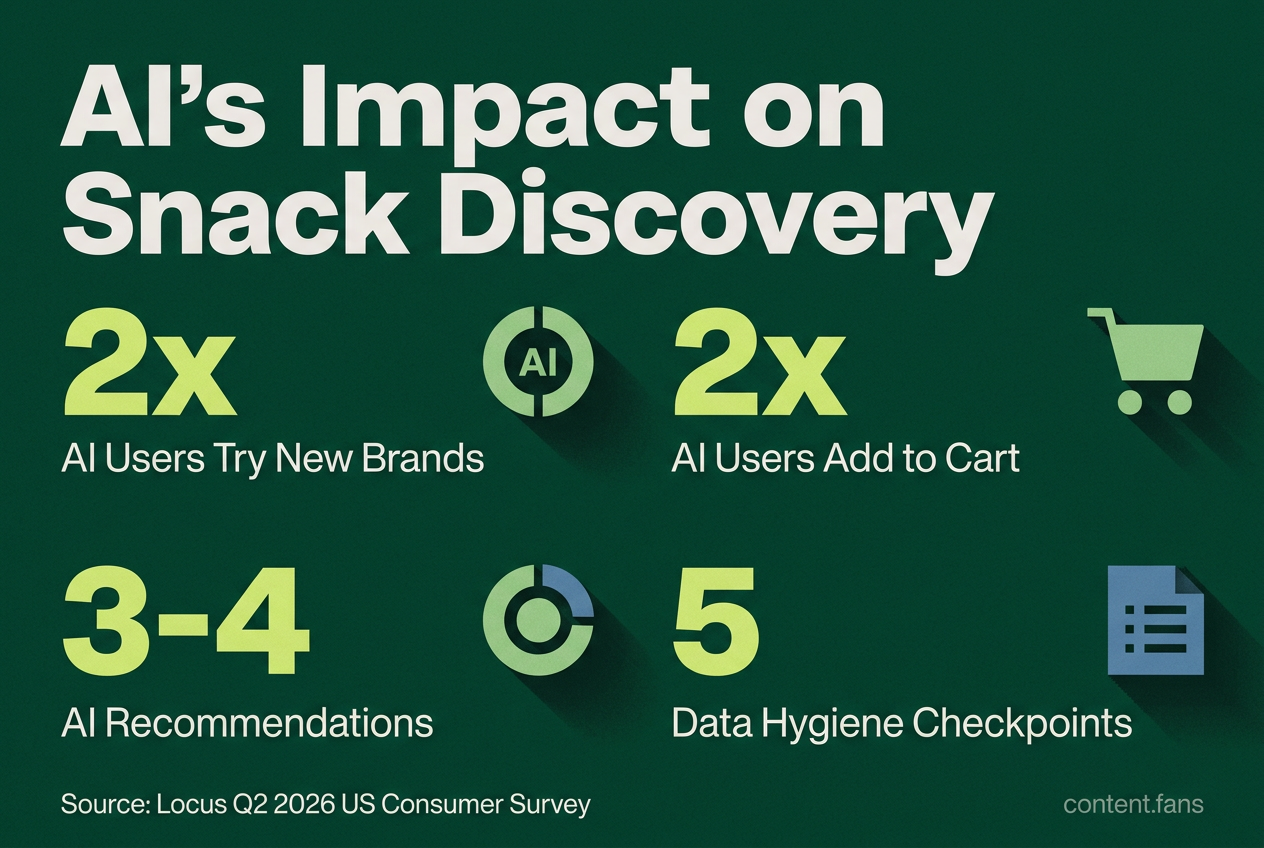
Product discovery is shifting from browsing search results to receiving inference-based answers. AI assistants typically cite only three or four top brands as matches, effectively shortening the consumer's consideration set. According to the Locus Q2 2026 US Consumer Survey, AI users are 2x+ more likely to try new brands (39% vs 18%) and 2x+ more likely to place more items in their carts (37% vs 17%). This trend towards AI-mediated shopping accelerates decision-making but also increases selectivity, as consumers rely more heavily on algorithmic recommendations.
The Risk of "Signal Dissonance" for Brand Visibility
Generative AI platforms build answers by aggregating data from product reviews, retailer feeds, and online forums. However, if this information is inconsistent, the AI may exclude a brand to avoid error - a risk McKinsey calls "signal dissonance." For snack brands, this means even minor data errors, like a mislabeled allergen or a missing weight field on a single platform, can have an outsized negative impact, causing the brand to be completely omitted from AI recommendations.
A Data Hygiene Checklist for AI Visibility
To remain visible in AI recommendation engines, snack brands must prioritize data hygiene. The following checklist outlines five essential practices to reduce catalog errors that can cause AI models to ignore or misrepresent a product.
- Assign a persistent identifier to every SKU so attributes stay linked across channels.
- Standardize critical fields such as weight and ingredient lists using a single format (for example, grams and YYYY-MM-DD dates).
- Run quarterly deduplication with both exact and fuzzy matching to catch misspellings.
- Cross-verify nutrition and certification claims against at least two vetted sources before publishing.
- Store source metadata for each attribute to support confidence scoring and rapid auditing.
How to Optimize for AI Recommendation Engines
Optimizing for AI goes beyond data cleanup; it requires syncing physical packaging with digital information. Brands with complete metadata and clear product imagery receive more algorithmic impressions, as clean data improves performance in retailer A/B tests. For example, a "Non-GMO Project Verified" seal on a bag of chips must also exist as a structured data point (e.g., a boolean field) in the product database. As AI assistants become a primary research tool, this parity between the physical label and digital data is essential for discoverability.
How is AI changing the way consumers discover snack brands?
AI has fundamentally shifted product discovery from browsing-based exposure to inference-based recommendation. Instead of encountering brands through search results, paid placements, or category browsing, consumers now receive AI-curated selections that narrow their consideration set to only the products algorithms choose to surface. According to 2026 research, this means AI citation frequency-how often a brand appears in AI-generated responses-has become more important than traditional exposure metrics. As a result, snack brands may have fewer opportunities to enter consumers' consideration sets at the moment purchase intent is expressed, making algorithmic visibility critical to discovery.
What makes consumers more selective when using AI tools?
AI-powered evaluation enables complete comparison outputs that synthesize nutrition, price, reviews, and other attributes without requiring shoppers to visit multiple product pages or construct their own evaluation frameworks. This delegated research means consumers evaluate a single AI-generated recommendation rather than comparing independent sources themselves. The convenience is significant-a growing number of customers now cite AI-powered platforms like ChatGPT as a key research tool, with usage patterns varying significantly by query type. However, this selectivity also means consumers lose visibility into how recommendations are generated and what signals shaped them, making transparency and trust-building essential for brands that do get surfaced.
Why does incomplete product data hurt brand visibility?
Retail recommendation engines and AI systems penalize products with signal dissonance-inconsistent or incomplete information across third-party sources. When AI models aggregate data from reviews, forums, blogs, and retailer sites, gaps or contradictions make brands less likely to be included in responses. Structured product information directly affects recommendation frequency: normalized attributes, complete metadata, and verified claims increase algorithmic confidence, while missing fields or unclear packaging signals reduce surfacing. For snack brands, this creates pressure to maintain data hygiene across all touchpoints, as AI systems amplify errors and may generate hallucinations when fed poor-quality information.
How can snack brands optimize for algorithmic discovery?
Brands should invest in three core areas: data hygiene, structured product information, and clear on-pack signals. Best practices include implementing persistent identifiers that survive channel changes, standardizing formats for dates and specifications, and using predefined values for attributes to enable accurate semantic search. Retailers specifically recommend creating comprehensive FAQ and guide content that answers complex customer questions, as AI agents factor this into reliability assessments. Additionally, optimizing product pages for multimodal interpretation-ensuring images, attributes, and context work for both visual and textual AI processing-improves discoverability in increasingly sophisticated recommendation systems.
What opportunities exist for brands that adapt to AI-mediated shopping?
AI users demonstrate measurably different purchasing behavior that creates openings for newer or smaller brands. Research shows AI users demonstrate significantly higher rates of brand experimentation and cart additions compared to traditional shoppers. This increased experimentation, combined with consumers' willingness to delegate research, means that snack brands with strong data foundations and third-party verification can compete on algorithmic merit rather than legacy brand equity alone. The key is ensuring that when AI systems evaluate the category, your products have the structured information and consistent signals that allow algorithms to recommend them with confidence.