
AI Email Personalization Drives 5x Reply Rates, 30% ROI in B2B
Serge Bulaev
AI-powered, hyper-personalized email outreach in B2B may raise reply rates to 15-25 percent, about five times higher than generic campaigns, which average around 3 percent. Research suggests this increase might lead to a 20-30 percent boost in campaign ROI when multiple data signals and predictive scoring are used. However, actual results can depend on data quality and channel mix. Some reports indicate brands using tailored experiences appear to be much more likely to win new leads, but data silos and privacy concerns could limit effectiveness. Ethical issues and algorithm bias may also be challenges as AI personalization spreads.
While generic B2B email campaigns struggle with reply rates near 3%, AI email personalization is delivering a fivefold increase. Data from Autobound shows hyper-personalized outreach consistently achieves 15-25% reply rates, compelling revenue leaders to rethink their strategies. This performance boost, linked by MassMetric research to a 20-30% rise in campaign ROI, is achieved by leveraging intent signals, dynamic content, and predictive scoring. This guide examines the metrics, modern toolsets, and strategic limitations of scaling AI-driven email personalization.
How Hyper-Personalized Email Outreach Shifts B2B Metrics
AI-driven hyper-personalization transforms B2B outreach by replacing generic messages with content tailored to individual prospect data, including job changes, tech stacks, and firmographics. This relevance-first approach significantly boosts key performance indicators, leading to higher reply rates, more booked meetings, and improved overall campaign return on investment.
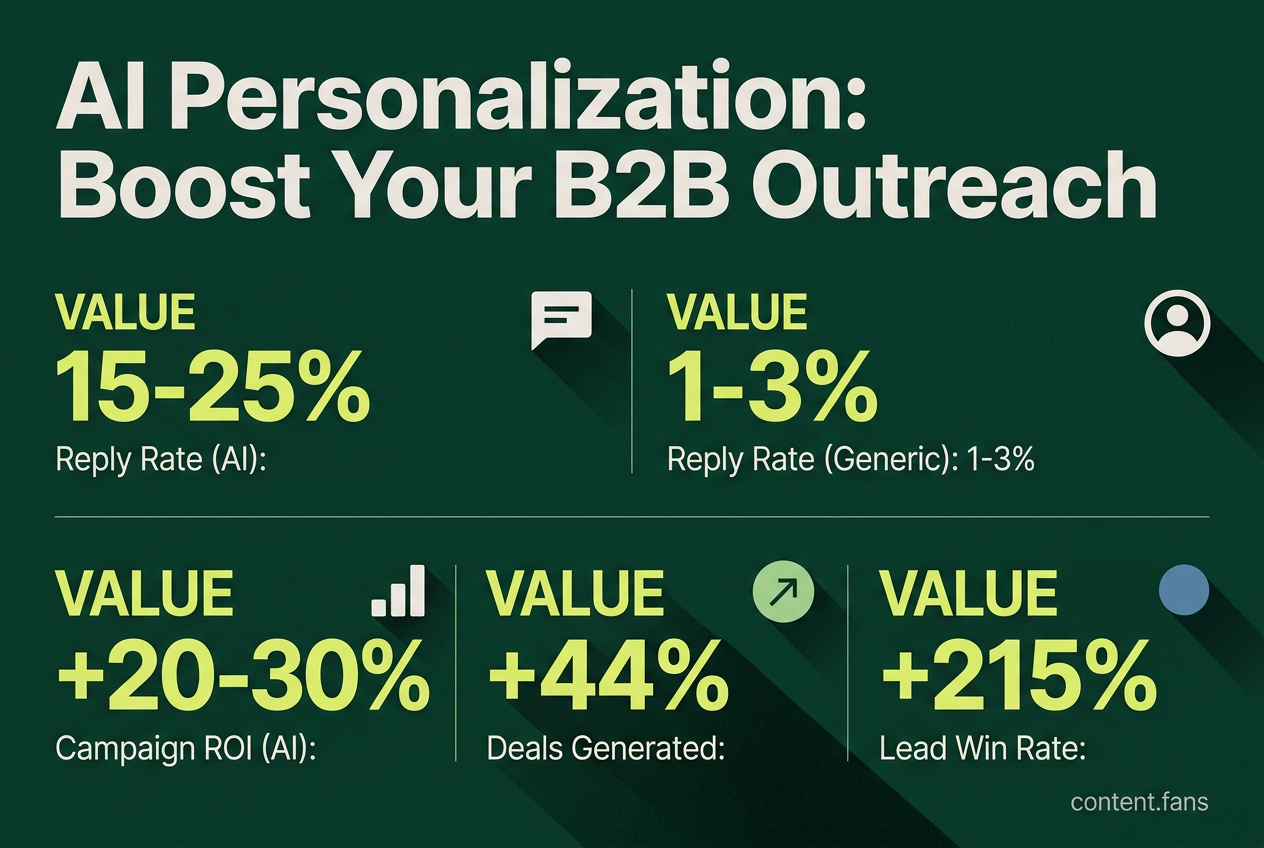
According to HubSpot's 2025 statistics, dynamic personalization can generate up to 44% more deals. Performance escalates when multiple real-time signals are layered; Martal research featured in Autobound shows that combining data on job changes, tech installations, and firmographic shifts can push reply rates to 25-40%. This multi-signal approach is over 142% more effective than basic single-field customization.
| KPI | Generic Outreach | Basic Personalization | Multi-Signal AI Personalization |
|---|---|---|---|
| Average Reply Rate | 1-3 % | 5-9 % | 15-25 % |
| Meetings per Rep (monthly) | 4-5 | 7-9 | 12-15 |
| Campaign ROI Change | baseline | +10-15 % | +20-30 %* |
*MassMetric cautions that actual ROI depends on data quality and channel mix.
Further data from Warmly's 2026 benchmark indicates that brands providing tailored experiences are 215% more likely to win new leads. A broader McKinsey analysis confirms this trend, noting that while most firms achieve a 10-15% revenue lift from personalization, market leaders can reach a 40% premium, highlighting the impact of strategic execution.
The 2026 Tool Stack for Scaled Personalization
Modern AI platforms streamline the entire outreach process by automating prospect research, copywriting, and deliverability management. Key tools in the 2026 stack include:
- Reply.io: Utilizes its Jason AI for intelligent reply classification and automated meeting booking, starting at $49 per month.
- Instantly: Combines Copilot AI with inbox rotation to achieve approximately 85% inbox placement, according to recent EmailToolTester reviews.
- Sendr.ai: Generates unique landing pages for each recipient and dynamically adapts email scripts based on the prospect's specific technology stack.
To maximize effectiveness, many revenue teams integrate these specialized platforms with CRM-native AI, like HubSpot's sequence builder or Salesforce Einstein, for advanced lead scoring and send-time optimization.
Data and Ethical Hurdles Ahead
Despite its power, AI personalization faces significant challenges. Forrester surveys reveal that for 38% of decision-makers, data silos are the primary obstacle to a cohesive customer experience, directly impacting AI accuracy. Privacy is another major concern; a 2022 Accenture poll found 41% of customers feel "creepy" when brands appear to know too much, a sentiment that extends to B2B interactions. Ethical boundaries are critical, as Kensium highlights a PwC finding that 85% of consumers would abandon a firm using AI unethically, suggesting transparency matters as much as deliverability. Bias remains a technical risk; unchecked algorithms may reinforce demographic patterns. MarketingProfs comments that these challenges are driving investments toward improved data governance and cross-platform orchestration to mitigate risks associated with siloed operations and third-party data dependence through 2026.
How does AI email personalization lift reply rates five-fold?
Signal-based AI emails score 15-25% reply rates - a 5x jump over the 1-3% that generic blasts earn.
Multi-signal campaigns that layer firmographics, intent data and recent events climb even higher, to 25-40%.
The leap happens because every sentence is rebuilt for the exact buyer moment, not the average persona.
What ROI should teams expect after switching to AI-driven outreach?
2025-2026 benchmarks show 20-30% higher campaign ROI for firms that deploy AI personalization versus teams that do not.
Marketing costs drop ~19% while pipelines move 25% faster, producing a net 30% ROI within the first two quarters for most B2B adopters.
Which AI tools actually write hyper-personalized emails at scale?
Jeeva AI and Sendr.ai are standout choices for non-technical teams: they read LinkedIn profiles, tech stacks and intent signals, then auto-generate unique copy for every prospect.
Platforms such as Instantly and Reply.io add deliverability safeguards (inbox rotation, warm-up) and autonomous reply handling, letting reps focus on calls, not inbox busywork.
What data does AI need to avoid "creepy" or off-target messages?
Feed the model only publicly available or first-party data - job posts, annual reports, social posts, website changelogs.
Skip sensitive or cross-context signals (health, personal finance) and always give prospects a one-click "why you received this" link.
Following this rule keeps open rates high and spam complaints low.
How difficult is implementation - do we need an army of data scientists?
Most 2026 tools are no-code: connect your CRM, pick intent filters, approve copy samples and launch.
Expect one week for basic setup and two-to-three sprints to refine signals and templates.
The main blocker is data silos - if CRM, web and event data live in separate systems, clean them first or the AI will write clever emails to the wrong humans.