
AI and A/B testing transform social ad campaign performance
Serge Bulaev
A/B testing and AI are helping marketers improve their social ad campaigns by testing one change at a time and using platform tools to check results quickly. Experts suggest running tests with at least 1,000 users for about one to two weeks and writing clear, measurable goals. Case studies suggest that changing just one thing, like a call-to-action, may lead to big improvements. AI appears to make tests faster by sending more users to better ads in real time, though results can vary. Marketers are also reminded to keep good records of each test and keep testing new ideas to always improve their ads.

To maximize ROI, marketers are using AI and A/B testing to methodically enhance social ad campaign performance. This strategic combination uncovers what truly resonates with audiences on platforms like Meta, TikTok, and Instagram. By following a disciplined approach, brands can trim wasted spend, achieve significantly higher conversion rates, and turn small creative tweaks into major revenue gains.
Define a Testable Hypothesis with a Single Variable
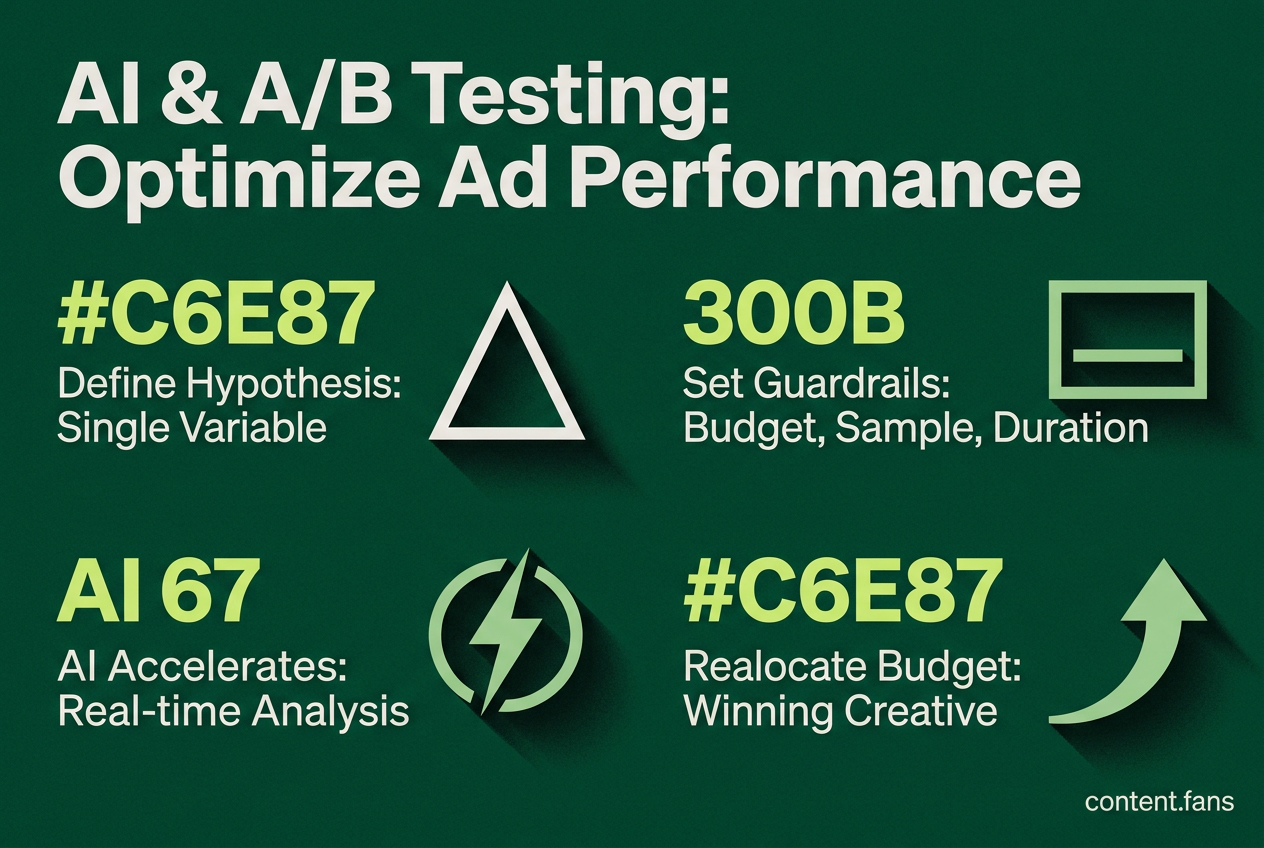
The foundation of a successful A/B test is isolating a single variable. By changing only one element at a time - such as a headline, image, or audience segment - marketers can accurately attribute performance changes. Start each test with a clear, measurable hypothesis (e.g., "Switching to lifestyle imagery will increase click-through rates by 15%"). For maximum impact, prioritize testing high-level concepts first. Authoritative guides from sources like AdManage.ai recommend this hierarchy:
- Offer and angle
- Hook and format
- Landing page path
- Audience selection
- Bidding or budget setting
Isolating one variable is the cornerstone of effective A/B testing. By changing only a single element, such as a headline or image, marketers can accurately attribute performance changes directly to that specific modification. This scientific approach eliminates guesswork and ensures that data-driven decisions guide campaign optimization.
Establish Statistical Guardrails for Budget, Sample, and Duration
For results to be statistically valid, tests require clear parameters. Budget allocation should be based on achieving statistical significance and sufficient sample size rather than arbitrary multipliers. Sample size requirements depend on the baseline conversion rate and desired statistical power - many tests require significantly more users than basic minimums to reach significance, while others may need fewer depending on the effect size being measured. Run tests for sufficient duration to account for daily fluctuations and gather meaningful data. You can use a workflow like the "ABO Lab" method, where each ad set in an Ad-set Budget Optimization campaign contains a single creative. According to a Madgicx guide, this setup ensures each variant receives enough impressions. Native tools like the Meta Split Test can automate traffic splits and analysis.
How AI Accelerates the Testing Cycle and Maximizes Returns
Artificial intelligence is revolutionizing test logistics by dramatically shortening feedback loops. While traditional tests take weeks, AI-powered algorithms analyze performance in real time to automatically reallocate budget toward the winning creative, compressing cycles to hours or days. Advanced methods like multi-armed bandit techniques continuously optimize traffic to maximize returns during the live test. Brands adopting AI-driven optimization typically report engagement lifts of 20-50% and conversion rate improvements of 2-3x, with revenue increases up to 15%.
From Minor Tweaks to Major Lifts: Documenting What Works
Single-variable experiments show that small changes can drive performance lifts, with typical ranges of 10-50% depending on the variable tested. For example, simply altering a CTA can significantly improve trial sign-ups. To capitalize on these findings, teams must archive every test: the hypothesis, variable, spend, and outcome. This creates a valuable internal library of insights, enabling a perpetual optimization loop where each winning ad immediately becomes the control for the next experiment, ensuring constant campaign improvement.