
How to Use AI Without Losing Your Critical Thinking Skills
Serge Bulaev
Experts warn that using AI as a replacement for human thinking may weaken critical thinking skills, a trend sometimes called "AI atrophy." To avoid this, professionals are advised to first form their own ideas, check important facts, and treat AI answers as suggestions that need to be tested. Making sure humans review important or uncertain AI outputs may help prevent mistakes. Alternating between using AI and working without it could keep skills sharp. Studies suggest that how AI is used - either as a helper or as the final answer - appears to affect whether critical thinking is preserved.

To use AI without losing your critical thinking skills, experts recommend treating it as an amplifier, not a replacement for human thought. Over-reliance on fluent chatbot outputs can erode judgment, a risk known as "cognitive offloading" or "AI atrophy." This playbook offers professionals a framework for using tools like Gemini, ChatGPT, and Claude while preserving their reasoning and analytical abilities.
Think before you prompt
To retain your critical thinking, begin by forming your own viewpoint before engaging an AI. Use the model to refine or challenge your ideas, not create them. Always verify important facts and treat AI-generated content as a first draft that requires human review and validation.
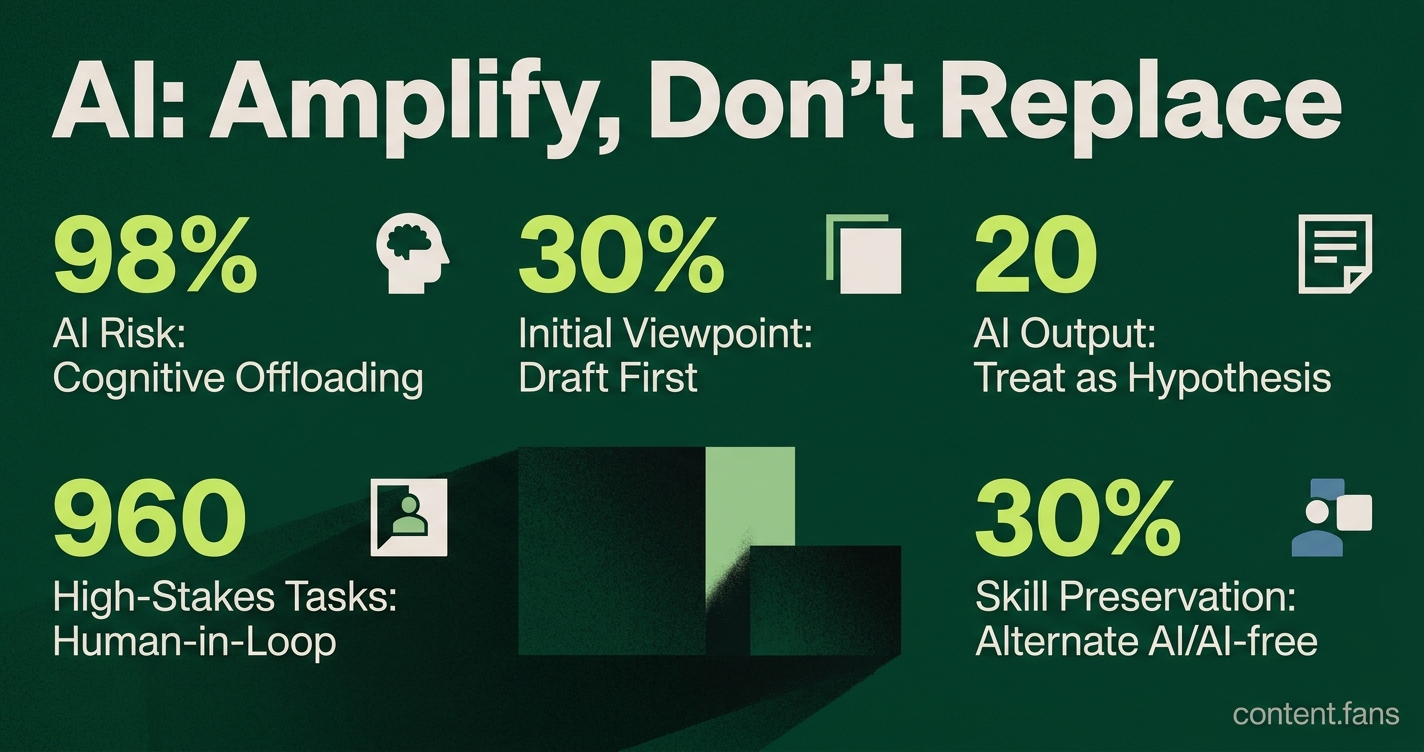
Always form an initial viewpoint before you prompt an AI. This "draft first, prompt second" method provides a baseline for spotting hallucinations and logical gaps. Similarly, an MIT Sloan video advises treating every AI output as a hypothesis to be tested, not a final answer.
Run a systematic verification loop
Unchecked AI reliance can reduce vigilance for facts. Implement a systematic verification loop to scrutinize for evidence, uncertainty, and bias. This process must include:
- Cross-checking all load-bearing facts - such as dates, statistics, or quotes - against a primary source.
If a source is unavailable, flag the claim for manual verification. Prompting the AI to list counterarguments or identify missing perspectives can also expose hidden assumptions and improve the output's integrity.
Keep humans at decisive checkpoints
For high-stakes tasks where errors have significant consequences, a human-in-the-loop (HITL) workflow is essential. Route any low-confidence or high-impact AI outputs to a qualified reviewer with override authority. Maintain accountability by logging all prompts, drafts, and edits to create a clear audit trail, which discourages passive approval.
Alternate AI and AI-free work
To prevent skill degradation, consciously alternate between using AI and working without it. Studies show that individuals who rely exclusively on AI for problem-solving struggle to perform the same tasks unaided. Preserve your cognitive "muscle memory" by scheduling AI-free sessions for tasks like brainstorming, outlining, or analysis, while leveraging AI for more routine work.
Prompt patterns that promote critique
Use specific prompts that force the AI to act as a critic, not just a creator. Instruct the model to analyze its own output with commands like:
- "Identify all factual claims and cite supporting evidence, noting any claims that lack a source."
- "List any contradictions, ambiguities, or weaknesses in the argument."
- "Flag any statements that require expert human review, such as legal or financial advice."
Requesting structured output with labels like "Verified," "Uncertain," and "Needs Review" helps editors prioritize their verification efforts efficiently.
Measure what matters
Look beyond automation rates to measure true quality. Track metrics like revision frequency, the number of human overrides, and time spent on manual verification. A rising override rate can signal issues like prompt drift or model overconfidence. Maintain stable quality by regularly refreshing prompts and escalating ambiguous outputs for human review.
A balanced workload protects cognition
The impact of AI on cognition depends entirely on how it is used. While an MIT Media Lab study linked "excessive reliance on AI" to lower critical thinking scores, well-structured AI use can augment human reasoning by handling rote work. The key is to use AI as a collaborative tutor that prompts questions, not as an oracle that provides final answers. A balanced approach combining verification, AI-free work, and human oversight ensures AI amplifies - rather than replaces - your thinking.
What is "AI slop" and why should I avoid it?
The term "AI slop" describes low-effort content produced by treating generative AI as a final authority rather than a collaborative tool. According to industry experts, this pattern of outsourcing thinking to services like Gemini, Claude, and ChatGPT contributes to what researchers call cognitive decline - a measurable reduction in individual reasoning capacity. Growing research confirms this risk: studies have found that after brief periods of AI assistance on reasoning tasks, participants performed worse on similar unaided tasks. Avoiding slop means preserving your own cognitive effort rather than accepting fluent but unverified outputs.
How can I use AI without experiencing "cognitive atrophy"?
The key is augmentation, not substitution. MIT Sloan research explicitly recommends treating AI outputs as hypotheses to test, not facts to accept. A practical approach follows three stages: think first, prompt second, verify always. Start by drafting your own outline or hypothesis before opening any AI tool - this preserves independent reasoning and makes model errors easier to spot. When you do use AI, ask it to explain steps, challenge your thinking, or identify missing perspectives rather than provide finished answers. Industry guidance emphasizes thinking through the problem and jotting down ideas before engaging AI assistance.
What specific verification steps should I follow for AI-generated content?
Treat every output as unverified until proven otherwise. For critical workflows, implement this checklist before accepting any AI response:
- Can this be verified? Cross-check dates, statistics, and quotations against primary sources
- What perspectives might be missing? Ask the model for counterarguments and alternative explanations
- Could this be biased? Review for unexamined assumptions or skewed framing
For high-stakes decisions, human-in-the-loop systems should route low-confidence outputs, unusual edge cases, and compliance-sensitive content to qualified reviewers. Log your prompts, model outputs, and verification steps to maintain auditability - this practice alone forces more engaged processing of the material.
Why does overconfidence in AI correlate with worse critical thinking?
Research cited by the BBC found that higher confidence in AI outputs was directly related to less critical thinking effort from users. This creates a dangerous feedback loop: the more you trust the tool, the less you engage your own judgment, which in turn makes you more susceptible to errors. Recent research confirms that generative AI affects "decision-making, user trust, and susceptibility to misinformation" - with trust becoming a liability when it substitutes for verification. The protective response is structured skepticism: explicitly prompt models to identify their own weaknesses, unsupported claims, and reasoning gaps before you evaluate their usefulness.
What does a healthy AI-assisted workflow actually look like?
Based on current best practices, effective workflows follow this sequence:
| Stage | Action | Purpose |
|---|---|---|
| 1 | Form your own view first | Preserve independent reasoning |
| 2 | Ask AI to improve, challenge, or extend | Augment rather than replace |
| 3 | Request sources and reasoning trails | Enable verification |
| 4 | Check for hallucinations, omissions, bias | Ensure output reliability |
| 5 | Rewrite in your own words | Confirm actual understanding |
Crucially, keep some tasks entirely AI-free. Periodic brainstorming, outlining, or problem-solving without assistance preserves what researchers call "thinking muscle memory." As experts warn: there is a place for AI, but we shouldn't allow algorithms to handle all thinking. The goal is using AI to handle routine cognitive load while reserving your own capacity for the deliberative processes that create genuine value.