
Agile Marketing Teams Integrate AI at Triple the Rate of Non-Agile Peers
Serge Bulaev
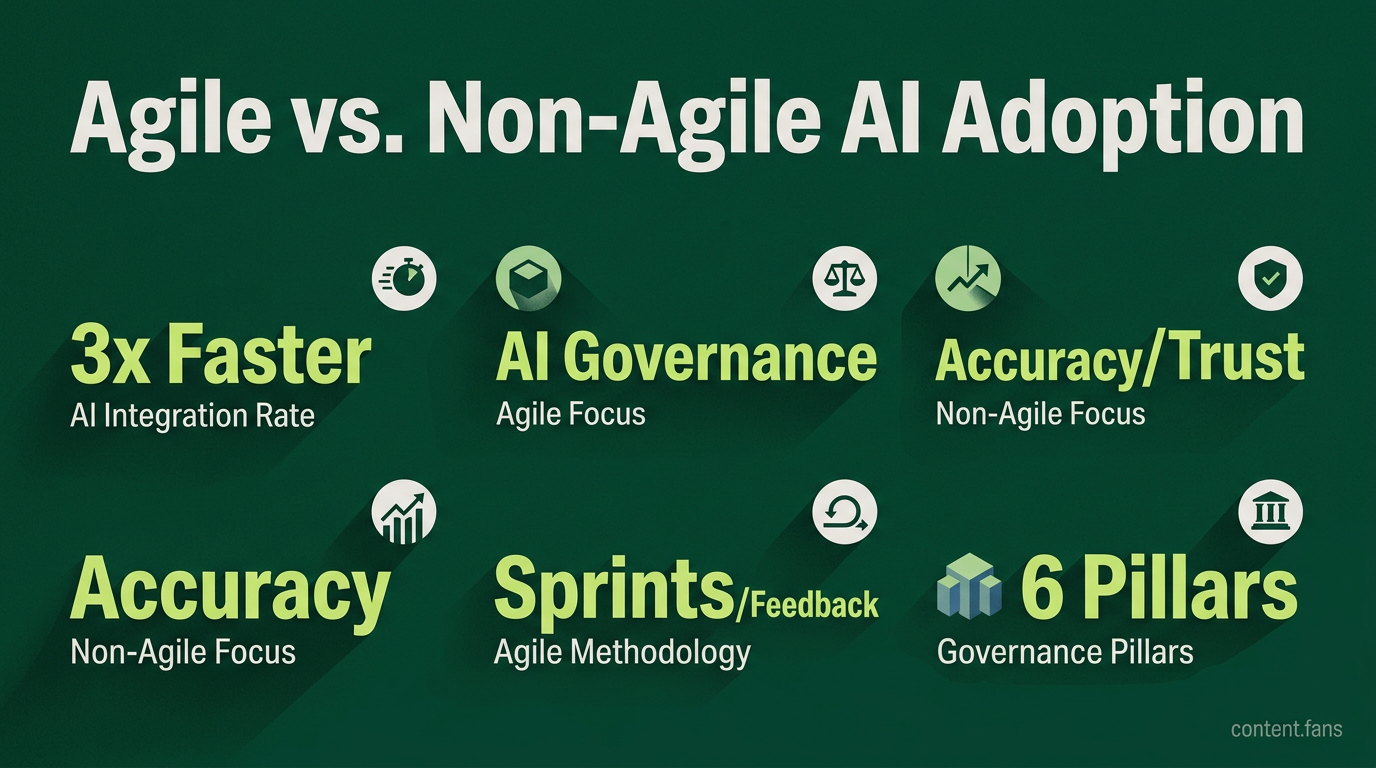
Agile marketing teams are integrating AI at much higher rates than non-agile teams, with 39% of agile teams reporting full AI use versus 13% of non-agile teams. The data suggests agile teams now focus more on managing and governing AI, while non-agile teams are still concerned about whether AI is accurate and reliable. Experts recommend agile teams create clear rules and cross-team committees for AI governance, while non-agile teams may benefit from treating AI as a helper and running small tests. Trends may change, but right now, agile teams appear to be moving ahead faster, possibly widening the gap in future years.

Agile marketing teams are integrating artificial intelligence three times faster than their non-agile counterparts, facing entirely different challenges as a result. A new survey reveals that agile marketers report significantly higher rates of full AI integration compared to non-agile teams, according to a recent CMSWire analysis.
This widening adoption gap shows the primary obstacle is no longer capability, but focus. Agile teams have moved on to advanced challenges like AI governance and scaling, while non-agile departments are still stuck validating AI's basic accuracy and reliability.
Governance Becomes the Agile Priority
Agile marketing teams outpace their peers because their core methodology - short sprints, rapid feedback loops, and continuous testing - is perfectly suited for AI experimentation. This iterative approach allows them to quickly validate AI tools, measure results, and adapt, while non-agile teams remain stalled by longer planning cycles.
With AI adoption maturing, agile leaders are now focused on controlling their expanding portfolios of AI models. Experts recommend establishing a formal AI governance framework built on six pillars: privacy and security, bias detection, compliance, transparency, reliability, and oversight. Best practices include forming a cross-functional governance committee, uniting marketing leaders with the CFO, CIO, and COO to ensure business rules align with technical capabilities.
To manage this, teams are adopting platforms that provide a unified control layer across disparate tools like Google Ads and Salesforce. An Improvado guide on the topic highlights critical features like real-time monitoring, audit trails, and runtime enforcement, warning that simple alert-based systems are insufficient. By implementing a unified layer, teams gain full visibility into data access and model behavior without overhauling their core infrastructure.
Beyond tooling, agile marketers must first redesign their workflows. High-performing teams methodically map each task, determine where AI can operate autonomously, and then incrementally deploy specialized AI agents. Campaign budgeting and metadata tagging are frequently identified as ideal low-risk starting points for automation.
Accuracy Anxiety Stalls Non-Agile Teams
For non-agile marketers, the primary roadblock isn't technology - it's trust. Industry reports indicate that a significant portion of non-agile teams cite accuracy and quality as their top barrier. This hesitation is compounded by a skills gap, with many workers expressing discomfort with AI decision-making and insufficient training.
To overcome this hesitation, leaders can take four strategic steps:
- Position AI as a creative assistant: Use AI to draft initial content, but ensure humans retain final editorial approval.
- Run controlled experiments: Launch small-scale tests in low-risk areas, such as A/B testing ad copy or landing page variants.
- Demand explainable AI (XAI): Choose tools that can clearly explain the logic behind their recommendations and audience segmentations.
- Invest in practical training: Close the skills gap with hands-on workshops that use live campaign data.
By implementing these measures, teams can transform skepticism into curiosity and build the confidence needed for wider AI integration.
Quantifying the Divide
The performance gap between agile and non-agile teams is evident across several key areas, with agile teams consistently showing higher rates of full AI integration, strategic work enablement, and cross-team collaboration gains. While these trends will continue to evolve, the data indicates that AI experience compounds. Teams that master governance now will likely widen the performance gap significantly, as they free up staff for high-level strategy while competitors are still validating basic AI outputs.
What Leaders Should Track Next
As teams mature, leaders must shift their focus to three key areas:
- Enforcement Depth: Evaluate whether governance tools block violations in real time or merely send alerts after the fact.
- Data Foundation Health: Recognize that clean, connected customer data is the non-negotiable prerequisite for any reliable AI model.
- Change Management Progress: Focus on transitioning marketers from task executors to strategic orchestrators who manage AI-driven workflows.
Ultimately, these priorities highlight that AI integration is a journey, not a destination. Agile teams are tackling maturity challenges, while non-agile teams are still working on initial adoption. Identifying a team's position on this spectrum is critical for executives to allocate budget, training, and governance resources effectively.