
StackAdapt Unveils MCP Server for AI Marketing Optimization in 2026
Serge Bulaev
StackAdapt plans to release its MCP Server for AI marketing optimization on April 21, 2026. The tool may let marketers use natural language to get live campaign data and make changes in real time, without needing extra technical work. There are no independent reviews yet, so it is not clear how well it works. Early reports suggest it could help marketers act faster on campaign insights, but the market is still deciding if this new approach is better than current dashboards. Industry studies suggest real-time AI tools like this may improve marketing results, though these results are not specific to StackAdapt.

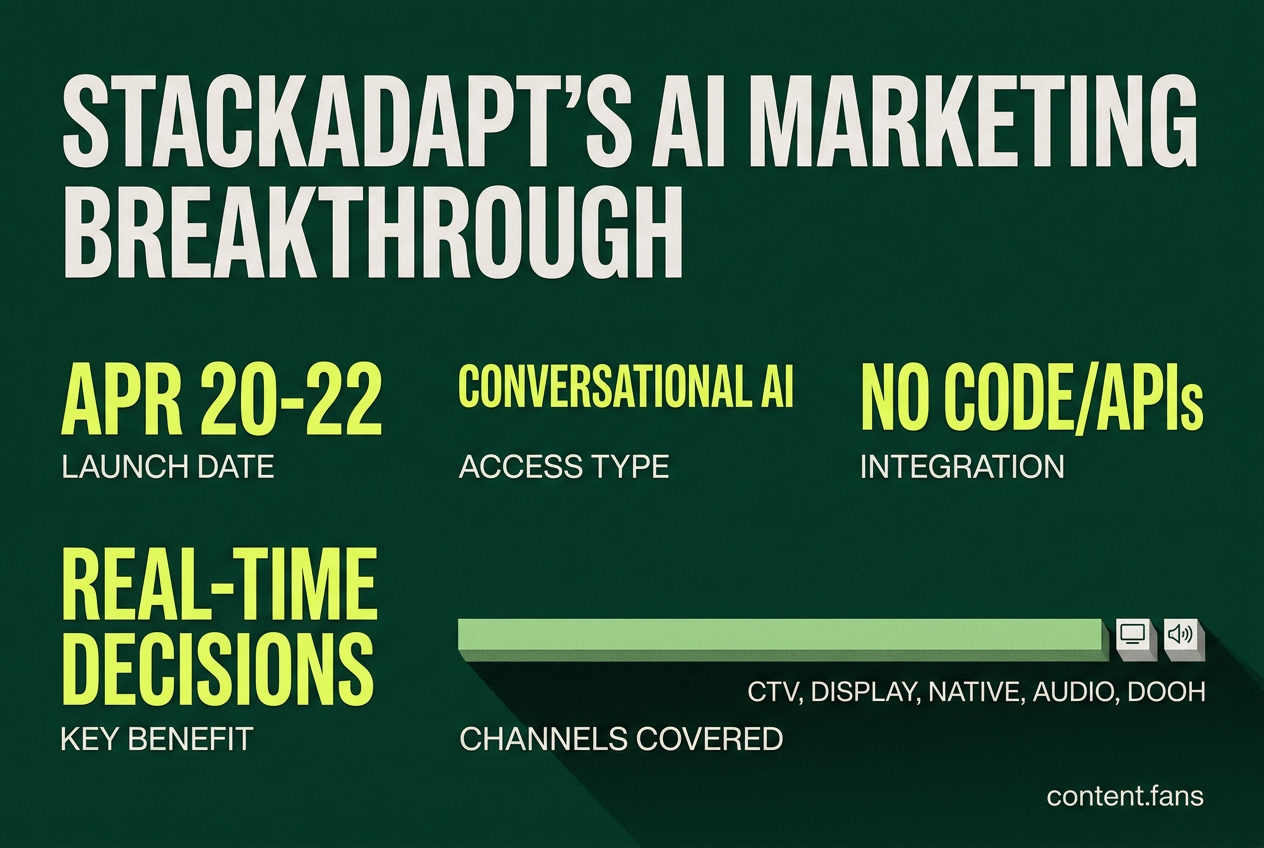
StackAdapt announced its Model Context Protocol (MCP) Server for AI marketing optimization on April 21, 2026, with the launch occurring around April 20-22, 2026. The new tool aims to give marketers conversational access to campaign data directly within AI workflows. According to industry reports, the service allows for real-time analysis and decision-making without requiring extra engineering resources.
This launch positions StackAdapt in the growing ad-tech segment that integrates performance metrics into large language models (LLMs) instead of traditional dashboards. The move signals an industry shift from retrospective reporting to real-time, AI-assisted campaign optimization.
What the MCP Server Promises
The StackAdapt MCP Server is an integration tool that connects live campaign data to AI assistants like Anthropic's Claude. It allows marketing teams to use natural language queries for performance insights, creative audits, and budget changes, aiming to streamline optimization without needing new code or APIs.
The server connects StackAdapt's Ivy AI assistant with external tools like Anthropic's Claude, enabling marketers to ask natural-language questions and get instant answers. Based on launch materials featured in MarTechEdge, the integration requires no APIs, code, or additional fees.
Key functions are expected to include:
- Real-Time Performance Queries: Ask plain-language questions about campaigns across channels like CTV, display, native, audio, and DOOH.
- Automated Pacing Alerts: Receive notifications when campaign spend or performance deviates from preset thresholds.
- AI-Assisted Workflows: Use agents for tasks such as creative audits and budget adjustments.
The tool is designed for performance marketers, B2B growth teams, and CMOs seeking to accelerate the cycle from data insight to campaign action.
Competing Offers in the Real-Time Intelligence Space
StackAdapt enters a competitive field. Platforms like Semrush, SpyFu, and Similarweb offer AI-integrated insights for PPC and traffic analytics, while Crayon, Brandwatch, and Contify focus on social sentiment and brand messaging. Many of these tools connect to AI models like ChatGPT to summarize findings. According to industry reports, competitive pricing varies significantly across different platforms (Visualping list). StackAdapt differentiates itself by embedding campaign data directly into conversational interfaces, avoiding the need for CSV exports.
Early Reaction and Data Gaps
As the MCP Server is a recent release, no independent reviews, user data, or analyst ratings are currently available. A search of major review sites like G2 and Capterra, as well as ad-tech forums, shows no mention of live deployments. This lack of third-party validation suggests the market is waiting to assess the value of a workflow-native tool versus traditional dashboards. Industry analysts recommend monitoring trade publications for adoption metrics after the platform has been live long enough for users to complete initial campaign cycles.
Why Conversational Analytics Matter
The move toward conversational analytics reflects a broader industry trend. General studies on AI in marketing indicate that automating data processing can increase campaign ROI by 20 - 30% and shorten content production cycles by up to 60%. While these figures are not specific to StackAdapt, they highlight the value proposition of real-time, AI-powered decision support. If the MCP Server performs as promised, it would enable marketing teams to make immediate budget and creative adjustments, a shift that aligns with industry predictions that a significant portion of enterprise applications will feature embedded agentic AI in the coming years.