
2026 Privacy Laws Reshape Marketing Data, Boost First-Party Strategies
Serge Bulaev
In 2026, new privacy laws in the U.S. may change how marketers collect and use customer data, making compliance more complex and costly. These laws require clearer consent, less data collection, and quick response to opt-out signals, which might lead marketers to use more first-party and zero-party data that comes from direct customer permission. Many marketers appear to be moving sensitive data into secure environments and adopting new tools to organize and analyze this data without relying on third-party cookies. It seems that a large part of customer activity happens anonymously, so marketers layer different data sources and track brand mentions in AI tools to spot interest. Teams that update their data strategies and use predictive models may see better growth, even as privacy rules make traditional tracking harder.

The arrival of new privacy laws will reshape marketing data collection and accelerate the shift toward first-party strategies. As marketers grapple with data decay, widening dark funnel gaps, and rising compliance costs, maintaining campaign attribution and measurement is becoming a critical challenge. This guide outlines the new regulations and details how leading practitioners are rebuilding their data foundations to connect with buyers in a privacy-first world.
How New Privacy Laws Redefine Consent and Collection
The emerging privacy laws redefine data collection by requiring explicit user consent, mandating data minimization, and enforcing universal opt-out signals. They shift the burden of proof to marketers, who must now justify all data processing activities and limit collection to what is strictly necessary for a stated purpose.
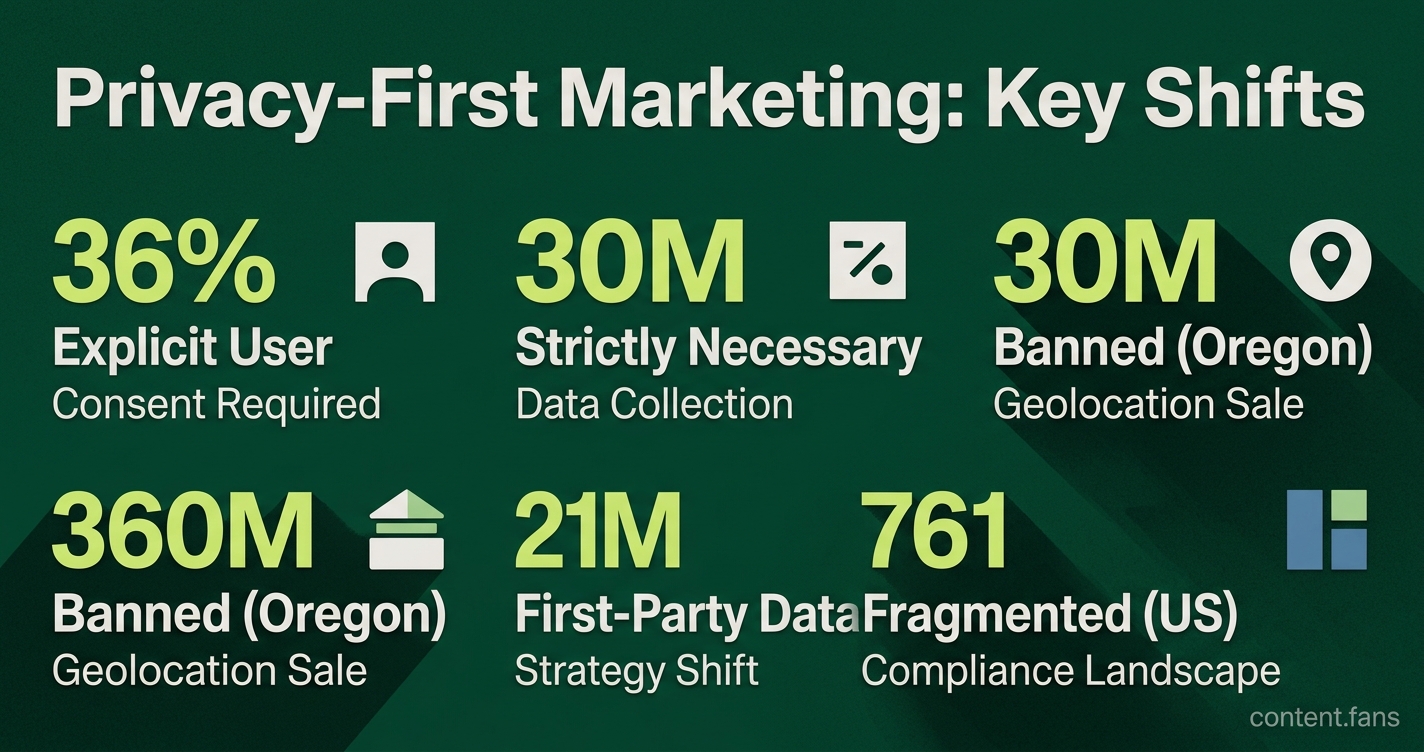
Multiple U.S. states will enforce comprehensive privacy statutes, creating a fragmented compliance landscape for national firms. Key regulations, like Indiana's Consumer Data Protection Act, mandate data protection impact assessments for profiling and expand sensitive data definitions, according to LP Legal. Oregon bans the sale of precise geolocation data within a 1,750-foot radius unconditionally, without requiring opt-out mechanisms. The law is more stringent than most state privacy laws precisely because it prohibits the sale regardless of consumer consent or opt-out choices, as noted by Ketch.
These statutes force three core operational shifts: providing clearer consent notices, practicing strict data minimization, and immediately honoring opt-out signals. For many businesses, this regulatory patchwork accelerates the move toward first-party and zero-party data strategies built on explicit, permission-based customer relationships.
How Do Marketers Build a Unified Data Foundation?
To combat data decay from siloed information, teams are building unified data foundations. With many marketers still lacking investment in structured data, the shift to unified martech stacks is critical. These platforms use cross-channel ingestion and AI-ready schemas to normalize behavioral, CRM, and product usage data in near real time, creating clean datasets for machine learning.
To enhance privacy, marketers are also adopting data clean rooms for joint analysis without exposing personal identifiers. The value is clear: industry reports suggest that first-party data programs can generate significant revenue uplift and cost savings, justifying investments in server-side tracking and unified infrastructure.
Key privacy-compliant alternatives to traditional tracking include:
- First-Party Data: Replacing third-party cookies with direct customer relationships.
- Contextual Targeting: Substituting behavioral profiling with on-page context.
- Zero-Party Data: Augmenting inferred demographics with user-submitted preferences.
- Data Clean Rooms: Standing in for raw PII file exchanges for secure collaboration.
How Can Teams Address Gaps in the Dark Funnel?
The "dark funnel" - where a significant portion of B2B research occurs anonymously in communities, AI chats, and private networks - presents a major visibility gap. Since no single platform can surface every hidden buyer, leading teams layer multiple data sources, such as Bombora intent scores, Demandbase account activity, and internal CRM patterns. The strategy focuses on identifying high-signal accounts and enabling rapid (<5 minute) engagement through automated alerts.
Another emerging tactic involves monitoring brand visibility within large language models (LLMs). Tracking whether an AI tool like ChatGPT recommends a vendor for "best project software" serves as an early indicator of brand consideration. This highlights the growing importance of influencing AI-generated results through strong placement on review sites like G2 and TrustRadius.
What Does Measurement Look Like Without Third-Party Cookies?
With universal opt-out signals breaking traditional multi-touch attribution, measurement is shifting toward privacy-safe models. Regulations in states like Kentucky and Rhode Island mandate recognition of automated browser signals, further limiting cross-site tracking. In response, marketers are adopting attribution models based on aggregated or modeled data.
Predictive analytics now forecast likely outcomes rather than tracking every user interaction. Vendors are integrating these modeled insights into Customer Data Platforms (CDPs), allowing teams to compare channel efficiency without compromising user privacy. Teams that prioritize high-quality data and adopt predictive models are reportedly achieving faster growth than peers using legacy methods. By navigating new regulations, unifying first-party data, and illuminating the dark funnel, marketers can maintain clear visibility and drive growth in a permission-based landscape.