
Enterprises trace AI ROI to revenue, not just efficiency, by 2026
Serge Bulaev
Many companies still measure AI's value by time saved, but studies suggest this misses important revenue and quality benefits. Experts recommend building clear baselines and using experiments to track not just efficiency, but also revenue and customer outcomes. Scorecards tracking both financial and quality indicators over time may help show AI's true impact. Strong ownership and regular reporting appear to be important for trustworthy results, but governance challenges remain. Evidence from 2024 to 2026 suggests that companies using these approaches may better connect AI to real business growth and improvements.

By 2026, leading enterprises will trace AI ROI to revenue, not just efficiency, moving beyond simple productivity gains. While many executives still measure AI's value in hours saved, this overlooks critical growth and quality benefits. Studies from Wharton and KPMG highlight that a narrow focus on efficiency misses indirect revenue and full cost impacts (KPMG). This playbook provides a clear path for CFOs and product leaders to connect AI initiatives directly to business growth.
Move past productivity counts
Mature AI measurement requires shifting from activity-based metrics like hours saved to outcome-based evidence. This involves defining specific business objectives first, then using scorecards to track financial results, quality improvements, and customer impact, anchoring AI's value to the strategic outcomes it is designed to influence.
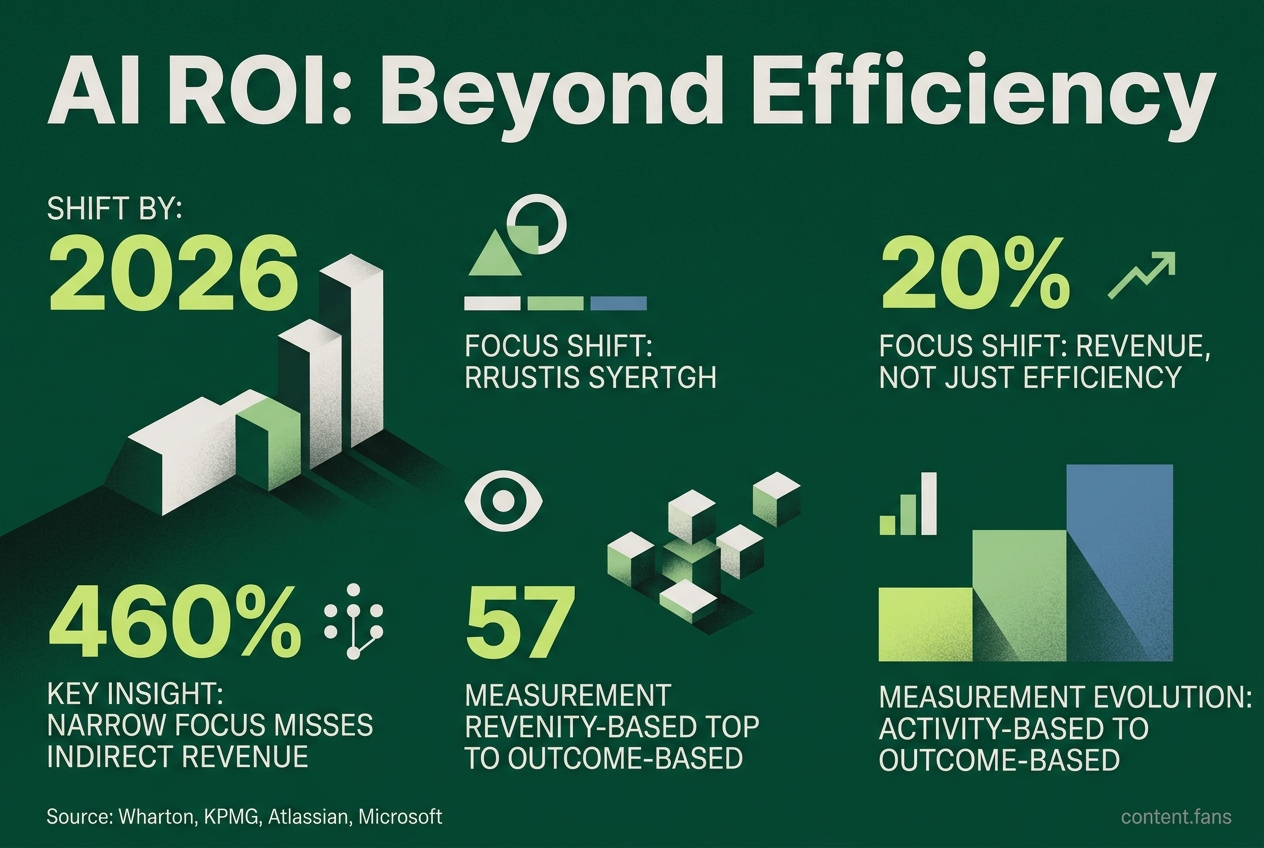
Leading frameworks demonstrate this shift. Atlassian's four-stage model inserts a quality layer to capture accuracy and customer outcomes before calculating ROI (Atlassian). Similarly, Microsoft's approach begins with the business objective and concludes with attributed financials and security posture, anchoring AI value to specific, intended outcomes rather than generalized time savings.
Build a baseline and experiment design
Reliable attribution requires establishing a pre-launch baseline of metrics like cycle time, error rates, and cost per transaction. To isolate AI's impact, experts recommend controlled experiments, such as A/B tests or matched cohorts, to measure incremental revenue and margin changes (Opagio). Without this rigor, it is difficult to distinguish AI-driven gains from other business changes. For example, an aviation provider used this method to attribute significant new revenue to an AI-driven dashboard that tracked pre- and post-deployment conversion rates.
Track revenue and quality KPIs over time
Post-deployment, a balanced scorecard should track financial, operational, and quality signals over time, as benefits often materialize across multiple quarters. Key performance indicators should extend beyond efficiency to include:
- Incremental revenue and revenue lift percentage
- Revenue per user (ARR/MRR) and average order value
- Customer-facing metrics like conversion rates
- Risk indicators like hallucination rates or policy violations
- Traditional metrics like hours saved and ticket deflection
Klarna's AI assistant, for instance, generated substantial profit by handling millions of chats, but the company continues to monitor customer satisfaction and escalation rates to ensure long-term value.
Govern ownership and reporting cadence
Effective governance hinges on clear accountability, with a designated business owner, technical owner, and finance reviewer for each AI initiative. Best practices include a use-case charter, documented baselines, and a regular reporting cadence. However, governance remains a major hurdle; surveys cite cost visibility and complexity as top barriers to trustworthy ROI. To build confidence, reporting should mature from simple workflow metrics to decision-grade evidence like attributed financials, using confidence ranges to ensure claims can withstand scrutiny.
Ultimately, case studies from 2024-2026 confirm that a disciplined approach - combining clear baselines, controlled experiments, and balanced scorecards - enables enterprises to reliably trace AI investments to revenue growth, margin improvement, and quality gains while managing associated costs and risks.
Why are enterprises shifting from efficiency metrics to revenue-based AI ROI by 2026?
Organizations are shifting beyond simple productivity metrics because they fail to capture AI's full business impact. While many executives expect revenue growth from AI, most firms lack the frameworks to measure it. This evolution from tactical cost-cutting to strategic growth initiatives requires tracing AI ROI directly to outcomes like incremental revenue, higher margins, and improved customer value.
What frameworks exist for measuring revenue-driven AI outcomes?
Several leading frameworks guide revenue-focused AI measurement:
- Microsoft's Value Framework: Prioritizes business results, starting with revenue impact and then covering risk, customer experience, and cost savings.
- Atlassian's Four-Stage Framework: Adds a critical "quality" stage to measure accuracy, consistency, and customer outcomes, not just speed.
- Berkeley's AI Value Audit: Uses a layered approach that builds from governance and workflow velocity to attributed financials.
- Deloitte's Balanced Scorecard: Combines and weights financial and non-financial metrics to create a holistic view of value.
A common thread is to define the business outcome first, establish a baseline, and track a balanced set of metrics over time.
How can companies measure incremental revenue from AI features?
Measuring incremental revenue from AI requires controlled experiments. A/B testing, which compares a treatment group with a control group, is the gold standard for attribution. When randomization isn't possible, matched cohort analysis is a strong alternative.
Real-world results validate this approach:
- A global aviation firm used a KPI dashboard to attribute significant revenue growth to an AI tool.
- Klarna attributed substantial profit to its AI assistant after it handled millions of customer chats.
Key revenue KPIs include incremental revenue lift, revenue per user (ARR/MRR), conversion rate, and average order value.
What governance structures ensure reliable AI ROI reporting?
Reliable AI ROI reporting depends on strong governance structures with clear ownership for each use case (business, technical, and finance). Key components include:
| Component | Purpose |
|---|---|
| Use-Case Charter | Defines the project's scope, goals, and success criteria. |
| Baseline Measurement | Creates a pre-deployment benchmark for comparison. |
| Value Hypothesis | States the expected outcome and attribution method. |
| Risk Controls | Manages potential bias, model drift, and transparency issues. |
| Monitoring Cadence | Ensures continuous tracking rather than a one-time assessment. |
| Audit Trail | Provides a verifiable record for internal and regulatory review. |
Despite this, cost visibility and governance complexity remain significant barriers, with many executives lacking confidence in their ability to measure AI ROI.
What common mistakes should CFOs avoid when tracking AI ROI?
CFOs should avoid three common pitfalls in AI measurement:
1. Focusing on Activity, Not Outcomes: Measuring logins or usage is not the same as measuring business value. Reporting must connect deployment metrics to realized financial or customer impact.
2. Underestimating Total Cost of Ownership (TCO): The full cost picture must include data preparation, integration, training, compliance, and ongoing governance - not just implementation.
3. Relying on Static Business Cases: AI value is not static. As Deloitte notes, factors like model drift and cost volatility require continuous monitoring against a pre-deployment baseline, not a one-time projection.