
X Expands Algorithm Transparency With New Code, 'Under the Hood' Tool
Serge Bulaev
X has released more of its recommendation code and a new tool called "Under the Hood" that lets some users see which labels may have limited the reach of their posts. Reports suggest this update expands the public code base by about ten to fifteen times, but some important details are still hidden, so a full audit is not possible. Early testers say the tool shows counts of how many times posts may have been excluded from search, had replies dampened, or were not recommended. Experts say the update might help researchers see more filters in action, but the missing code means claims about bias cannot be fully checked. For users in the pilot, the changes may make it easier to understand why their posts did not get much attention, though the feature is only available to a small group so far.

X has significantly expanded its algorithm transparency by releasing a much larger portion of its recommendation code and launching a new diagnostic tool, "Under the Hood." This update aims to give users and researchers a clearer view into how the "For You" timeline is curated and addresses long-standing user complaints about opaque content moderation, often referred to as "shadowbanning."
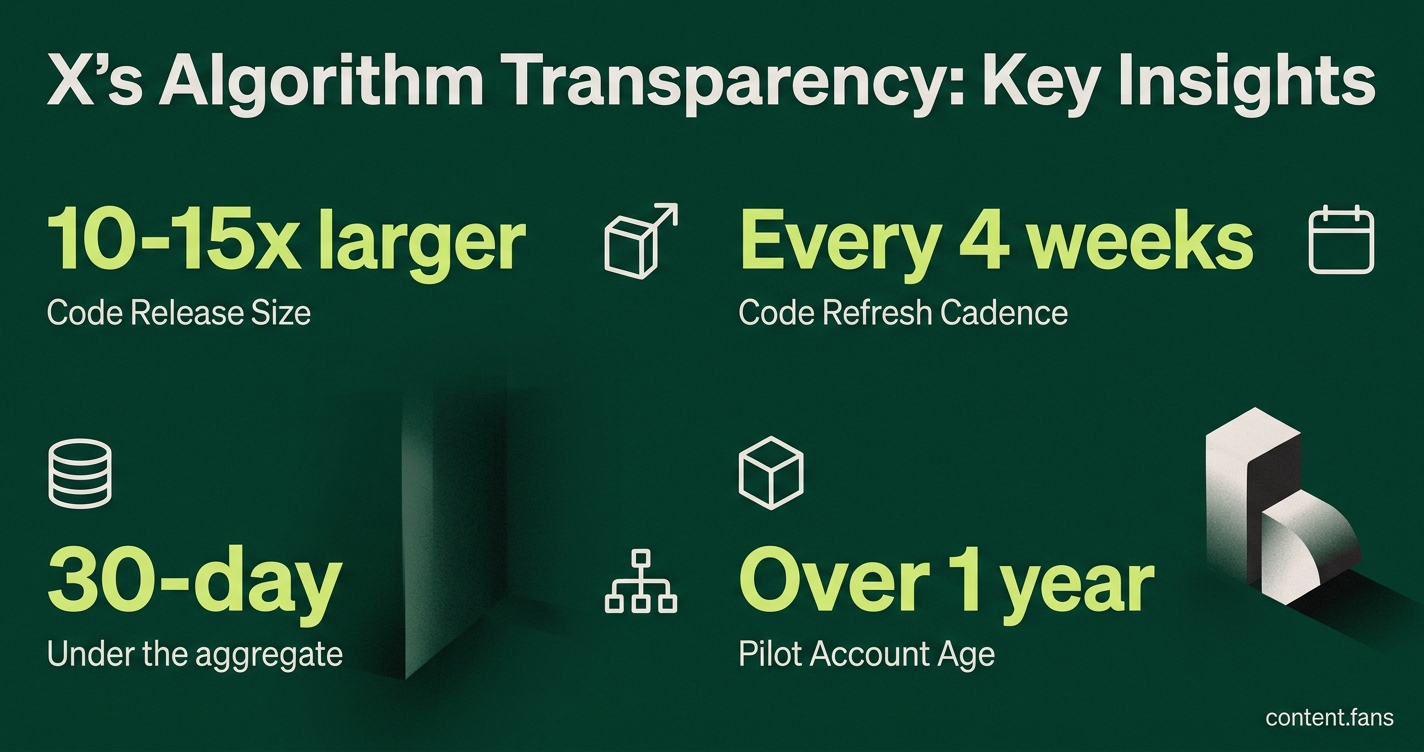
According to a January 20, 2026 TechCrunch report, the public code release is ten to fifteen times larger than previous versions. However, Engadget adds that with key ranking weights and configuration data still redacted, a complete and independent audit of the platform's claims remains impossible.
How the 'Under the Hood' Tool Impacts Creators
The new 'Under the Hood' tool allows select users to download a report detailing visibility-limiting labels applied to their posts. This data, which covers search exclusions and recommendation suppression, helps creators understand if their content's reach was impacted by platform policies rather than just audience engagement.
Pilot participants, limited to accounts over one year old with at least ten recent posts, can request a monthly JSON file listing these labels. This provides creators with a clearer sense of whether specific quality signals or policy enforcement, rather than simple audience disinterest, limited a post's circulation.
Key Details from X's Open-Source Code Release
The updated GitHub repository, released under an Apache v2 license, provides new documentation on the core stages of feed generation, including candidate sourcing, relevance scoring, and social proof amplification. Key revelations from the code include:
- Expanded Configuration: The release exposes more model configuration files, filter names, and a high-level diagram of how the feed is assembled.
- Visibility Scoring: Code comments detail how safety or spam labels can subtract points from a post's visibility score.
- Update Cadence: A new README file promises code refreshes every four weeks, a change from an earlier seven-day open-source pledge reported by Reuters.
- Aggregate Data: The "Under the Hood" export provides aggregate label counts for the last 30 days, not a post-by-post breakdown.
Expert Analysis: A Step Forward, But Gaps Remain
Researchers view the expanded code as a positive step, as it allows independent teams to confirm the existence and function of certain visibility filters. However, they emphasize that a reproducible audit is still out of reach because critical information like training data pathways and specific numeric weights for ranking remain blanked out.
Consequently, definitive verification of claims about political bias or unfair reach suppression remains partly untestable. For everyday users in the pilot, the primary benefit is improved explainability, allowing them to connect engagement dips with specific platform actions. Broader trust in feed fairness, however, will depend on the comprehensiveness of future updates.
What exactly did X release in its August 2026 transparency update?
X released two major components: expanded open-source code for its "For You" timeline and a new "Under the Hood" tool for eligible users. The GitHub codebase grew by 10 to 15 times, revealing more about the ranking system's configuration and filters. The new tool lets pilot users download a JSON file with a 30-day summary of visibility-limiting labels applied to their account.
Who can access the new "Under the Hood" tool?
Access is currently limited to a randomized pilot group. To qualify, an account must be at least one year old and have made at least 10 posts in the previous month. This restriction means most X users cannot yet access their own visibility data, even as the platform promotes the initiative as a major transparency effort.
Does this finally prove whether "shadowbanning" exists on X?
Not exactly. While the released code does not contain a single "shadowban switch," it does confirm the existence of named visibility-limiting mechanisms, such as ranking controls and recommendation suppression. These systems can produce effects that are functionally identical to what users call shadowbanning. The gap between X's official terminology and user experience persists, as researchers note that redacted code prevents full verification of these systems.
How does X's transparency compare to Meta, TikTok, and YouTube?
X is the current leader among major platforms in code-level disclosure, publishing actual code while competitors mostly release high-level explanations and policy documents. This leadership has limits, as key parameters and training data remain redacted. As a result, no major platform currently enables full independent auditing, making X's transparency real but ultimately selective - more than rivals, but not enough for total accountability.
What critical information is still missing from X's disclosures?
Despite the expansion, significant gaps remain in X's transparency. Critical details such as ranking weights, specific model parameters, and training data are intentionally redacted or withheld. These omissions prevent researchers from independently reproducing or fully verifying X's ranking behavior. As TechCrunch reported, the company's commitment to four-week updates could gradually address these limitations if sustained over time.