
Walleye Capital Mandates AI Fluency for 400 Employees
Serge Bulaev
Walleye Capital, a $10 billion hedge fund, now requires all 400 employees to be fluent in using AI tools like ChatGPT for their daily work. The company treats AI skills as essential, not optional, and expects everyone from researchers to lawyers to use large language models for tasks such as data analysis and memo writing. There are incentives and training, including weekly meetings, usage leaderboards, and spot bonuses for effective AI use. Sources suggest this approach may signal a bigger shift in the finance industry, though results are still developing. Early signs at Walleye suggest faster work and less time spent searching for information, but it is not yet clear how big the impact will be.

In a landmark move for the financial sector, Walleye Capital mandates AI fluency for all 400 employees, positioning artificial intelligence as a core competency. The hedge fund's chief executive, Will England, shocked peers by telling staff that ignoring tools like ChatGPT is akin to refusing the internet in 1995. The Minneapolis-based firm now treats AI literacy as basic workplace hygiene, expecting every researcher, lawyer, and analyst to integrate large language models (LLMs) into their daily work.
From Mandate to Mechanism: How Walleye Implements AI
England's internal memo declared AI "not optional for people who think for a living." According to a podcast discussion and a summary on Every's episode page, employees are now expected to use an LLM before opening traditional software like Excel for tasks such as creating decks or drafting memos. To facilitate this, Walleye provides enterprise-grade generative AI tools and has embedded model access directly into its research platform, allowing analysts to query earnings calls, broker notes, and historical data in a single interface. Legal and compliance teams use similar tools to find precedent language and identify policy conflicts. England believes AI can make employees "at least 20 percent smarter right now," but emphasizes that the quality of the final output remains the ultimate measure of success. To maintain oversight, the firm reportedly logs prompt histories to ensure auditability without stifling experimentation.
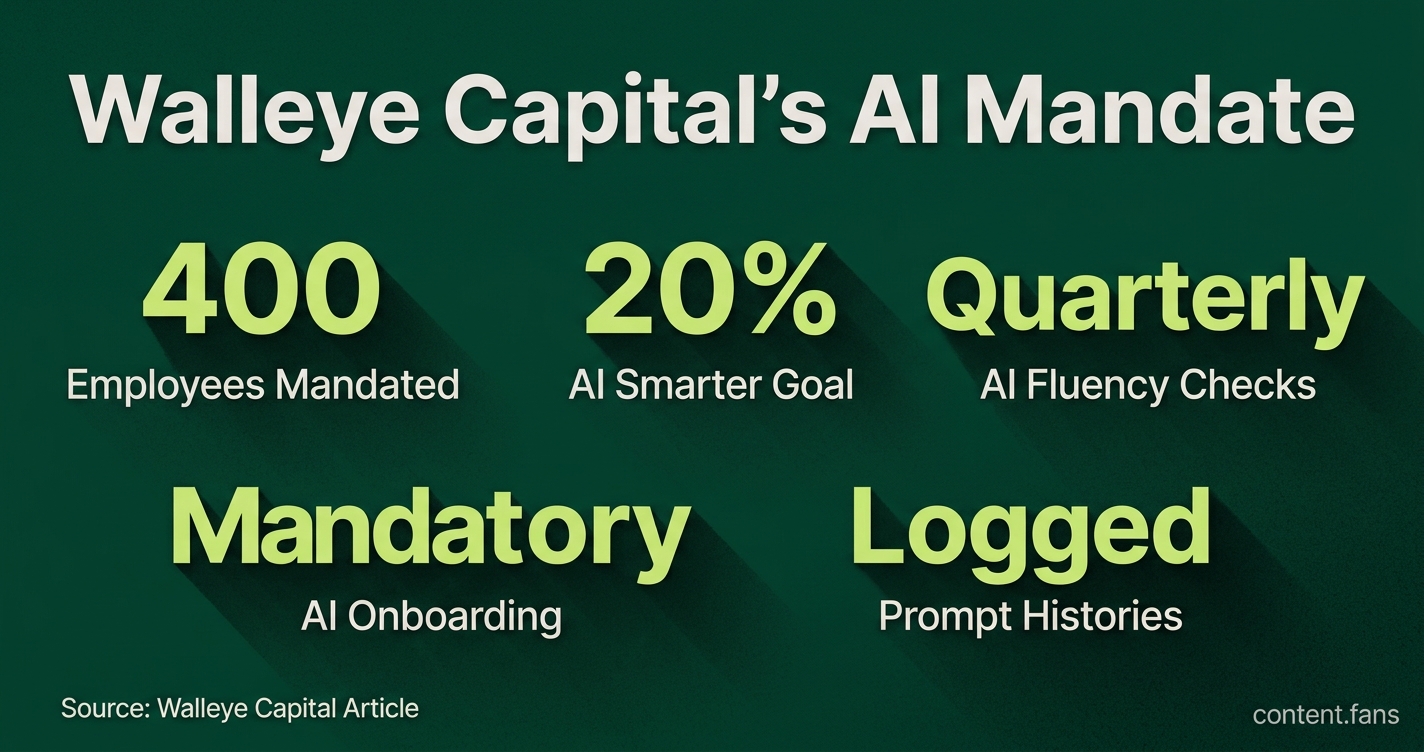
Walleye Capital operationalizes its AI mandate by providing enterprise accounts for generative AI and embedding model access into its core research platform. This requires employees across all departments - from research to legal - to use these tools for daily tasks like data analysis and memo writing, with prompt histories logged for compliance.
Driving Adoption: Incentives, Training, and Culture
To ensure the mandate translates into practice, Walleye has established a robust support system. As detailed in a LinkedIn strategy note, the firm holds weekly meetups for staff to demonstrate effective prompts and vote on the best use cases. Usage leaderboards create transparency and friendly competition, while managers issue spot bonuses for impactful AI suggestions. Key components of the program include:
- Mandatory AI onboarding for all new hires, regardless of their role.
- Shared prompt libraries with examples and warnings about potential pitfalls.
- Dedicated Slack channels for troubleshooting AI hallucinations.
- Quarterly "AI fluency checks" integrated into performance reviews.
Training explicitly frames LLM use as a strategic advantage, not "cheating," encouraging staff to delegate routine synthesis to AI and focus their expertise on higher-value tasks like scenario planning and relationship building.
A Blueprint for the Finance Industry?
Walleye's firm-wide policy may signal a significant shift in asset management, moving AI from experimental pilots to a fundamental redesign of operating models. By extending the mandate beyond front-office research to include finance, compliance, and legal, Walleye puts pressure on competitors to define baseline AI skills across their entire organizations. Observers argue that accelerated memo drafting and data analysis can shorten idea-generation cycles, potentially leading to faster and more informed trading decisions.
The cultural elements - leaderboards, executive modeling, and public recognition - are considered as crucial as the technology itself. Without such reinforcement, AI adoption at other firms risks stalling. While long-term outcomes are still unfolding, early results at Walleye indicate greater speed in producing investment write-ups and less time spent on data retrieval, suggesting that broad AI literacy can enhance knowledge management and efficiency without increasing headcount.
Why did Walleye Capital make AI fluency mandatory for all 400 employees?
CEO Will England views AI adoption as non-negotiable for competitive firms, comparing refusal to use AI to refusing the internet in 1995. Walleye Capital treats AI as core operating infrastructure rather than an optional productivity tool. England has told employees that if they are not using ChatGPT, they are "leaving money on the table" - a stance reflecting the growing adoption of AI across financial services firms.
How is Walleye Capital implementing this mandate beyond simply providing access to tools?
The firm has built structural mechanisms to drive genuine adoption:
- Weekly AI meetups and usage leaderboards create social accountability
- Rewards for suggesting tools that get adopted firm-wide
- Mandatory AI training extending to non-investment functions - accounting, finance, compliance, and legal
- Internal knowledge systems that turn institutional knowledge into a "living, searchable intelligence system"
This reflects a broader industry shift: successful AI adoption requires managerial and cultural reinforcement, not just software licenses.
What specific tasks is Walleye using AI for in its investment process?
England outlined practical applications across the entire investment workflow:
- Drafting memos with LLM assistance
- Analyzing unstructured data and ingesting earnings reports
- Stock selection support and risk review
- Real-time insight surfacing from internal and external information
The goal is to shift employees' "context level" upward - allowing them to focus on more abstract, higher-value work rather than manual information processing.
What cultural message did Will England send about how employees should view AI?
England openly admitted to using ChatGPT to draft a firm-wide email, framing this transparency as leadership by example. His core message: focus on results, not the toil of producing output manually. He explicitly told staff that "AI is not cheating" - it should free people to spend more time thinking rather than executing routine tasks.
This results-over-effort philosophy addresses a common barrier in professional services, where visible labor often signals commitment.
What does this signal about AI trends in financial services?
Walleye's approach reflects accelerating trends in the industry:
| Trend | Observation |
|---|---|
| AI moving from experimentation to mandate | A growing number of financial institutions are moving beyond pilot programs |
| Expansion beyond front-office | Back-office automation, data visualization, and software engineering are becoming common use cases |
| Rising investment intensity | Many AI practitioners expect spending to increase significantly |
England's prediction that AI can make employees "at least 20 percent smarter right now" suggests hedge funds and asset managers are increasingly treating AI literacy as baseline competency - comparable to spreadsheet or email proficiency - rather than a specialized technical skill.
The full interview with Will England is available on the AI & I podcast hosted by Dan Shipper, with episode highlights on X, YouTube, Spotify, and Apple Podcasts.