
Ukrainian Cybersecurity Firms Expand as Enterprises Adopt SaaS Security
Serge Bulaev
Ukrainian cybersecurity firms are expanding as more companies use SaaS security platforms to protect against rising cloud threats. Investors appear interested in Ukrainian expertise, possibly as a response to a large increase in cyber incidents in 2024. Analysts suggest that cloud migration, tougher EU regulations, and lower costs might be driving more enterprises to choose Ukrainian SaaS security products. The local market may grow by 50 percent in five years if current trends continue, though this depends on ongoing investment and stable internet access. It appears that AI features and Zero-Trust controls from Ukrainian vendors, along with strong European ties, may explain why most large enterprises now use SaaS security solutions.
Ukrainian cybersecurity firms are gaining traction primarily through managed security services, threat intelligence, and incident response capabilities developed through real-world threat exposure. Kyiv-based firms offer diverse services including perimeter scanning and Static Application Security Testing (SAST), though service combinations vary by provider. These companies leverage their battlefield-tested expertise to serve international markets seeking proven cybersecurity solutions.
Growing investor interest and strategic European partnerships are fueling this expansion. Ukrainian cybersecurity expertise has attracted significant investment as organizations worldwide seek defense against evolving cyber threats. Such investments signal confidence in Ukrainian technical capabilities as businesses face an increasingly complex threat landscape.
Key Market Drivers for Enterprise Adoption
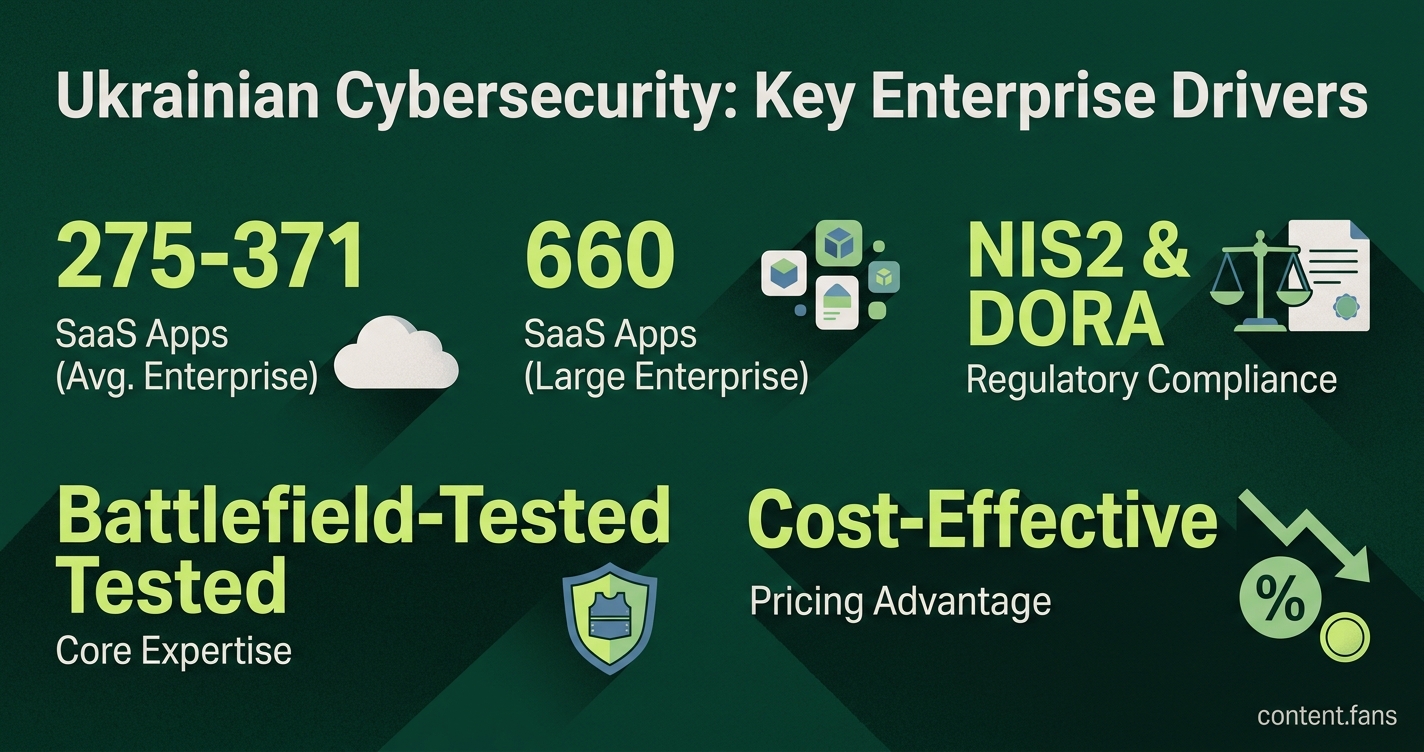
The expanding digital footprint of modern businesses, with the average enterprise managing approximately 275 to 371 SaaS applications (with large enterprises managing around 660), creates significant security challenges. CISOs are increasingly exploring Ukrainian cybersecurity providers, driven by a convergence of critical factors.
Enterprises are considering Ukrainian cybersecurity services due to battlefield-tested expertise against sophisticated threats, competitive pricing models, and platforms that help meet stringent EU regulations like NIS2 and DORA. The accelerated shift to cloud infrastructure further amplifies demand for proven security solutions.
Key pressures driving enterprise security decisions include:
- Cloud Migration Needs: Kinetic risks in Ukraine have forced local organizations to migrate to cloud environments, giving Ukrainian providers unique experience with rapid, secure cloud transitions.
- Regulatory Compliance: New EU directives like NIS2 and DORA impose strict cybersecurity standards. Many Ukrainian platforms include automated reporting features that simplify compliance and reduce administrative overhead.
- Cost-Effectiveness: As many companies increase their cybersecurity budgets, organizations seek greater value. Providers in Central and Eastern Europe frequently offer competitive pricing without compromising on security capabilities.
Leading Ukrainian Cybersecurity Providers and Their European Footprint
A growing ecosystem of Ukrainian firms provides specialized security solutions:
- Established Providers: Multiple Ukrainian firms deliver managed security services, specializing in continuous threat monitoring and incident response for enterprise clients.
- Consulting Specialists: Several companies offer outcome-based consulting and ethical hacking services, with focus on securing critical infrastructure sectors.
- Technical Integrators: Various firms provide expert consulting for Zero-Trust architecture implementation and managed SIEM services that integrate with third-party security tools.
The domestic cybersecurity market has demonstrated growth, though specific market size figures vary across industry reports. Projections suggest continued expansion over the coming years, depending on sustained foreign investment and stable infrastructure. Recent funding activity indicates resilient investor confidence in the sector.
Ukrainian providers frequently cite competitive advantages such as AI-powered analytics, comprehensive Zero-Trust controls, and efficient deployment capabilities. This technical expertise, combined with firsthand experience defending against advanced persistent threats (APTs), positions them well in the global security market. Looking ahead, the integration of post-quantum cryptography represents a critical evolution that could drive significant security upgrade cycles.
What is driving Ukrainian cybersecurity firms to expand now?
The wartime experience with cyberattacks has turned Ukraine into a testing ground for enterprise security solutions. Local cybersecurity firms are packaging their battle-tested tools into services that global CIOs can implement rapidly. Venture capital is showing interest in these capabilities, while many Ukrainian IT companies now run defense projects that serve as product development laboratories.
Which European partnerships matter most?
Ukrainian vendors are targeting European markets to help organizations meet NIS2 and DORA compliance deadlines. Ukrainian managed security services are being adopted by organizations across Europe, with dark-web monitoring and threat intelligence services being integrated by European managed security service providers (MSSPs). The UK-Ukraine TechBridge serves as a catalyst, pairing Ukrainian engineers with British integrators for joint infrastructure security projects.
What enterprise problems do these services solve?
They address "SaaS sprawl" challenges: the average enterprise now runs 500-1,295 cloud applications, creating significant security oversight gaps. Ukrainian offerings deliver API-first security posture management, continuous SAST scanning, and backup solutions that can be deployed rapidly. For CISOs, this translates to consolidated security oversight and measurable compliance with GDPR, CCPA, and emerging EU security mandates.
How big is the addressable market?
The global SaaS security segment continues to grow rapidly, with various industry reports projecting strong expansion through 2030. Cloud encryption represents one of the fastest-growing security niches, while a significant portion of large enterprises already deploy multiple SaaS security platforms. Ukrainian firms are positioned at the intersection of these trends, offering advanced features at competitive price points developed through wartime operational discipline.
What should buyers verify before engaging?
- Data-residency options - ensure EU-only hosting if required
- Zero-trust architecture - growing enterprise adoption requires granular identity controls
- Battle-tested references - request case studies from critical-infrastructure clients in Ukraine or Eastern Europe
- Company stability - evaluate funding status and operational continuity plans for sustained service delivery