
TIME Expands Newsletter Growth With Simple Forward-to-a-Friend CTA
Serge Bulaev
TIME may be growing its newsletter by adding a simple line near the end that says, "If someone forwarded this to you, sign up here." This small message appears to make it easier for new people to subscribe and encourages current readers to share with friends. The strategy also includes social icons and a contact email, giving readers more ways to interact. Research suggests that having just one clear action at the end of the email helps increase clicks, and adding rewards for referrals might boost sign-ups even more. Tracking how readers respond to these options may help TIME understand what works best.

TIME's newsletter growth is being accelerated by a simple forward-to-a-friend CTA, a tactic that turns readers into advocates. The strategy uses a single sentence near the footer of every health newsletter - "If someone forwarded this to you, sign up here" - to remove friction for potential subscribers and quietly encourage sharing. This micro-module creates multiple conversion paths, pairing the subscription invite with social follow icons and a plain-text contact email.
The Strategic Power of a Footer CTA
While conventional wisdom prioritizes above-the-fold CTAs, data supports placing them in the footer for engaged audiences. Industry research indicates that while top-of-email buttons capture a significant portion of clicks, a single, clear CTA can substantially improve overall click performance. By placing its CTA after the content, TIME targets readers who are already invested. This aligns with research from Protocol80, which found that late-email CTAs can boost conversions where context is essential, as it is with health-related content.
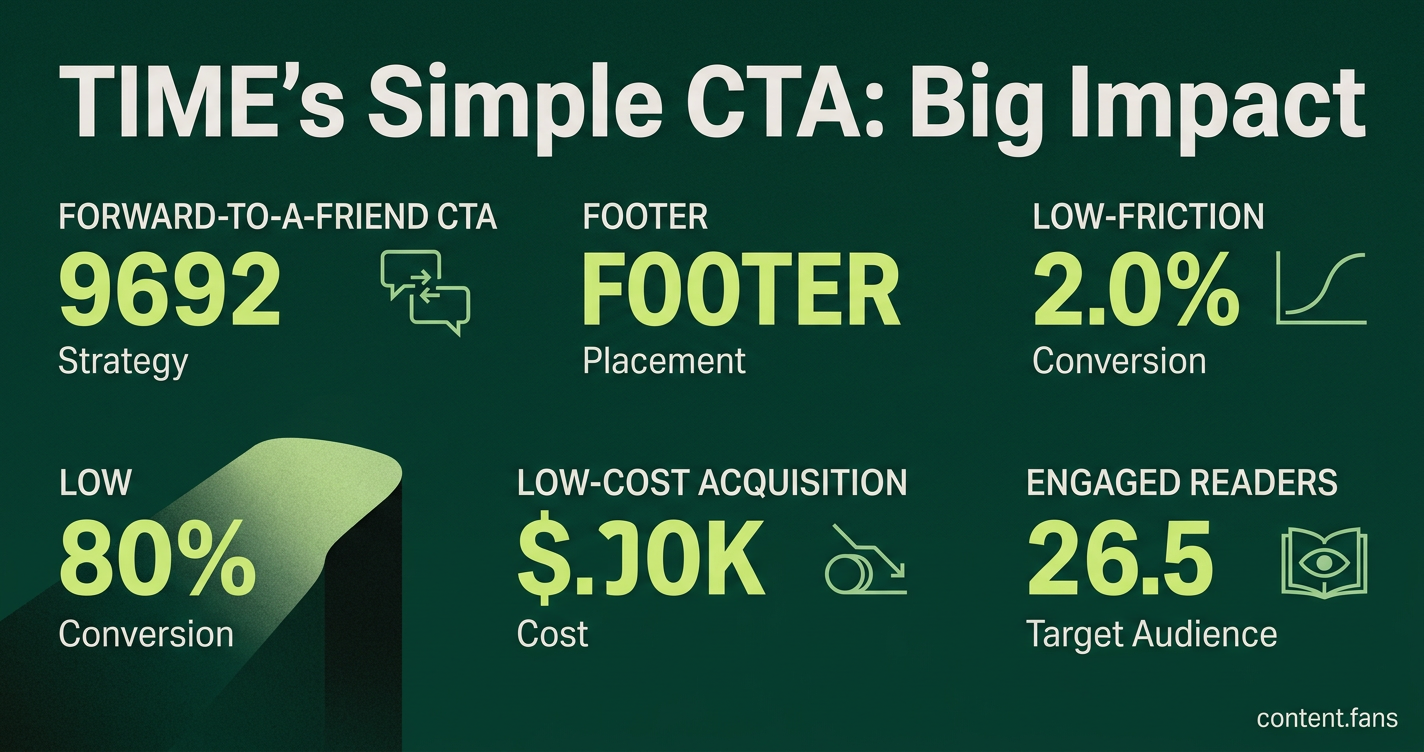
TIME's forward-to-a-friend CTA converts new readers by placing a simple "sign up here" link within forwarded emails. This low-friction method leverages trusted recommendations to generate high-intent subscriptions. By targeting engaged readers, the strategy creates a low-cost, high-conversion acquisition channel without a formal referral program.
Tracking and Optimizing Forward-Based Growth
To maximize the impact of a forward-friendly CTA, publishers must measure its performance. Using UTM tags or dedicated landing pages allows teams to attribute new subscribers directly to forwards. As a Beehiiv guide on referral programs advises, simplicity is paramount: focus on a single primary action and maintain clear, simple rules. Beyond the CTA itself, TIME includes other trust-building elements:
- Builds Trust: Including a direct contact email (newsletters@time.com) signals transparency and accessibility.
- Offers Social Proof: Social media icons provide an alternative, public sharing option to cater to different user habits.
- Gathers Zero-Party Data: Integrated survey links allow editors to collect valuable data on topic preferences for content personalization.
Layering in Incentive Tiers
To transition from a passive strategy to an active referral program, the current best practice is to implement tiered milestone rewards. Instead of cash payouts, which are better suited for paid newsletters, free publications often see stronger results from rewards based on exclusive access or status. A simple path to implementation includes:
- Keep the existing footer line for passive sign-ups.
- Add a small link next to it that says, "Earn rewards when friends subscribe."
- Offer a valuable digital perk after three confirmed sign-ups for quick fulfillment.
A/B Testing Your CTA Copy
Industry research shows that emails with a single call-to-action can achieve significantly more clicks than those with multiple competing CTAs. Therefore, testing should concentrate on optimizing the wording of that one CTA, not adding more. Instead of a neutral prompt, test benefit-driven copy such as:
- "Get our next issue in your inbox - subscribe free."
- "Like this digest? Claim your own copy each week."
Crucially, marketers must track performance by device. A responsive email design is essential, as industry reports indicate it can substantially increase mobile click-through rates.
Essential Measurement Checklist
To gauge the effectiveness of this strategy, track the following components with specific KPIs.
| Monitored Element | Key Performance Indicator (KPI) |
|---|---|
| Forward-to-Subscribe CTA | New subscribers attributed via a forward UTM tag |
| Social Share Icons | Follower growth rate correlated with newsletter sends |
| Reader Survey Link | Survey completion rate and primary drop-off points |
| Public Contact Email | Reader engagement rate (replies per 1,000 recipients) |
Systematically tracking these signals reveals which touchpoints are most effective at driving subscriber acquisition and engagement.