
The Information Unveils AI Assistant for Paywalled Journalism
Serge Bulaev
The Information has announced an AI assistant designed to help analysts and subscribers get useful insights from paywalled journalism more quickly. The assistant may help enterprise readers by offering fast searches, source transparency, and clear citations, which suggests users might pay extra for these features. There are several possible ways to earn money, such as licensing, usage-based fees, or adding the tool to publishers' platforms. Experts recommend strong oversight, clear disclosure of AI involvement, and reliable sourcing to reduce mistakes. Early tests and partnerships with other software may help grow its use while keeping exclusive journalism secure.

The Information has launched a new AI assistant for paywalled journalism, an innovative tool designed to provide analysts and premium subscribers with rapid, verifiable insights from its exclusive reporting. This move aims to enhance the value of its subscription by transforming in-depth investigative stories into actionable, decision-ready briefs for enterprise users.
How the AI Assistant Delivers Actionable Insights
The Information's AI assistant, known as Deep Research, is a tool that synthesizes paywalled articles into instant, sourced answers. It uses a retrieval-augmented generation engine, multi-step reasoning, and inline citations to provide enterprise users with export-ready briefs, ensuring every claim is linked back to original reporting.
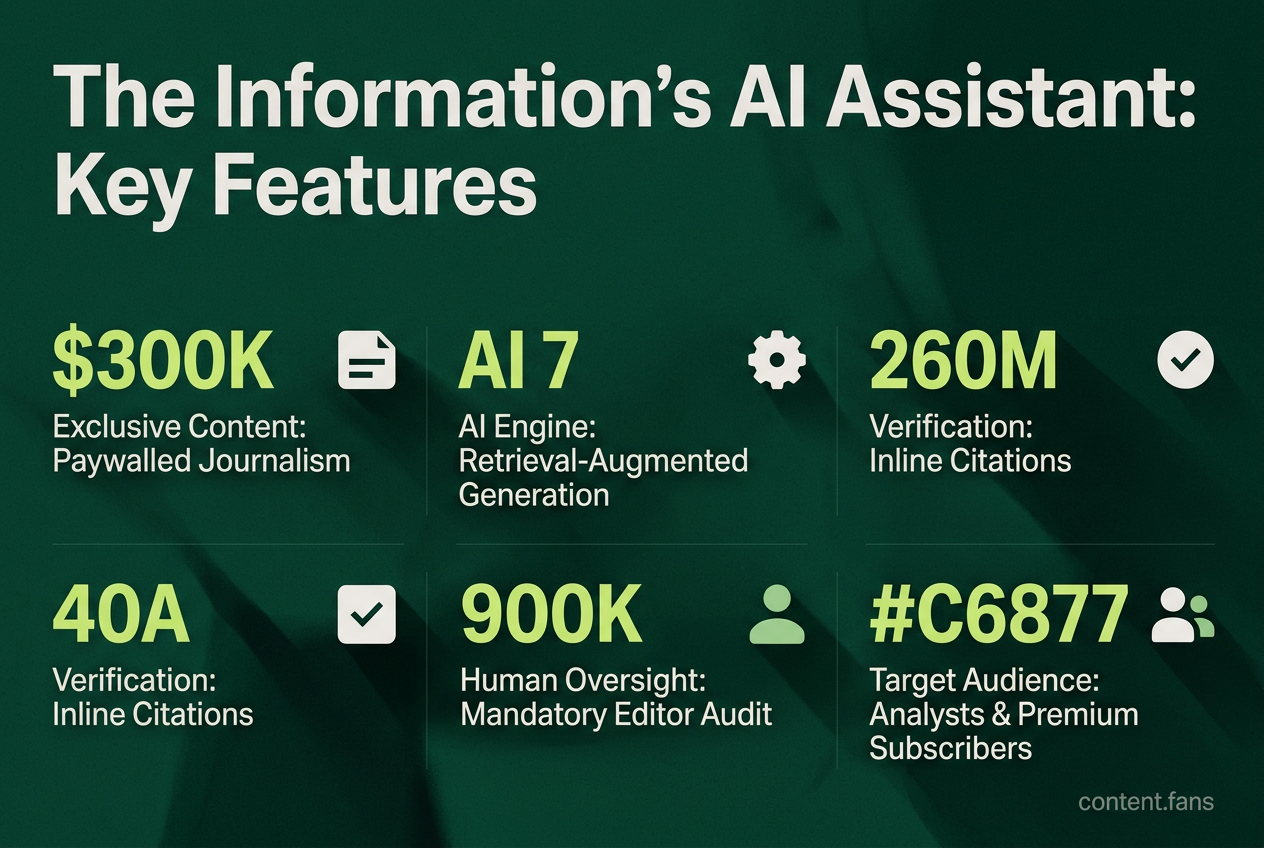
The system's core capabilities are built on a powerful technology stack designed for accuracy and efficiency:
- Curated Retrieval Engine: Queries are restricted to The Information's authenticated corpus of articles and licensed databases, preventing access to unverified external content.
- Multi-Step Reasoning: The AI maps user questions to relevant article passages, identifies key entities, and drafts a coherent synthesis of the findings.
- Inline Citation Layer: Every factual claim is accompanied by a clear citation that includes the original paragraph, reporter byline, and publication date, allowing for instant verification.
- Workflow Export Channels: Findings can be seamlessly exported as Markdown, CSV, or via CRM webhook, moving insights directly into professional workflows.
Upholding Journalistic Integrity with AI Guardrails
To ensure the AI assistant does not fabricate insights, The Information has built its workflow on a foundation of provenance and transparency. Adhering to guidance on AI in journalism, the safety playbook rests on four key pillars:
- Verified Corpus: The AI only retrieves information from a curated index of the publisher's own fact-checked articles.
- Mandatory Human Oversight: Every AI-generated summary is audited by an editor against the original source material before it is delivered to a subscriber.
- Click-to-Verify Citations: Each synthesized fact links directly to the source article, empowering users to follow the provenance trail.
- Rapid Corrections Pipeline: A system is in place to flag, correct, and retrain the model on any identified errors, improving its accuracy over time.
The Business Case: Monetization and Target Audience
Market analysis suggests that enterprise readers will pay a premium for AI tools that offer clear source transparency. Agentic assistants are seen as "fast and practical for landscape scans" (Trilogy AI analysis), a value that is amplified when the underlying content is exclusive and paywalled.
The primary customers for this tool fall into three main segments:
- Enterprise Strategists requiring current competitive intelligence.
- Equity Analysts summarizing market themes for financial models.
- Consulting Firms that repackage research for their clients.
Emerging monetization models show significant promise, with tiered subscriptions generating more revenue than single-price offerings and early pilots suggesting higher customer lifetime value when a paywall is paired with AI summarization.
Seamless Workflow Integration and Partnership Ecosystem
To maximize adoption, the roadmap includes plug-and-play connectors for tools that analysts use daily. Planned integrations include a Chrome extension, a Slack bot for direct answers in channels, and CRM enrichments for Salesforce and HubSpot. Each integration is designed to preserve the complete citation trail for compliance and auditing purposes.
While The Information's core journalism will remain proprietary, the strategy includes a hybrid approach by inviting select research partners to license their datasets into the retrieval layer. This mirrors models like Gemini Deep Research, where private and public data can be indexed together under mandatory human oversight, expanding the tool's footprint while keeping exclusive journalism securely gated.