
Study: Psychological Safety Boosts AI Adoption by 29.6%
Serge Bulaev
Studies suggest that psychological safety may be a key factor in how much employees use AI tools at work. One study found that when psychological safety went up by one unit, initial use of AI rose by 29.6 percent. Most executives link psychological safety to AI success, but less than half say their own workplaces have high safety levels. Managers play a big role because they help turn policy into action and support their teams. Training programs and new rules are being used to help leaders build trust and make fairer for teams to try AI and share concerns.

Psychological safety is a critical driver that makes AI adoption 29.6% more likely to succeed, serving as a key antecedent to initial engagement. Far from being a soft skill, a supportive culture is now directly linked to ROI. A 2026 arXiv study of 2,257 employees found that each one-unit increase in psychological safety makes AI adoption 29.6% more likely to succeed, functioning as a key antecedent of initial engagement. This data positions workplace culture as the primary factor for employee engagement with new AI systems.
This emerging consensus is echoed in executive suites. According to industry reports, a significant portion of leaders connect psychological safety with the success of their enterprise AI initiatives. However, a substantial execution gap exists, as many of those same executives rate their organizational safety levels as less than optimal.
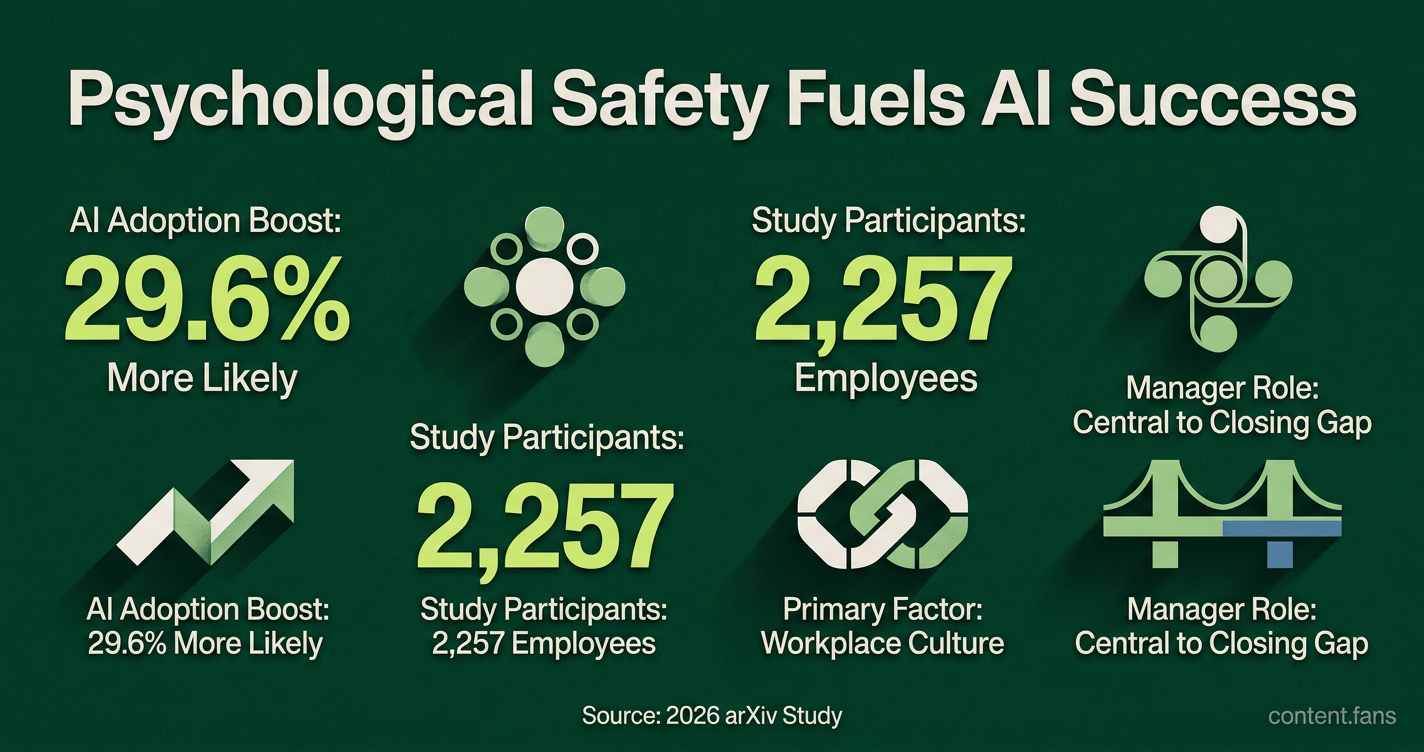
Frontline managers are central to closing this gap. They are tasked with translating high-level corporate policy into the daily behaviors and team dynamics that foster trust, bearing responsibility for both successful AI implementation and employee well-being.
Why psychological safety matters for AI uptake
Psychological safety is crucial for AI adoption because it allows employees to experiment, make mistakes, and ask questions without fear of blame. This open environment prevents workers from hiding AI use, which is critical for fostering collective learning and ensuring new tools are integrated effectively and ethically.
AI deployments are unique in how they can simultaneously threaten an employee's sense of identity, competence, and status. In environments where mistakes are punished, employees are more likely to bypass official AI pilots or hide errors, which stalls collective learning. This "under the table" experimentation, common in low-safety cultures, prevents organizations from developing shared knowledge. Conversely, creating dedicated feedback channels and decoupling AI experimentation from performance reviews can reverse this trend, building trust and encouraging transparent adoption.
Training managers in relational leadership
To build this culture, leading organizations are investing in manager training that prioritizes leadership skills alongside technical capabilities. LeadershipAI by GP Strategies emphasizes AI leadership, strategy, and human-AI collaboration. These curricula are built on the principle that relational intelligence is a vital complement to technical expertise.
Key leadership competencies for AI integration include:
- Fostering team-wide acceptance of AI tools
- Using coaching circles to surface and address hesitation early
- Negotiating change effectively across different business functions
- Prioritizing human connection during AI-driven process redesigns
- Clearly communicating responsible AI principles to all staff
These programs utilize peer discussions and action-learning projects, recognizing that psychological safety is built through consistent, observable leadership actions, not just through written policies.
Embedding safety into governance structures
Beyond training, organizations are embedding psychological safety into their formal governance structures. Many modern frameworks utilize multi-layer models that may include AI steering committees, centers of excellence, and ethics boards with authority to review projects that raise ethical concerns. These frameworks mandate specific operational controls:
- Mandatory risk assessments prior to any model deployment.
- Continuous monitoring for bias and drift, with public audit trails.
- Clearly documented human oversight roles for every AI project.
- A comprehensive inventory of all production AI models for leadership visibility.
Experts agree that these structural safeguards provide the necessary "psychological cover," empowering teams to raise concerns about AI systems without fearing career repercussions and reinforcing a culture of responsible innovation.
Ultimately, psychological safety and relational leadership are not optional extras for the age of AI. They are measurable, strategic levers that organizations are actively integrating into leadership development, governance, and daily team rituals to unlock the full potential of artificial intelligence.
What does psychological safety mean for AI adoption in practical terms?
Research provides insights into the relationship between psychological safety and technology adoption success. The statistic matters because it positions psychological safety as a measurable, strategic lever rather than a soft cultural ideal. Organizations can now justify investments in relational leadership and manager training with ROI projections tied directly to technology adoption rates.
Why does psychological safety matter more for AI than other workplace changes?
AI adoption uniquely threatens identity, competence, and status simultaneously - unlike previous technological shifts that typically challenged only one or two of these dimensions. Employees experimenting with AI tools often face the uncomfortable reality of admitting "I have no idea what I'm doing" while their performance is being evaluated.
Without psychological safety, AI adoption happens "under the table" - individually, invisibly, and without collective learning. This hidden adoption pattern prevents organizations from capturing network effects and building shared institutional knowledge around AI capabilities.
What specific training do managers need to lead AI-augmented teams?
LeadershipAI emphasizes human-AI collaboration and leadership, focusing on "fostering team acceptance" and "maintaining human connection" through coaching circles and readiness assessments.
Various programs integrate negotiation and change management modules specifically designed for AI transitions. Core competencies include separating experimentation from performance evaluation - a structural change that gives employees permission to fail while learning new tools.
How are organizations structuring governance to support ethical AI adoption?
Mature organizations have moved beyond ad-hoc committees to structured governance approaches that may include strategic AI steering committees, operational centers of excellence, and independent ethics boards with authority to review problematic applications.
The Singapore Model AI Governance Framework is a voluntary guide that provides recommendations for AI governance, including considerations for risk assessments, human oversight, technical safeguards, and responsibility definitions. This framework reflects growing recognition that governance architecture determines whether AI investments translate to sustainable value.
What creates the gap between recognizing psychological safety and building it?
While many business leaders recognize the connection between psychological safety and AI success, fewer rate their organization's psychological safety as optimal. This execution gap stems partly from challenges in implementation: research suggests that unmanaged AI adoption can create additional workplace tensions, as employees may feel less comfortable admitting mistakes or speaking up as AI use intensifies.
Breaking this cycle requires structural interventions - risk bands that protect experimenters, modeled vulnerability from senior leaders, and specific feedback channels rather than generic "open door" policies. Organizations treating psychological safety as a communications campaign rather than an organizational design priority may find their AI investments underperforming their potential.