
Stack Overflow updates 'Stack Internal' to ground AI with verified knowledge
Serge Bulaev
Stack Overflow updated its 'Stack Internal' platform in July 2026 to help AI tools use more accurate and verified company knowledge. The update adds features like confidence labels, provenance cards, and better connections to other tools, aiming to reduce errors in AI responses. Many large companies are trying methods like Retrieval Augmented Generation (RAG), but they often struggle with permission controls and old data. Stack Internal may help by making it easier to manage trusted information, control access, and track where answers come from. The goal appears to be lowering mistakes in AI by using checked, company-specific answers and making the system more secure and transparent.

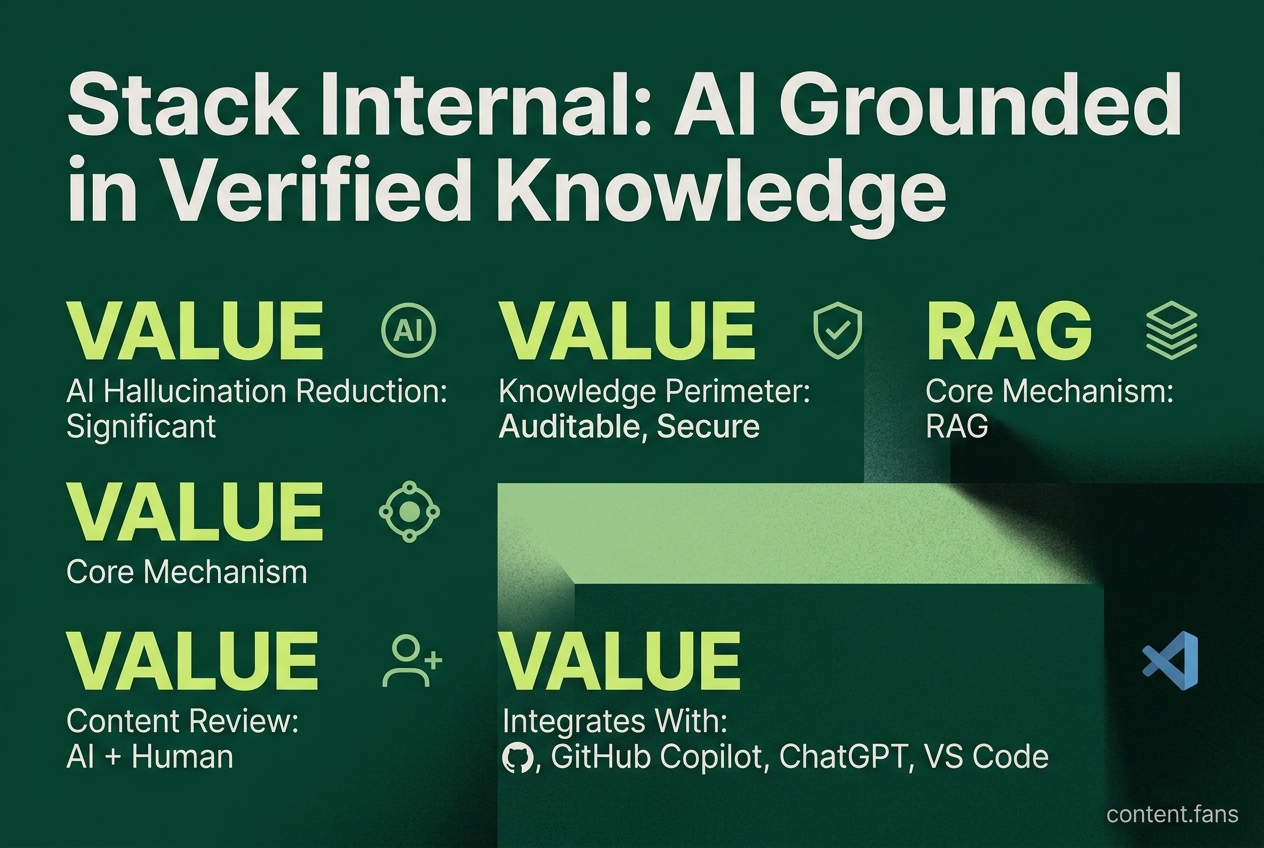
Stack Overflow's Stack Internal platform helps ground AI with verified knowledge, a critical step for any enterprise using generative AI. The updated service addresses AI hallucination by ensuring assistants draw from authoritative, company-specific sources. This is crucial, as research shows verification frameworks can significantly reduce AI error rates.
Here's what enterprises need to know about this development:
What is Stack Internal and how does it differ from standard Stack Overflow?
Stack Internal is a private knowledge platform that converts a company's proprietary data into a trusted, auditable memory for its teams and AI tools. It integrates with existing enterprise systems to provide verified, company-specific answers, helping to reduce AI errors and ensure information security.
Unlike the public platform, Stack Internal acts as an "auditable, secure perimeter for your proprietary knowledge." It captures organizational know-how in formats like private Q&A, long-form Articles, and Collections, transforming it into what Stack Overflow calls a "living, reusable memory" for teams and AI agents. Recent updates have enhanced this with response-level confidence labels and provenance cards, which show the origin and trustworthiness of information for better decision-making.
How does Stack Internal reduce AI hallucinations?
The platform's core mechanism is Retrieval-Augmented Generation (RAG), which grounds AI responses in curated, company-specific knowledge. This approach is a key pattern for AI success, with industry research showing significant hallucination reductions. Stack Internal addresses common RAG failure points through:
- Unified Search: A single search interface queries both private and public knowledge, using AI reranking to surface the most relevant results for large enterprises.
- Trusted Content Pipeline: Content undergoes AI scoring for accuracy and optional human review before being published to the trusted knowledge base.
- Secure Ingestion: It provides automatic ingestion from tools like Microsoft Teams, Confluence, Slack, and ServiceNow while enforcing access controls at the retrieval layer to prevent data leaks.
What integrations are available for AI tools and developer workflows?
Stack Internal connects verified knowledge to tools teams already use. An included MCP Server provides direct integrations for GitHub Copilot, ChatGPT, Cursor, and, via Microsoft, Visual Studio Code and Copilot.
This architecture supports agentic orchestration, a concept where AI systems decide when to search, calculate, or synthesize information. As noted in enterprise RAG research, this is essential for handling complex internal queries by giving AI structured, permission-aware access to organizational knowledge.
What security and governance features does Stack Internal provide?
The platform is built with security as a foundational principle, not an afterthought. Key capabilities include:
| Security Layer | Implementation |
|---|---|
| Authentication | SSO, SAML, SCIM 2.0, Okta integration |
| Access Control | Role-based permissions, multi-team permissions, ACL evaluation at retrieval time |
| Auditability | Audit trails, provenance cards showing source and confidence |
| Compliance | SOC 2 Type II, with single-tenant hosting available for highest tiers |
The platform offers multiple tiers, with features like enhanced AI search and single-tenant hosting in the enterprise plan. Pricing is available through direct sales consultation.
Why are verified internal knowledge layers becoming critical for enterprise AI?
Several converging trends make this type of infrastructure essential:
-
Scattered knowledge and scaling risks: Enterprise data is often fragmented across SharePoint, wikis, and other storage systems. At scale, retrieval quality can degrade. Research confirms that precise, permission-aware retrieval is critical for large knowledge bases.
-
The challenge of retrofitting permissions: Building access control from the start is essential, as it is one of the most difficult features to add later. Stack Internal's architecture is designed around this principle.
-
Intensifying regulatory and liability pressure: Industry reports on RAG highlight data security, accuracy, and relevance as core governance challenges. Weak controls can lead to unauthorized access or information leakage through AI outputs.
For any organization deploying AI, the ability to ground responses in vetted, attributable knowledge is a measurable risk reduction strategy supported by growing evidence.