
Shopify Opens Checkout to AI Agents via New WebMCP Protocol
Serge Bulaev
Shopify has introduced a new WebMCP protocol that may let AI agents help with checkout tasks on its platform, like reading delivery options, applying discounts, and completing checkouts after the buyer approves. The protocol appears to treat checkout steps as structured actions, which Shopify suggests could make the process faster while keeping buyers in control. Early tests in demo stores suggest WebMCP might make checkouts quicker and cheaper than older automation scripts, but real-world results could vary. Some limits remain, as agents cannot add items or change payment cards and must follow existing security checks. Merchants may not yet have clear ways to see or track agent-driven orders, and future updates might address this need if agent use grows.

Shopify is opening its checkout to AI agents via the new WebMCP protocol, a significant update for e-commerce automation. The implementation raises important questions for merchants, shoppers, and the broader industry about security, performance, and control.
What is WebMCP and how does it change AI agent checkout?
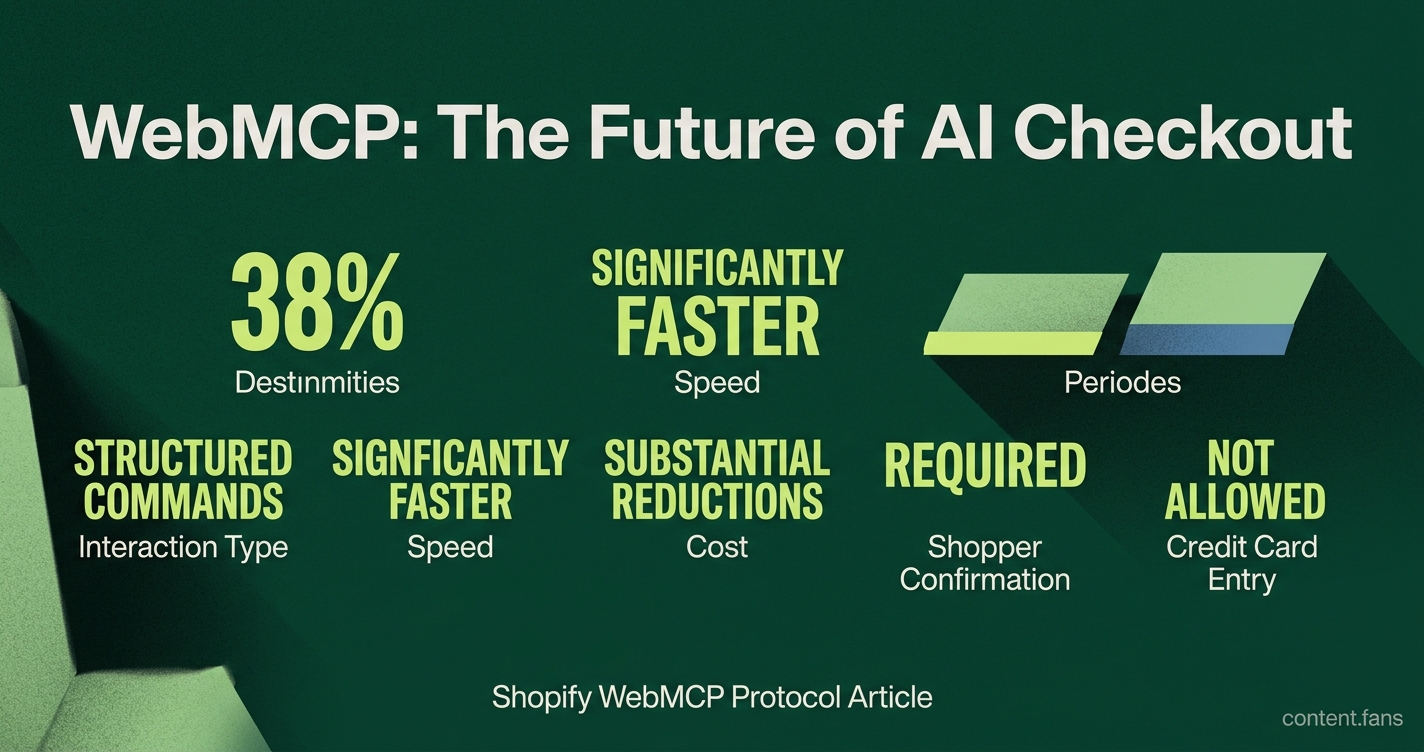
WebMCP (Web Model Context Protocol) is a Shopify protocol that lets compliant AI agents interact with checkout using structured commands instead of screen scraping. This allows agents to perform tasks like applying discounts or selecting shipping options more reliably and quickly, fundamentally changing the automation process.
Rather than relying on visual page scraping and simulated clicks, agents can now call specific functions like get_checkout, update_checkout, and complete_checkout to interact with the checkout state directly. This approach contrasts with traditional browser automation, which must repeatedly read pages and simulate user actions - a process that introduces latency and failure points. By allowing agents to act on structured data, WebMCP makes the interaction more reliable and faster.
How much faster and cheaper is protocol-based checkout?
Shopify's internal tests show WebMCP checkouts completing significantly faster than traditional browser automation methods. The company also reported substantial reductions in language-model costs in its controlled test.
However, these figures come with caveats. The benchmark used Shopify's own demo stores and a single AI model, so real-world performance across diverse merchant environments has not yet been validated.
What security protections exist for shoppers?
The protocol is designed with several core safeguards, and it requires explicit shopper confirmation before finalizing any purchase - an agent cannot complete an order on its own. Key protections include:
- Agents cannot add new items to carts; they only work with existing checkout sessions.
- New credit card details cannot be entered by agents; payments are processed through Shop Pay or other previously saved methods.
- Shoppers must authorize every transaction through the standard confirmation flow.
These limitations address critical fraud concerns, as uncontrolled agents have been documented breaching e-commerce sites, reinforcing why controlled permissions are essential.
How will this affect merchant analytics and attribution?
A primary challenge for merchants is that agent-assisted orders may appear in dashboards without any special identifier, complicating analytics and attribution. Current documentation does not indicate any specific labeling or filtering for these transactions. This means:
- Orders will appear as standard Shopify transactions in core metrics like revenue, AOV, and conversion rate.
- Attribution to "AI agent assisted" will be ambiguous without new reporting dimensions.
- Marketing analytics may require adjustment, as traditional attribution models may not capture the agent's role in the purchase.
Can merchants opt out or control agent access?
Currently, no merchant opt-in is required for WebMCP functionality, and Shopify has not detailed any controls for disabling it or filtering agent-originated orders. This automatic rollout reflects a strategy to treat agent assistance as a natural extension of shopper behavior, not a separate channel. The trade-off is less granular control for merchants, who should monitor their dashboards for unexpected patterns and consider supplemental tracking to identify agent influence.
Key Takeaway: While Shopify's WebMCP integration marks a technical leap forward in checkout automation, its automatic rollout creates immediate operational challenges. The lack of merchant controls and dedicated reporting for agent-assisted sales produces an analytics gap that businesses must address with custom solutions until Shopify provides future platform-level updates.