
SAP Unveils Autonomous Enterprise Suite with AI Agents at Sapphire 2026
Serge Bulaev
SAP announced its Autonomous Enterprise suite at the Sapphire 2026 conference. This suite combines a Business AI Platform with agents embedded in core applications, which may help automate processes in areas like finance, supply chain, human resources, and customer experience. The new suite includes over 50 assistants and more than 200 specialized agents designed to run end-to-end workflows, though its real-world effectiveness still needs to be validated. SAP emphasizes built-in governance and audit trails to manage risk, but pricing details have not been disclosed. Experts suggest this may help existing SAP clients upgrade automation without major custom changes, though some uncertainty remains until it is tested at scale.

At its Sapphire 2026 conference, SAP unveils its Autonomous Enterprise suite with AI agents, a landmark initiative to process data and deploy AI. According to the company's official announcement, the solution integrates a Business AI Platform with an Autonomous Suite, embedding agents directly into core applications like S/4HANA and SuccessFactors SAP News.
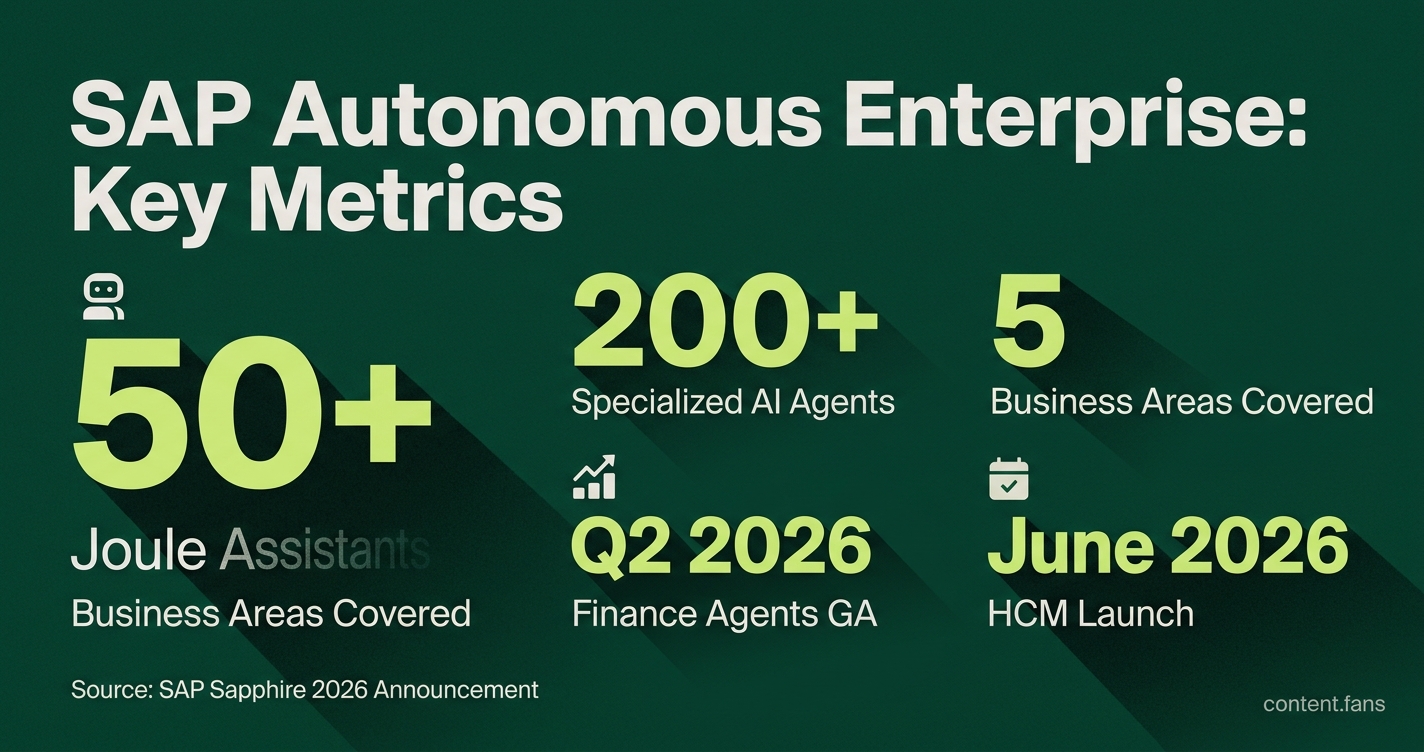
SAP detailed that over 50 domain-specific Joule Assistants now orchestrate more than 200 specialized agents for end-to-end workflows. These assistants "run processes from start-to-finish" within existing SAP environments, potentially reducing the need for separate automation tools, as reported by DestinationCRM DestinationCRM.
What is inside the Autonomous Suite?
The SAP Autonomous Suite contains over 50 Joule Assistants and 200+ AI agents designed to automate business functions across finance, supply chain, procurement, HR, and customer experience. These components are embedded within core applications to execute end-to-end workflows using contextual data and built-in governance.
SAP groups the new capabilities into five key business areas:
- Finance: The Autonomous Finance pack features agents for financial close, planning, billing, and cash management. Analysts at Constellation Research report these agents will "sense changes, reason over risk and automate workflows" and are slated for general availability in Q2 2026 Constellation Research.
- Human Capital Management (HCM): Scheduled for June 2026, HCM assistants will use data from SuccessFactors and the SAP Business Data Cloud for payroll, recruiting, and workforce planning.
- Customer Experience (CX): These assistants coordinate workflows across marketing, commerce, sales, and service.
- Supply Chain & Procurement: These areas are also covered, with a central Knowledge Graph providing relationship context for all agent actions.
Governance and Audit Focus
A core pillar of the Autonomous Enterprise suite is its "governance-by-design" architecture. SAP's AI Agent Hub is engineered to manage both native and third-party agents with unified policies, inheriting role-based access directly from existing ERP authorizations. According to observers at SAPinsider, this framework provides comprehensive audit trails of each agent's reasoning and is designed for SOX compatibility and ISO-certified development.
Key governance safeguards include:
- Comprehensive Audit Trails: Every agent action and its justification are logged for review.
- Human-in-the-Loop Control: Threshold-based autonomy automatically escalates high-risk or high-value decisions to human users for approval.
- Inherited Security: Agents operate within the user's existing Identity and Access Management (IAM) permissions, preventing them from bypassing established controls.
Commercial Model and Rollout Timing
While specific pricing details have not been released, SAP announced a €100 million partner fund to speed up customer deployments. The company is promoting adoption through its primary cloud offerings: RISE with SAP subscribers will receive three assistants in their first year, and GROW with SAP customers get the entire portfolio upon go-live.
The rollout is staggered:
* Q2 2026: Autonomous Finance assistants reach general availability.
* June 2026: Autonomous HCM becomes available.
* Q3 2026: The Enterprise Planning module will be released.
All suite components operate on the SAP Business Technology Platform, which is now hosted in 12 Microsoft Azure regions to meet global data residency needs.
Why This Matters for Existing SAP Clients
The Autonomous Enterprise suite offers a significant upgrade path for SAP's installed base, enabling advanced automation without extensive custom code rewrites. Since the AI assistants are delivered via standard application updates, organizations can maintain a "clean core" strategy by activating these features while managing customizations as side-by-side extensions. This approach allows early adopters to target high-volume processes in finance and procurement, where the benefits of auditable, rule-based automation can be demonstrated quickly.
To accelerate development, SAP offers 2,400 pre-built Joule skills in Joule Studio for no-code and pro-code extensions. Additionally, industry-specific editions with tailored data models and compliance checks are planned for seven verticals.
While no formal customer references are available yet, analysts note that the suite's true test will come when multiple agents are deployed at scale. However, the platform-level governance model is viewed as a strategic response to concerns about managing AI in complex enterprise environments, though some uncertainty remains until it is tested at scale.
What is SAP Autonomous Enterprise and when was it announced?
SAP Autonomous Enterprise Suite was introduced on May 12, 2026 at SAP Sapphire Orlando. The solution marries SAP Business AI Platform (SAP BTP + SAP Business Data Cloud + SAP Knowledge Graph + Joule Studio) with SAP Autonomous Suite, delivering 50+ domain-specific Joule Assistants that in turn orchestrate more than 200 specialized AI agents across finance, supply chain, procurement, human capital management, and customer experience.
Rollout is already underway: Finance agents became generally available in Q2 2026, Autonomous HCM follows in June 2026, and Enterprise Planning agents arrive Q3 2026.
How does the suite automate business processes?
The platform follows an "agentic" automation pattern:
- Sense - real-time ingestion of transactional, behavioral, and external data.
- Reason - agents apply machine-learning models to predict revenue, risk, cash-flow, or workforce needs.
- Act - pre-approved actions (for example, automatic GL posting, purchase-order scheduling, or HR onboarding) run end-to-end inside SAP S/4HANA, SuccessFactors, Ariba, or CX.
Every step is governed by business-aware policies - agents inherit the exact roles and permissions of the human user who authorized them and never exceed predefined risk/value thresholds; anything above the threshold pauses for human approval.
What are the announced pricing and adoption incentives?
SAP has not disclosed SKU-level pricing, but it sweetens adoption through:
- €100 million partner fund to co-finance customer deployments.
- RISE with SAP customers receive 3 Joule Assistants at no extra cost in year 1.
- SAP GROW delivers the full portfolio on day-one for new cloud ERP customers.
The company says it is using RISE and GROW as the primary on-ramps to ensure rapid adoption across its installed base.
What governance, audit, and security safeguards are built in?
SAP moved governance from afterthought to core architecture. Key controls include:
- Audit trail on every agent action - what data was used, why a decision was taken, and the final outcome (SOX-compatible ISO certified process).
- Role-based access - agents cannot bypass the user's ERP authorization matrix.
- Threshold-based autonomy - high-risk or high-value decisions automatically escalate to humans.
- SAP AI Agent Hub - a cross-vendor governance layer that can also manage third-party agents (Salesforce, ServiceNow, Microsoft, etc.).
A joint SAP-NVIDIA reference architecture (published at the Architecture Center) codifies these patterns for enterprise security teams.
How does n8n fit into SAP's low-code/no-code strategy?
Although the Sapphire keynote centered on Joule and SAP Build/Process Automation, SAP's 2024 investment in n8n (valued at USD 5.2 B) remains a pillar of its LCNC strategy. n8n nodes and workflow templates are embedded inside Joule Studio, giving citizen developers a visual way to extend SAP processes without Groovy coding. The combination lets enterprises combine SAP-native AI agents with n8n's 350+ community connectors, preserving both clean-core ERP philosophy and open ecosystem flexibility.