
Microsoft, Amazon offer dedicated AI instances to prevent data leaks
Serge Bulaev
Many companies are worried that their chat data might be used to train AI models, so they are choosing special cloud setups from Microsoft and Amazon. These dedicated instances may keep each company's data separate and promise not to share it with the AI providers. Microsoft and Amazon say their services do not use customer data for model improvement and offer special security features. Still, experts say users must watch for risks and carefully manage settings, because some features might not work in these locked-down systems. The need for this isolation comes from concerns about data leaks and possible fines under privacy laws.

To prevent sensitive chat prompts and proprietary information from being used in third-party training data, enterprises are rapidly adopting dedicated AI instances. These secure, single-tenant cloud environments from providers like Microsoft and Amazon offer a powerful solution to the growing risk of AI-related data leaks. Early adopters include major firms in banking, insurance, and semiconductor design, who require stringent data isolation.
How Dedicated AI Instances Prevent Data Leaks
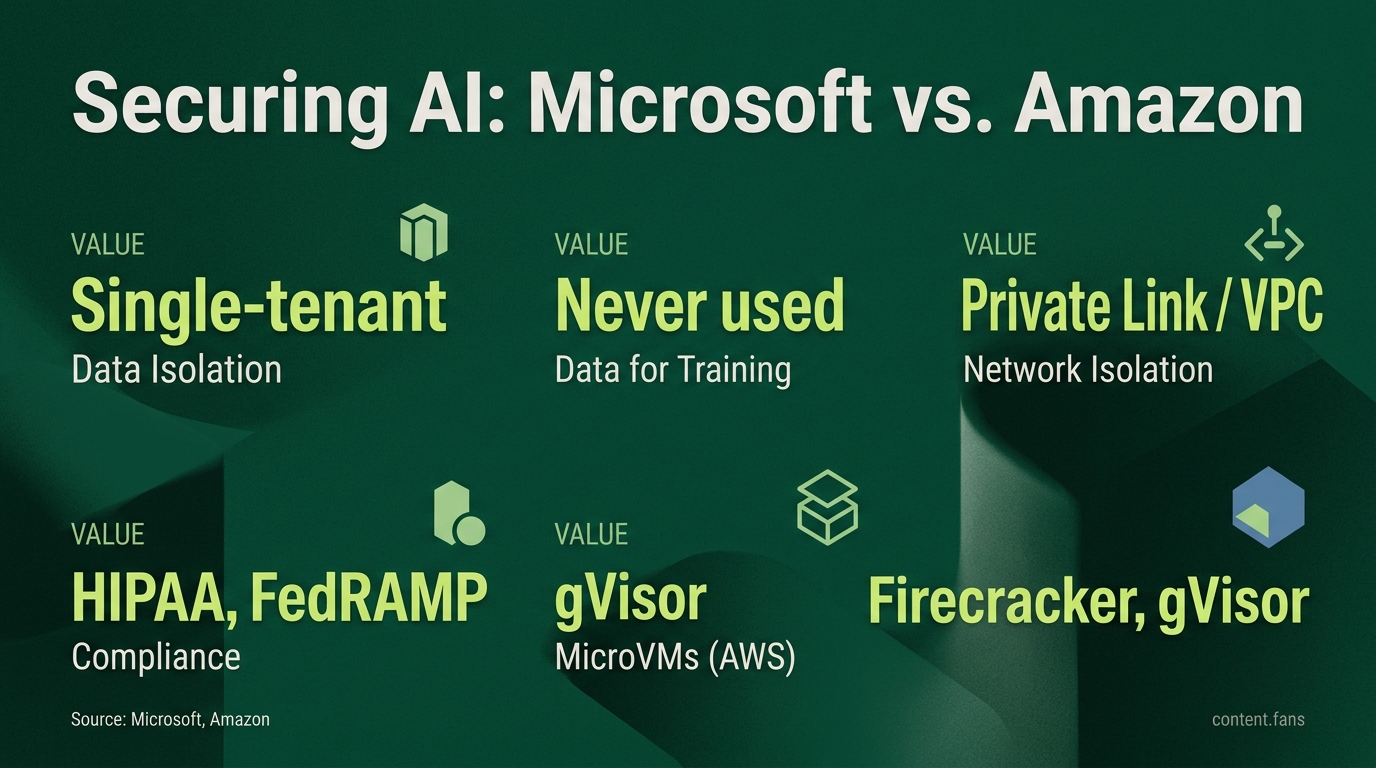
Dedicated AI instances prevent data leaks by running models in a private, single-tenant environment. This architecture isolates prompts and completions, uses private networking to avoid the public internet, and contractually guarantees that an organization's data is never used for external model training or review by the provider.
Microsoft Azure's Dedicated OpenAI Service
Microsoft's Azure OpenAI Service provides dedicated instances that isolate prompts and completions within a tenant-specific resource. These deployments guarantee customer data is never used for model training and feature robust security controls, including Private Link for network isolation, customer-managed encryption keys, and Entra ID integration. Comprehensive audit logs in Azure Monitor support compliance with standards like HIPAA and FedRAMP, as detailed in the official Azure OpenAI Security Baseline.
Amazon Bedrock's Isolated Claude Deployments
For users of Anthropic's models, Amazon Bedrock ensures customer data is not used to train Anthropic's base models, but data is shared with Anthropic for inference in standard deployments. Zero data sharing requires private deployments which are not the default path. AWS Bedrock isolates inference using AWS Firecracker microVMs and gVisor for hard isolation, with network policies enforced via restricted proxies. Requests can be routed through private VPC endpoints, and CloudTrail logs requests, ensuring all inference remains within a specific AWS region, a key requirement for data sovereignty detailed in the Claude on AWS Bedrock: Enterprise Architecture Guide (2026). However, responsibility for configuring IAM roles and security policies to secure this boundary remains with the customer.
The Growing Imperative for AI Data Isolation
The need for data isolation is no longer theoretical. Industry reports indicate that many companies have suffered AI-related data leaks, with a significant portion facing security incidents from exposed prompts. The risk of severe regulatory fines under GDPR and HIPAA has prompted many firms, especially in fintech, to halt AI deployments until data residency and privacy can be guaranteed. High-profile incidents, like the Grok code leak, highlight the significant reputational damage that results from mishandling user data.
Key Evaluation Criteria for Dedicated Instances
A checklist for buyers comparing dedicated instances should include:
- Training Data Exclusion: Confirm that prompts and completions are contractually excluded from all vendor training pools.
- Encryption Control: Require customer-managed keys for data at rest and verify key rotation capabilities.
- Network Isolation: Utilize private endpoints (VPC or VNet) to ensure traffic never traverses the public internet.
- Auditing and Monitoring: Enable real-time audit log streaming into your Security Information and Event Management (SIEM) system.
- Security Testing: Conduct red-team exercises to test for potential cross-tenant access vulnerabilities before deploying to production.
Dedicated AI instances provide a critical middle ground between the security risks of public endpoints and the high cost of on-premise models. While they offer powerful protections, enterprises must recognize their own responsibilities. As both Microsoft and Amazon clarify, access controls and governance remain the customer's duty. Even with isolated architecture, some features may be limited, reinforcing that successful AI adoption requires a combination of robust technology and vigilant, continuous oversight.