
Pinterest signs $4 billion AWS deal, adopts Trainium for AI
Serge Bulaev
Pinterest has agreed to spend $4 billion on Amazon Web Services (AWS) cloud infrastructure through 2031, which is its biggest cloud deal so far. The company says this partnership may help power new AI features like visual search and recommendations. Pinterest plans to use AWS Trainium chips and more Graviton CPUs, which AWS claims could offer better price and performance, though these are vendor claims and not independently proven. Some experts suggest this long-term deal might make Pinterest more dependent on AWS technology. The deal appears to show that companies may trade flexibility for better AI tools and predictable costs.

In a significant cloud investment, Pinterest signs a substantial AWS deal extending through the coming years, a landmark agreement that deepens a partnership started in 2010. The commitment dedicates significant resources to power Pinterest's next generation of AI-driven visual search, shopping, and content recommendation features.
Hardware choices that shape the plan
Pinterest's major AWS deal secures long-term access to specialized AI hardware, including Trainium chips for model training and Graviton CPUs for inference. This investment aims to enhance its AI-driven visual search and recommendation features for its substantial user base while ensuring predictable costs and infrastructure capacity.
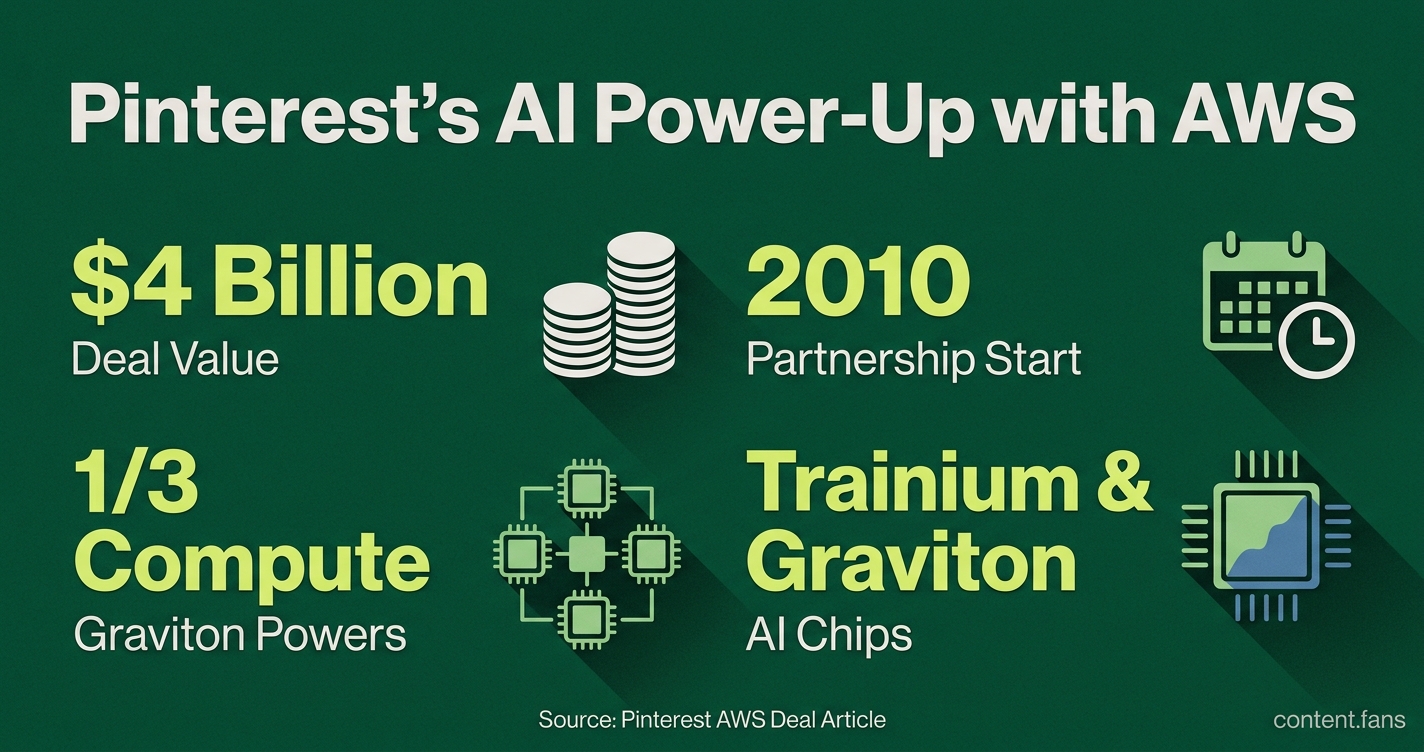
Pinterest will transition its large-scale AI model training to AWS Trainium chips and expand its use of ARM-based Graviton CPUs for inference. According to a company press release, this purpose-built silicon provides the necessary price-performance for training and running AI models at scale. Notably, Graviton already powers about one-third of Pinterest's compute fleet. According to industry reports, AWS's Trainium2 instances offer improved price-performance compared to comparable GPUs, highlighting the strategic value for Pinterest's vision and language models.
How the deal maps to Pinterest's product roadmap
To serve its substantial monthly user base with fast, personalized results, Pinterest's expanded AWS commitment will directly support several key product areas:
- Advanced Recommendations: Implementing transformer-based systems to replace older retrieval methods.
- Visual Search: Powering the core visual search engine with advanced multimodal models.
- Conversational AI: Enhancing the new Pinterest Assistant with open-source vision-language models.
Behind the scenes, Pinterest is also modernizing its infrastructure by migrating from legacy EC2 instances to a Kubernetes architecture on Amazon EKS, which improves developer productivity and enables automated scaling.
Enterprise strategy signals
This multi-year pact highlights a growing enterprise trend: using long-term contracts to secure vital AI capacity. As reported by CNBC, the agreement is the largest infrastructure commitment Pinterest has made. Analysts caution that such deals can deepen technical dependence on a single provider. By adopting AWS-specific technologies like Trainium and managed EKS, Pinterest accepts reduced portability. This move signals a strategic trade-off, where organizations prioritize faster AI implementation and budget predictability over infrastructure flexibility.
Reported economics of Trainium vs GPUs
| Metric | Trainium2 (AWS claim) | NVIDIA GPU (EC2 P5e/P5en) |
|---|---|---|
| Price-performance | Improved performance | Baseline in AWS comparison |
| Software ecosystem | AWS Neuron focused | Broader CUDA ecosystem |
| Portability | AWS specific | Multi-cloud capable |
It is critical to note that these figures are vendor-reported claims from AWS. In the absence of independent, third-party benchmarks, they should not be considered definitive proof of superiority but rather as a key factor in Pinterest's decision-making process.
What CIOs can learn
Pinterest's strategy offers a clear blueprint for how CIOs can structure multi-year cloud deals to:
- Secure reserved capacity for specialized AI chips.
- Achieve predictable spending via committed use discounts.
- Align infrastructure modernization directly with product development goals.
For enterprises considering a similar path, this case underscores the importance of balancing cost optimization against future vendor flexibility. The Pinterest model demonstrates that using technologies like Kubernetes, open-source models, and careful workload segmentation can help mitigate lock-in risks, even when leveraging custom silicon.
What does Pinterest's major commitment to AWS include?
The agreement obliges Pinterest to spend substantial resources on AWS infrastructure through the coming years, the largest infrastructure outlay in the company's history. Beyond raw compute and storage, the money secures preferential access to AWS Trainium chips for AI training and an expanded deployment of Graviton CPUs that already handle roughly one-third of Pinterest's global compute load.
Why did Pinterest choose AWS Trainium over NVIDIA GPUs?
According to industry reports, Trainium2 EC2 Trn2 instances deliver improved price-performance compared to GPU-based P5e/P5en instances for large-scale model training. Pinterest says the Trainium stack gives it "the price-performance to train and run AI models at massive scale" while remaining fully inside the AWS ecosystem it has used since 2010.
How will Pinterest use the new AI hardware day-to-day?
Pinterest will run large language models and vision-language models on Trainium to power personalized visual search, recommendation feeds, and the new Pinterest Assistant conversational discovery product. Graviton CPUs will take over more of the traditional discovery stack that serves its substantial monthly user base, while the company completes its migration from legacy EC2 fleets to Kubernetes on Amazon EKS.
What are the strategic and lock-in implications for other enterprises?
The deal is a textbook example of long-term commitments being used to secure AI capacity, pricing certainty, and roadmap stability. Enterprises gain priority access to scarce AI accelerators and predictable budgets, but workloads that rely on Trainium, Graviton, and Amazon EKS become more expensive to port elsewhere. Pinterest openly treats AWS as a strategic partner, not a commodity supplier, reflecting how AI-focused organizations now weigh vendor concentration risk against scale and speed.
How does Pinterest's approach compare to other AI infrastructure choices?
| Option | Strength | Weakness |
|---|---|---|
| AWS Trainium | Competitive training cost on AWS, improved price-performance | Requires Neuron SDK and AWS-native toolchain |
| NVIDIA GPUs | Broadest software support, easiest multi-cloud portability | Higher cloud list price, supply constraints |
| Google TPUs | Excellent throughput for transformer workloads | Limited availability outside Google Cloud |
| On-prem GPUs | Full control, no cloud egress fees | Large capital outlay, slower scaling |
Pinterest's choice illustrates a growing industry pattern: accept cloud-specific silicon lock-in when the unit-cost savings and capacity guarantees outweigh portability concerns.