
Pew: AI Writes One-Third of Web Pages Published Since ChatGPT Launch
Serge Bulaev
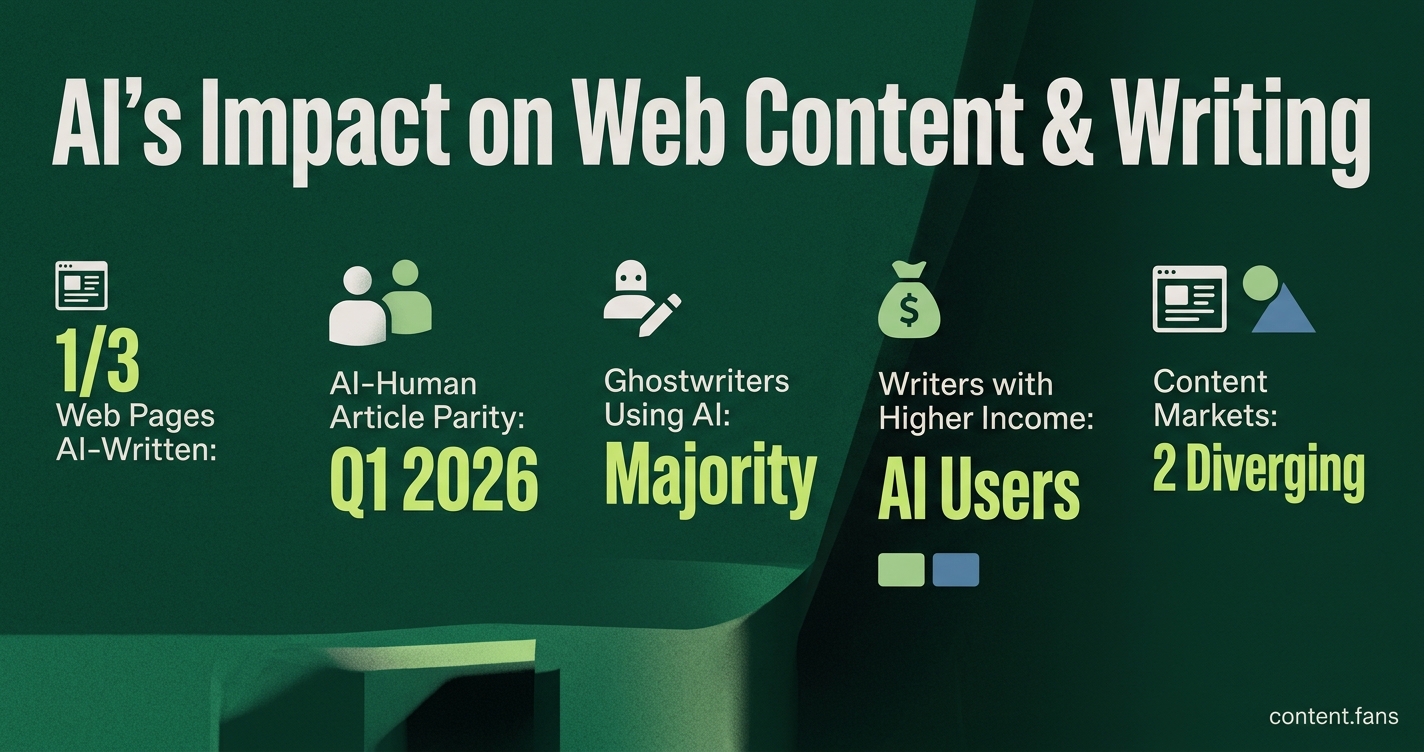
Recent studies suggest that over one-third of new web pages published since ChatGPT's launch may show signs of being written by AI, but the shift to machine-written content is uneven. Some reports indicate heavy mixing of human and AI writing rather than full replacement. Freelance writers and ghostwriters are already using AI, mostly for research and outlines, with only a small portion letting AI write full drafts. There appear to be two markets: fast, low-cost content and higher-value, trust-based writing that still demands human work. Even as automated writing grows, expert humans are still needed for projects that require trust, personality, and careful judgment.

The claim that AI writes one-third of new web pages is no longer a provocation but a data point. Recent analysis from the Pew Research Center confirms that over a third of content published since ChatGPT's debut shows AI authorship signals. Further, Graphite's running index reports AI-generated articles reached near parity with human-written articles around late 2025 to Q1 2026, with 49.9% in Q1 2026 and evidence of a plateau around 50%.
However, these statistics point to a complex, uneven shift toward automation. An Ahrefs study found that while some AI text appeared on a significant portion of new pages, only a small percentage were written entirely by AI. This indicates a widespread pattern of human-AI collaboration and content blending, rather than a wholesale replacement of human writers.
What This Means for Professional Writers
The rise of AI has created a split market for writers. While AI disrupts low-cost, high-volume content production, demand remains strong for high-value work requiring human expertise, strategic insight, and trust. Professional writers are adapting by using AI as a tool for research and drafting.
Ghostwriters and freelance creators are at the forefront of this change as clients weigh hourly rates against instant AI drafts. A 2025 survey from the Association of Ghostwriters found that a majority of its members use AI for research and outlining, but only a small percentage let it draft entire chapters. Meanwhile, a Gotham Ghostwriters study notes that writers who regularly use AI report higher average incomes, suggesting that leveraging AI as a partner for high-margin projects is a winning strategy.
Two Diverging Content Markets Emerge
- Speed-First Content: Commodity work like basic blog posts, product descriptions, and social media captions where speed and cost are primary drivers.
- Trust-First Content: High-value work such as executive ghostwriting, in-depth narrative nonfiction, and brand strategy that demands accountability and a distinct human voice.
Industry reports show downward rate pressure on speed-first content, while demand for the trust-first tier remains resilient. For example, long-form ghostwriting projects continue to grow, driven partly by author demand for human accountability following high-profile AI plagiarism controversies.
The AI Detection and Tooling Arms Race
In response to the influx of AI content, publishers and platforms are deploying stricter detection tools. Graphite, for instance, flags articles as AI-generated based on its classifier predictions of machine origin. Yet, as Pew notes, these tools identify "signals" with probabilistic certainty, not absolute proof. Consequently, writers are refining prompts, adding personal anecdotes, and using proprietary data to improve quality and comply with disclosure policies.
Establishing Ethical Guardrails for AI Content
Industry bodies are converging on core ethical principles for generative AI, including transparency, lawful data use, human review, and bias testing, as summarized in the Advertising Association's 2026 GenAI guide. Reflecting client concerns, many ghostwriters now include contract clauses specifying if and how AI will be used, making transparency a professional standard.
Outlook: The Future of AI and Human Writing
The evidence points to a split ecosystem where routine text production is increasingly automated. However, projects that hinge on credibility, personality, and nuanced judgment still place a premium on expert human authors. Writers who master AI as a powerful drafting assistant while retaining full editorial control are best positioned to command premium fees. While the web will continue to absorb machine-generated text, the value of a trusted human voice has not diminished.