
OpenAI unveils Realtime API suite for unified voice AI
Serge Bulaev
OpenAI launched the Realtime API suite in May 2026, offering three new voice intelligence models in one package. These models may make it easier for developers to add live voice features, as they combine transcription, reasoning, and speech synthesis into a single tool. Early reports suggest the APIs work quickly, support many languages, and may improve the success of voice agents, although most data comes from vendors or partners. Costs and performance might depend on how the models are set up. Analysts say the Realtime models are changing what developers expect from voice AI, but broader market validation is still ongoing.

OpenAI's launch of the OpenAI Realtime API suite around May 9, 2026, marks a significant shift for developers building live voice AI features. The new suite bundles transcription, AI reasoning, and speech synthesis into a single WebSocket endpoint, streamlining complex workflows and setting a new standard for real-time, speech-to-speech interaction.
What Is the OpenAI Realtime API Suite?
The OpenAI Realtime API suite is a unified voice intelligence platform that combines speech-to-text, AI reasoning, and text-to-speech into a single API call. It provides developers with three specialized models for building low-latency, conversational voice agents, live translation, and high-speed streaming transcription.
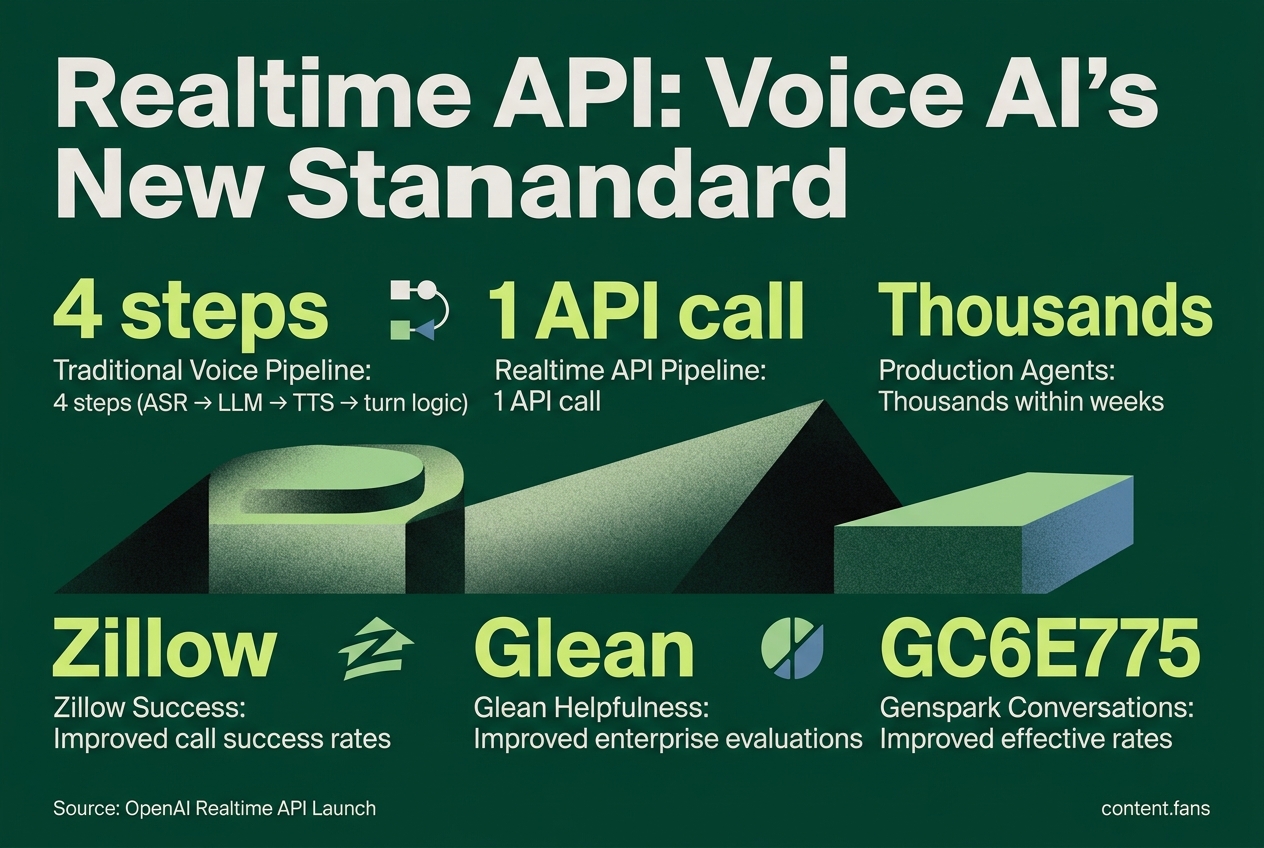
The suite collapses the traditional four-step voice pipeline (ASR → LLM → TTS → turn logic) into one API call, offering three distinct models:
- GPT-Realtime-2: Powers live audio conversations with advanced reasoning capabilities and extended context windows, with significant improvements reported on audio-reasoning benchmarks.
- GPT-Realtime-Translate: Delivers live speech translation, covering many input languages and multiple output languages.
- GPT-Realtime-Whisper: Optimized for streaming speech-to-text (STT) with a focus on achieving low end-to-end latency.
How Are Businesses Using the Realtime API?
Within weeks of its public launch, thousands of production agents were powered by the Realtime API. Enterprise adopters report significant performance improvements, highlighting the suite's immediate impact on real-world applications.
Reported Enterprise Wins:
- Zillow: Achieved substantial improvements in call success rates during adversarial tests.
- Glean: Recorded significant improvements in helpfulness during enterprise evaluations.
- Genspark: Achieved improved effective conversation rates with fewer dropped calls.
Common Use-Cases:
| Use-Case | Key Tooling Benefit |
|---|---|
| Customer Support Copilots | Native interruption and overlap handling |
| Browser "Site Navigator" Agents | Coherent long conversations via extended context |
| Voice-Powered Coding Assistants | Tool and function invocation without leaving audio mode |
What Are the Technical Benefits of the Unified Architecture?
The single-call design provides major advantages over legacy stacks that stitch together separate services for transcription, language processing, and speech synthesis.
| Legacy Stack | Realtime API Advantage |
|---|---|
| Multiple separate service hops | Low end-to-end latency |
| Voice prosody lost in ASR | Emotion and accent preserved for context |
| Requires custom barge-in logic | Built-in interruption handling |
| Multiple bills (ASR, LLM, TTS) | Single, unified usage meter |
Early adopters note that this simplified architecture can significantly reduce development lead times and, in some configurations, substantially lower operational costs compared to multi-vendor solutions (source).
How Does the Realtime API Suite Compare to Competitors?
OpenAI's native speech-to-speech design positions it against both hyperscalers and specialized voice AI providers. While competitors like Google Gemini Live and AWS Nova Sonic target similar full-duplex use cases, OpenAI's key differentiators are its unified context and native tool use.
- Architecture: The single-connection model reduces failure points compared to modular stacks like Deepgram plus ElevenLabs.
- Context Window: The extended audio context enables longer, more coherent conversations.
- Tool Use: Native tool-calling eliminates the need for external orchestration logic.
While voice specialists like Inworld AI may lead on expressive prosody, analysts position the Realtime API as a top choice for developers seeking to build and deploy robust, full-duplex agents quickly.
Key Takeaways for Developers
Early data suggests the Realtime API suite excels in applications that demand long context, rapid turn-taking, and integrated tool use. While most performance metrics currently originate from vendors and their partners, the architectural advantages are clear.
Developers can choose the model that fits their exact needs:
* Realtime-2 for complex, deep-reasoning dialogue.
* Realtime-Translate for on-the-fly multilingual support.
* Realtime-Whisper for fast, efficient text transcription.
The unified API is setting new expectations for what a voice AI service should handle out of the box, offering a powerful tool for building the next generation of conversational agents.