
OpenAI Unveils GPT-Red, an AI That Red Teams Its Own Models
Serge Bulaev
OpenAI has created GPT-Red, an AI system designed to find weaknesses in its own models by generating tricky prompts. The system is used only inside OpenAI and kept offline to prevent misuse. Early results suggest GPT-Red may find prompt-injection attacks much more successfully than humans, and it may also discover new types of attacks not seen before. OpenAI says using GPT-Red with its newer models appears to have reduced their failure rates against these attacks. The company has not shared the model or its data, and it is meant to be a safety tool, not a commercial product.

OpenAI is internally testing GPT-Red, a powerful AI that red teams its own models to discover and patch vulnerabilities. This internal-only system automates the process of finding security weaknesses by generating adversarial prompts, proving significantly more effective than human testers and uncovering novel attack methods before models are publicly released.
What is GPT-Red and how does it work?
GPT-Red is an internal OpenAI system that automates AI security testing. It uses a "self-play" method where one AI agent tries to find vulnerabilities, like prompt injections, in another AI model, which in turn learns to defend against these attacks, continuously improving its safety.
Developed specifically to attack and break other OpenAI models, GPT-Red uses self-play at frontier compute scales. The system operates on a reinforcement learning loop: an attacker agent is rewarded for provoking undesirable behavior, while a defender agent adapts to block these attempts without harming its core task accuracy. This automated arms race surfaces complex vulnerabilities like prompt injections and novel "fake chain-of-thought" tricks that human testers often miss.
How effective is GPT-Red compared to human red teamers?
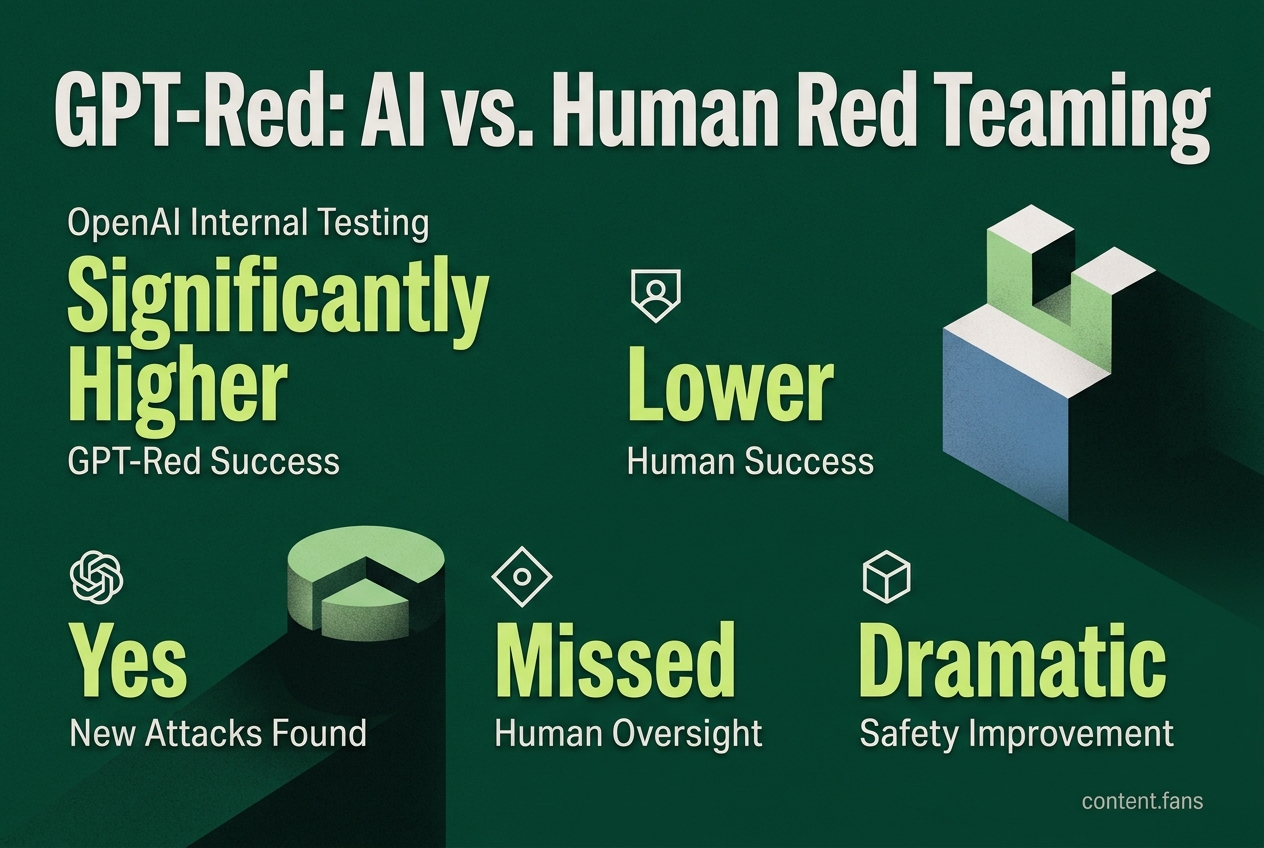
The performance gap is striking. GPT-Red demonstrates significantly higher success rates compared to expert human red teamers in identifying vulnerabilities across various testing scenarios.
Beyond just a higher success rate, GPT-Red's automated approach discovered entirely new attack classes that human testers had overlooked. The real-world impact is significant: after being hardened by GPT-Red's findings, OpenAI's models showed dramatic improvements in safety against direct injections.
Why is GPT-Red kept internal and not released publicly?
OpenAI has made GPT-Red a strictly internal tool to prevent its offensive capabilities from being misused. As a model explicitly designed to attack systems, it presents a significant dual-use risk. The same techniques that harden defenses could be weaponized by malicious actors to exploit other AI systems.
This concern is supported by research showing that automated attack methods achieve substantially higher success rates against vulnerabilities compared to manual testing approaches. Keeping GPT-Red sandboxed aligns with industry best practices for handling powerful, offensive security tools.
What does this mean for the future of AI safety evaluation?
GPT-Red demonstrates a fundamental shift in AI security, proving that safety evaluations can be scaled with compute power rather than being limited by human headcount. This addresses a critical bottleneck where model development often outpaces the capacity for manual security testing.
However, the approach has limitations. It primarily targets a specific attacker class (prompt injection) and may leave other vulnerabilities unexplored. Industry-wide, automated red teaming is becoming a continuous, mainstream workflow. Tools like Microsoft's AI Red Teaming Agent and others in the growing ecosystem of AI red teaming tools now support hundreds of attack vectors, yet the offense-defense arms race continues to accelerate.
What are the broader implications for AI development?
GPT-Red's development signals three significant shifts for the AI industry:
-
Continuous Testing is the New Standard: Security validation is moving from a pre-deployment checkpoint to an integrated part of the development pipeline. Platforms like Confident AI are combining continuous adversarial testing with full observability.
-
Increased Pressure on Disclosure Practices: OpenAI's internal-only approach limits external validation, creating tension with emerging regulatory frameworks like the EU AI Act, which demands structured transparency. A promised pre-print on GPT-Red may offer a step toward peer review.
-
The Offense-Defense Balance is Intensifying: While GPT-Red demonstrates defensive value, the automation it represents also enables more sophisticated attacks. This dynamic favors well-resourced organizations that can implement hybrid red-teaming and sandboxing, potentially widening the security gap between industry leaders and smaller operators.