
OpenAI Unifies Codex and ChatGPT, Shifts to Single AI Platform
Serge Bulaev
OpenAI has combined Codex and ChatGPT into a single AI platform, so users can access both code and chat features through one API and purchase. This change may make it easier for companies to manage contracts and for developers to use AI in their workflows. Early signs suggest that users like having coding and chat tools together, and some companies may have seen faster work as a result. However, there are still questions about safety, control, and whether this approach will work for all types of businesses. Experts say it is too early to know if the new system will be a complete success.

OpenAI's move to unify Codex and ChatGPT into a single AI platform is a strategic realignment, not just a branding update. This consolidation merges the specialized Codex models for coding with the versatile ChatGPT interface, simplifying access for all users through a single API and purchasing model.
The decision signals a broader strategy to create a cohesive ecosystem that integrates consumer products, developer tools, and enterprise services through a unified, agent-native interface.
Why OpenAI collapsed two surfaces
OpenAI consolidated its platforms to create a unified API, streamlining development and simplifying enterprise contracts. This integration allows shared data feedback loops, model upgrades, and safety systems between its coding and chat models, reducing operational overhead and accelerating the development of more advanced, agent-native AI capabilities.
According to industry reports, the company has outlined its vision for a unified agent-native API surface, enabling developers to access reasoning, tool use, and multimodal functions from one endpoint. Consolidating products also simplifies enterprise procurement, as large customers can now negotiate a single contract covering all features.
While the API documentation may still list separate model names, developers are guided toward higher-level tools like the Responses API and Agents SDK. These abstractions mask the underlying model - whether language, code, or multimodal - powering a specific task.
Early signals from enterprises and developers
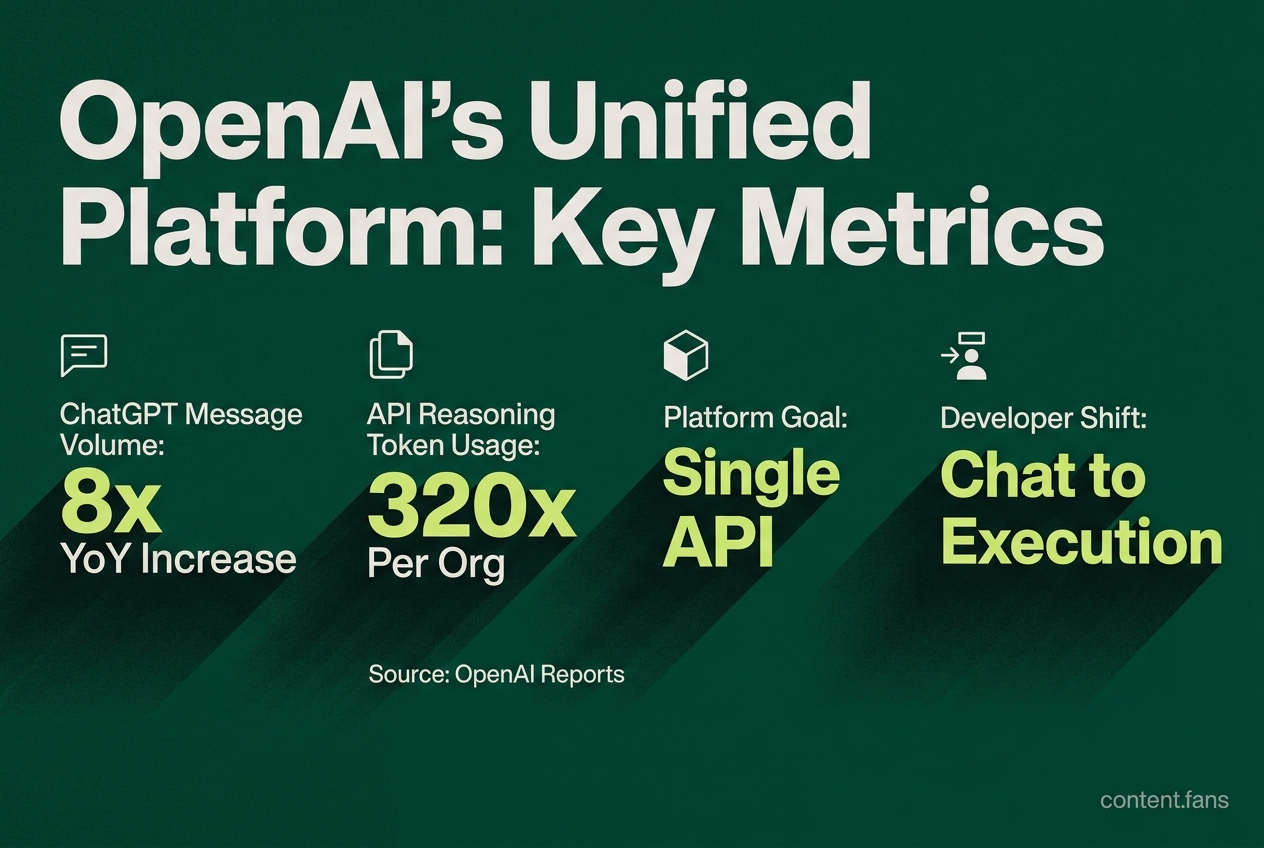
Early data suggests the unified platform is gaining traction. OpenAI reports an 8x year-over-year increase in ChatGPT message volume and a 320x rise in API reasoning token usage per organization, suggesting strong enterprise adoption of the combined workspace (next phase of enterprise AI page). Many enterprises are reporting significant improvements in development workflows after transitioning to the integrated environment.
Developer feedback reflects a similar trend. Community discussions show a move away from simple code completions toward complex, agentic workflows that can generate, test, and refactor code within a sandboxed environment. This represents a shift from "chat" to "execution," where the AI operates across longer, more persistent tasks with human oversight.
To facilitate this transition, OpenAI provides key building blocks for developers:
- Agents SDK: For orchestrating complex, multi-step tasks.
- Responses API: For enabling structured data returns and function calls.
- AgentKit: For providing templates to govern workflow automation.
These tools encourage the integration of AI into repeatable, automated processes instead of relying on one-off prompts.
Competitive ripples
The consolidation has prompted responses from competitors, each leveraging their unique strengths. Google is focusing on distribution by integrating its Gemini AI across Android and Workspace. Anthropic is positioning Claude as a trusted alternative for regulated industries, emphasizing safety and policy controls. Meanwhile, open-weight models like Meta's Llama offer greater flexibility, challenging OpenAI's platform-centric approach.
While integrating coding and chat capabilities strengthens OpenAI's competitive advantage, it also raises new questions. Enterprises appreciate the simplified billing, but their platform teams are demanding stronger governance controls, as the unified agent can access documents, write code, and execute actions in a single session.
In response to regulatory concerns about auditability in the US and Europe, OpenAI has enhanced its enterprise tier with more detailed usage logs and approval workflows. The effectiveness of these controls will be critical in determining if the unified platform can scale from limited pilots to core business integration.
The Path Forward
While a final verdict on the platform's success is premature, early indicators are positive. Strong adoption metrics, favorable case studies, and the competitive landscape suggest the unified model successfully reduces friction for newcomers and increases engagement for current users. However, long-term growth will hinge on managing costs, ensuring robust safety protocols, and maintaining developer trust.