
OpenAI integrates Codex into ChatGPT, plans unified "superapp"
Serge Bulaev
OpenAI plans to combine Codex and ChatGPT into a single product, creating one interface that can chat, write code, and run tasks. Reports suggest this move aims to make things easier for users and reduce the need to switch between different tools. Some experts warn that this change might make it harder to switch away from OpenAI's platform. The exact timing of the release is still unclear, but the new "superapp" could arrive soon. Whether this superapp becomes the main tool for companies and developers may depend on its price and how well it works compared to competitors.

Recent reports confirm that OpenAI integrates Codex into ChatGPT, moving toward a single, unified "superapp" for conversation, coding, and task execution. This consolidation is more than a feature update; it signals a strategic shift to a streamlined user experience that could reshape how developers and enterprises engage with AI. The merger promises tighter API integration, unified billing, and a single governance layer, but industry observers also raise concerns about potential vendor lock-in.
Why OpenAI says a single agent matters
The move is driven by internal findings that the Codex model excels at general knowledge work, not just coding. By merging it with ChatGPT, OpenAI aims to leverage its most powerful technology across all productivity tasks and reduce friction for users navigating separate product offerings.
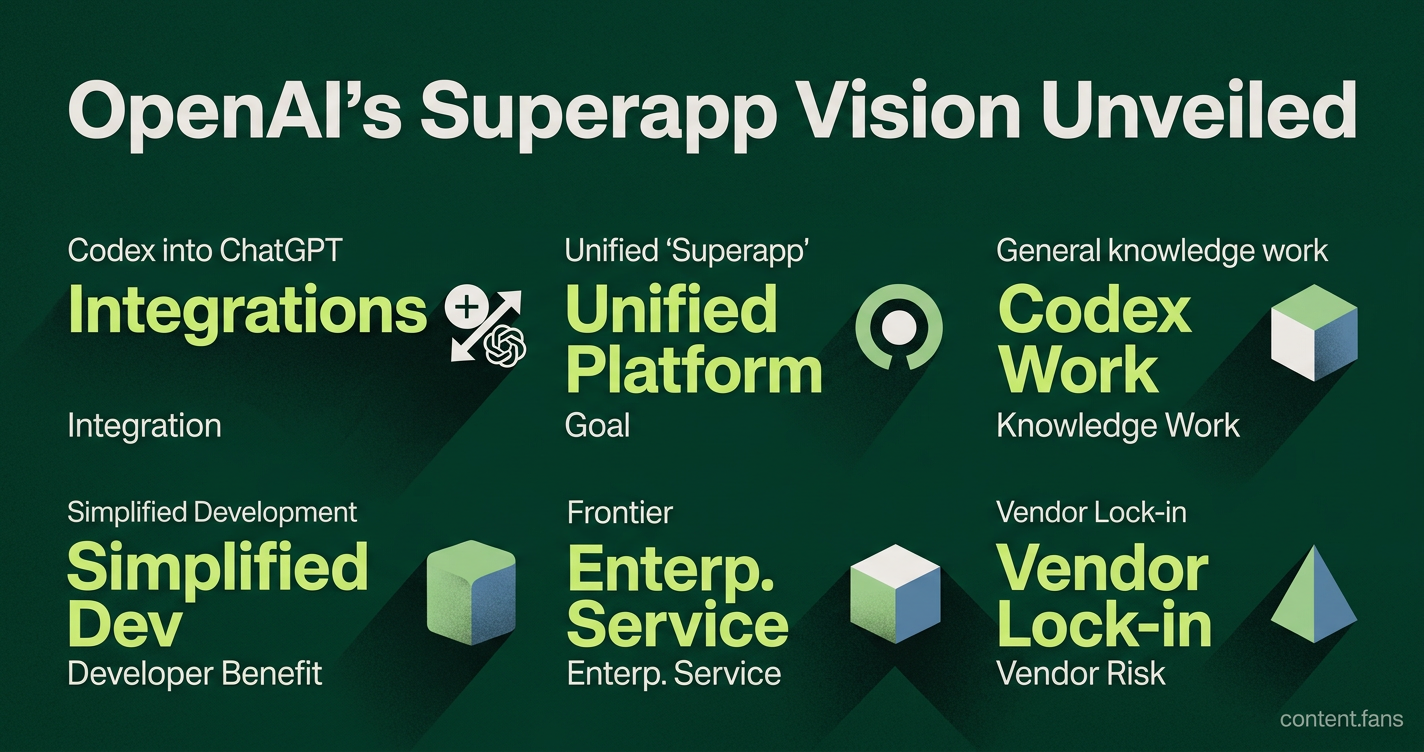
According to reporter Stephanie Palazzolo, OpenAI leaders found that the software behind Codex is "actually much better" for tasks like drafting emails and editing spreadsheets (YouTube interview). The company's goal is a single "superapp" combining chat, code, and workflow execution to eliminate product silos (analysis). This vision positions a "unified AI superapp" as the primary hub for both individual and enterprise users, built on the "Frontier" intelligence layer (OpenAI blog). This approach suggests the unified agent will become the standard interface for all users.
Developer workflow and billing shifts
For developers and IT teams, the consolidation is expected to bring significant changes:
- Simplified Development: A reduction in overlapping SDKs will likely speed up integration testing.
- Predictable Costs: A single pricing model is expected to replace separate tiers for Codex and ChatGPT, making cost forecasting easier.
- Centralized Governance: A unified console for permissions and guardrails could streamline audits, though it may also increase dependency on the platform.
This aligns with reports on OpenAI's Frontier service, which aims to provide a shared control plane for managing all AI agents. This suggests a move toward centralizing security, administration, and compliance management.
Risks and open questions
Despite the benefits, industry analysis from firms like Portkey.ai and Ancher.ai highlights the risk of increased platform dependence. A deeply integrated, all-in-one stack makes migration to other providers more complex and costly. Furthermore, the consolidation does not eliminate underlying implementation challenges, as enterprises must still manage data access policies and human-in-the-loop reviews.
The exact release timing is still unconfirmed. While reports in early June suggested the desktop superapp would ship "in the upcoming weeks," the integration remains imminent but not yet available to the public.
Competitive backdrop
This strategic consolidation is widely seen as OpenAI's answer to competitors who are also creating integrated AI offerings. While Google DeepMind embeds Gemini into its Workspace suite and Anthropic promotes its safety-first Claude models, OpenAI is leveraging its mature ecosystem to provide a broad, all-in-one solution. Competitors, however, continue to differentiate with features like larger context windows or more stringent safety controls.
Ultimately, the decision for developers and IT leaders will involve a trade-off between the convenience of a unified platform and the flexibility of specialized tools. The success of the merged Codex-ChatGPT product will hinge on its pricing, the quality of its governance tools, and its speed to market.
What exactly is changing in OpenAI's product lineup?
OpenAI is consolidating Codex and ChatGPT into one product instead of maintaining separate code-generation and chat interfaces. OpenAI planned to combine Codex and ChatGPT into a unified desktop experience described as a 'super app,' with Codex integrated into ChatGPT in the following weeks. Users who currently toggle between apps will find one unified interface powered by a shared account and single billing plan.
Why is Codex being moved from a standalone tool to an integrated feature?
The reported point is that Codex was being positioned as useful for broader productivity tasks beyond coding, with integration into ChatGPT intended to bring those capabilities into a general work interface. Folding Codex into ChatGPT therefore lets OpenAI leverage its strongest model across the entire productivity spectrum without forcing users to learn multiple products.
How will the new unified platform affect developer workflows?
Developers should expect fewer API surfaces and clearer integration paths:
- A single Frontier layer will govern all agent behavior, making it easier to orchestrate chat and coding tasks in one flow.
- Unified billing and model access eliminate the need to juggle separate ChatGPT and Codex quotas.
- Teams already using OpenAI tooling will see closer coupling between consumer and enterprise SDKs, reducing fragmentation in release cycles (Milik.ai analysis).
The trade-off is an increased risk of vendor lock-in, as migration away from a deeply integrated stack becomes harder.
What competitive advantages does this give OpenAI versus Google DeepMind and Anthropic?
| Competitor | OpenAI's new edge |
|---|---|
| Google DeepMind | While Google offers tight Workspace integration, OpenAI's merged Codex + ChatGPT delivers a cross-platform desktop super app that is not locked to one productivity suite. |
| Anthropic | Anthropic wins on safety, but OpenAI now provides one-stop agentic workflows that simplify adoption for both consumer and enterprise buyers. |
| Analyst consensus places OpenAI ahead in distribution breadth after the consolidation, with the new interface potentially accelerating user growth by reducing the cognitive overhead of choosing between tools (Gapper.io summary). |
When can users expect the integrated experience to roll out?
According to industry reports, Codex functionality will be inserted into the ChatGPT app everywhere within weeks. The "super app" desktop release was planned for the following weeks, suggesting early adopters should see the transition in the near term, with mobile updates following shortly after.