
OpenAI Codex tops 5M weekly users, expands into knowledge work
Serge Bulaev
OpenAI says Codex now has more than 5 million weekly users, a big increase since February. About 20 percent of users may be knowledge workers, not just developers. Codex is being used for more than just coding, as it is now part of many business tools and workflows inside ChatGPT. Studies suggest it might boost productivity for both developers and business users. It appears that more companies are starting to use Codex regularly, but it is not certain if the high growth will continue.

OpenAI Codex is experiencing significant growth in weekly active users, marking a dramatic expansion from a developer-centric tool to a versatile knowledge-work platform. As adoption accelerates, its integration into ChatGPT business workflows is reshaping how teams approach tasks far beyond coding.
Explosive User Growth in 2026
Industry reports suggest a steep adoption curve for Codex. According to various sources, weekly users have shown substantial growth throughout the year (Panto AI). This rapid expansion, combined with reports that enterprise usage has grown significantly since January, highlights sustained momentum among both developers and business users.
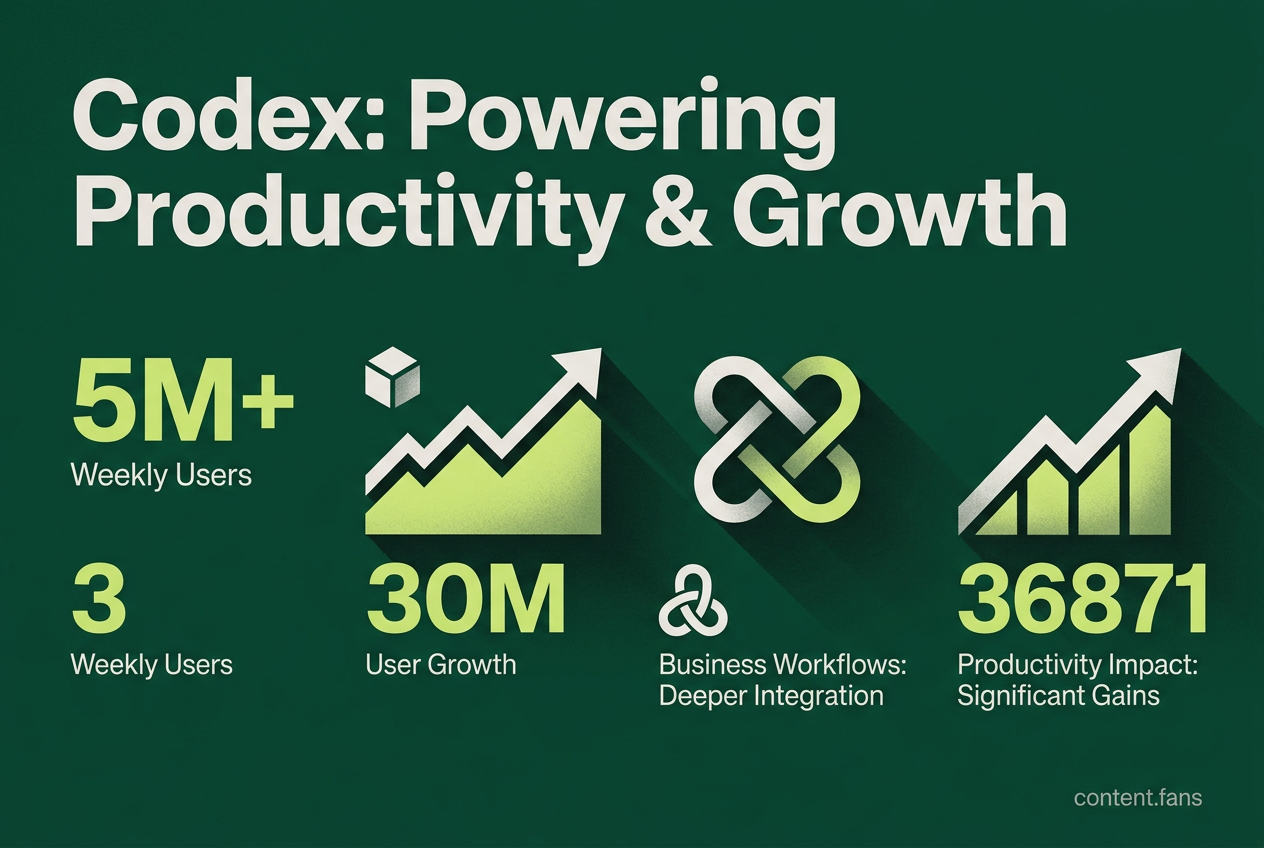
OpenAI's Codex has seen substantial growth in weekly active users, driven by both developers and a growing cohort of knowledge workers. This expansion reflects the tool's evolution from a specialized coding assistant into a broader workflow automation layer integrated within ChatGPT for business applications.
Deeper ChatGPT Integration Unlocks Business Workflows
OpenAI is embedding Codex directly into the ChatGPT Business ecosystem to automate professional tasks. Recent release notes detail several key enhancements, including a new desktop app for Windows and macOS, a curated directory of plugins for specific industries, and write-enabled actions for Microsoft and Google applications.
Available plugins bundle reusable workflows, including:
- Finance and public-equity analysis skills
- Banking data connectors
- Sales pipeline automations
- App integrations with Google Sheets write access
The notes confirm that an updated model is being tested as the default for code review and cloud tasks, with local execution available via the CLI and IDE extensions.
Quantifying the Productivity Impact on Knowledge Work
The expansion of Codex is backed by studies showing significant efficiency gains. While developers remain the core user base, a growing portion of weekly users are now non-coders. Research validates this trend: industry studies suggest that LLM assistants can substantially increase developer productivity. Similarly, research from leading institutions indicates AI-assisted developers spend more time on core coding and less on project management tasks.
For business roles, new write-enabled features in productivity suites could deliver comparable benefits. Citing earlier research, economic studies suggest generative AI could save workers significant time per week, potentially boosting aggregate productivity. This suggests Codex's expansion beyond pure coding could unlock similar efficiencies in documentation, email, and data analysis.
How fast has Codex adoption accelerated this year?
Industry reports suggest Codex has seen substantial growth in weekly developers throughout the year, and enterprise usage has grown significantly since January. The speed of that jump illustrates how quickly teams are moving from pilot to daily use.
What share of Codex users are knowledge workers rather than coders?
Industry data suggests a significant portion of weekly activity comes from non-coding knowledge workers - analysts, researchers, finance staff, and product managers who use the tool for data pulls, memo drafting, spreadsheet automation, and similar tasks. The remainder are engineers applying Codex inside IDEs, CLIs, and now the ChatGPT web interface.
How is Codex being woven into ChatGPT?
A new Codex app for Windows and macOS lets teams run isolated coding agents, review diffs, and manage long-horizon tasks from a command center inside ChatGPT Business workspaces. Reusable "skills" and plugins bundle Google Docs, Sheets, Outlook, and calendar actions so the same agent that writes code can also draft follow-up emails or update project trackers.
Which professional workflows get dedicated plugins?
According to industry reports, finance, public-equity research, sales CRM, and banking ops are among the first vertical packs being developed. For example, a banking plugin can pull live market data into a risk model, while a sales plug-in can auto-draft personalized outreach from CRM notes and recent earnings calls.
Where is productivity impact most visible so far?
Industry studies suggest substantial coding-speed improvements when staff use LLM assistance, with significant gains coming from generated code. Separately, economic research indicates generative AI can save substantial work hours across knowledge roles, translating to meaningful time savings per work week and a modeled boost in aggregate productivity.