
General Compute Raises $15M, Launches ASIC Cloud to Rival GPUs
Serge Bulaev
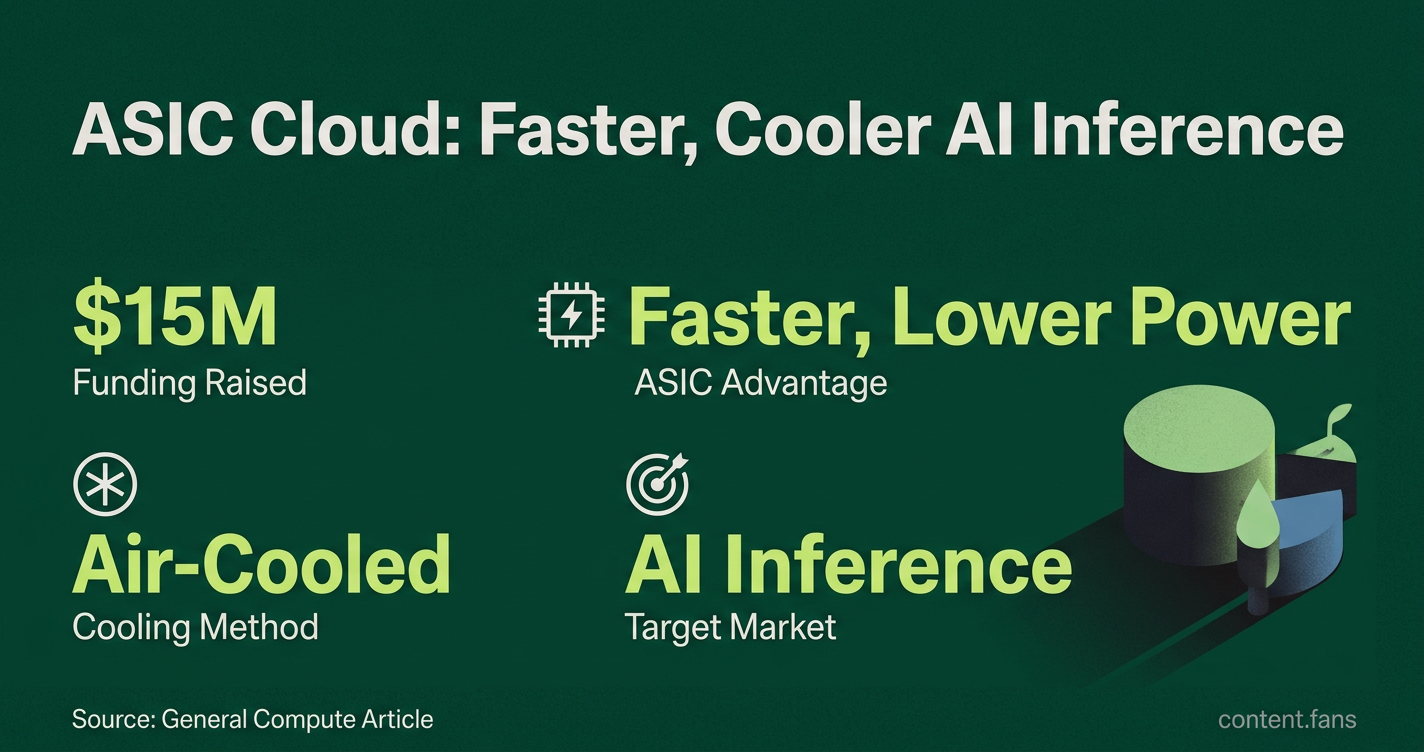
General Compute has raised $15 million to build a cloud service using special ASIC chips that may run large language models faster and with less power than regular GPUs. The company claims its new chips, made by SambaNova, can process data up to three times faster than leading GPUs and work with regular air cooling, which might save money. Some early tests suggest up to 16 times shorter runtimes on certain models, but independent proof is still needed. Experts think that while GPUs might still be better for some tasks, ASICs could soon be used for faster, energy-saving work. It remains to be seen if General Compute's service can reliably scale and compete as more results and customer feedback come in.

Startup General Compute has secured $15M to launch its ASIC cloud, a new service aiming to rival GPUs for AI inference workloads. The company's promise hinges on a single claim: purpose-built silicon can serve large language models (LLMs) faster and with lower power than today's data-center GPUs. According to industry reports, the funding came via two rounds: a $3M pre-seed and a $12M seed, culminating at a significant post-money valuation. With its "General Compute Cloud" now available, the team is betting that throughput and energy efficiency will define the future of the AI inference market.
Strategic Investor Backing
General Compute provides cloud-based access to Application-Specific Integrated Circuits (ASICs) for running AI models. This specialized hardware is designed to perform AI inference tasks, such as powering large language models, more quickly and with lower energy consumption compared to general-purpose GPUs from vendors like NVIDIA.
The funding round structure reflects growing investor interest in specialized AI infrastructure, with participation from multiple venture capital firms focused on AI hardware and infrastructure investments. The inclusion of limited partners from established AI infrastructure companies signals confidence from those already familiar with the specialist silicon market.
A Bet on SambaNova ASICs and Air Cooling
The capital supports a substantial purchase order for SambaNova SN50 chips. According to vendor specifications, these ASICs deliver competitive performance on frontier models compared to leading GPU benchmarks. Crucially, the SN50 cards are air-cooled, allowing deployment in standard racks without costly liquid-cooling retrofits. The company has begun deploying its first clusters commercially.
Stated Performance Advantages:
* Significantly shorter runtimes on select LLMs (internal testing)
* Higher tokens per second than comparable GPU servers on SN50 silicon
* Air-cooled operation in standard racks (no new HVAC spend)
ASIC vs. GPU: The Broader Market Context
While independent benchmarks for General Compute are pending, the performance claims align with industry trends for specialized silicon. According to industry reports, benchmarks on similar hardware have shown substantially higher throughput and significantly better performance-per-watt than traditional GPU solutions. Experts believe that while GPUs will retain an edge for flexible model training, ASICs are poised to capture a significant share of latency-sensitive inference workloads in the coming years.
The Competitive Landscape for AI Silicon
General Compute enters a competitive field. It faces startups like Cerebras, Graphcore, and Intel's Habana Labs, all offering cloud-accessible accelerators. It also competes indirectly with hyperscalers like Google (TPU), AWS (Trainium), and Meta (MTIA), which deploy their own custom silicon. This crowded market suggests General Compute's success will depend on its full-stack software integration and ability to deliver predictable, low-latency performance, not just on raw hardware specs.
Key Milestones to Watch
The industry will be watching for several key indicators of General Compute's viability. These include the release of third-party benchmarks confirming performance claims, publication of customer reference workloads, and a potential Series A funding announcement. Most critically, proof that its air-cooled ASIC clusters can scale without thermal throttling will determine if the substantial hardware investment can translate into sustainable revenue.
What is General Compute's ASIC cloud and how does it differ from GPU-based solutions?
General Compute has developed what it calls the world's first ASIC-native neocloud, purpose-built for AI inference rather than adapted from general-purpose graphics hardware. Unlike GPU clouds that rely on NVIDIA's flexible but power-hungry architectures, General Compute's stack uses application-specific integrated circuits (ASICs) designed exclusively for running large language models.
The key distinction lies in specialization. GPUs handle many computational tasks well; ASICs do one thing exceptionally. For inference workloads - the actual running of trained AI models - this translates to dramatically faster processing and substantially lower energy consumption. The company represents a significant investment in challenging GPU dominance in the AI infrastructure market.
How much funding has General Compute raised and who are its investors?
According to industry reports, General Compute has secured funding across multiple rounds, with participation from venture capital firms focused on AI infrastructure. The investor roster includes strategic players with deep AI infrastructure experience, reflecting investor confidence in specialized inference hardware. The company has transitioned from development to commercial deployment of its General Compute Cloud platform.
What performance claims does General Compute make compared to GPU clouds?
The company claims its ASIC cloud runs frontier LLMs significantly faster than standard GPU clouds while maintaining substantially higher energy efficiency. These claims align with broader industry trends for ASIC inference performance. According to industry reports, specialized inference chips have demonstrated substantially higher throughput than traditional GPU deployments on large language models, with significantly better performance per watt.
General Compute's specific implementation uses SambaNova SN50 chips capable of competitive token generation speeds compared to GPU deployments. The architecture targets latency-sensitive workloads including coding agents, voice AI, and autonomous systems where response speed directly impacts user experience.
Why does air-cooled deployment matter for data center economics?
Air-cooled infrastructure represents a significant operational cost advantage. Traditional GPU clusters require extensive liquid cooling and specialized HVAC systems, driving up both capital expenditure and ongoing energy costs. General Compute's ASICs run cool enough for standard air-cooled data centers, eliminating the need for expensive infrastructure overhauls.
This matters because cooling typically accounts for a substantial portion of data center energy consumption. By deploying in existing facilities without new cooling infrastructure, General Compute can offer competitive pricing while maintaining margins. The approach also enables faster geographic expansion - the company can leverage underutilized data center capacity rather than building from scratch.
Who are General Compute's main competitors in the ASIC cloud space?
The competitive landscape spans hyperscaler custom silicon and specialized ASIC startups. Direct competitors include:
- Groq - Already offers LPU-based inference cloud with verified speed advantages
- SambaNova Systems - Provides DataScale 2 accelerators with programmable efficiency
- Cerebras - Wafer-scale single-chip solutions for massive models
Hyperscalers present indirect competition through their own ASICs: Google's TPU v7 (Ironwood), AWS Trainium 3, Microsoft's Maia 200, and Meta's MTIA v4. These are generally restricted to each platform's ecosystem, whereas General Compute offers multi-tenant cloud access.
According to industry reports, NVIDIA's inference market share faces growing competition as specialized silicon proliferates. General Compute's positioning as an independent, ASIC-native cloud provider - rather than a GPU reseller or single-vendor shop - distinguishes it in a market increasingly fragmented by workload specialization.