
Google Cloud report: AI agents shift business focus to orchestration, governance
Serge Bulaev
The Google Cloud 2026 AI Agent Trends Report suggests that businesses are moving away from single prompt AI and toward agent-based systems that require careful orchestration and strong governance. Many executives believe that using AI agents may improve productivity and free up staff for more creative work, with about half expecting agents to handle most customer support in the near future. The report highlights the need for strict security and control measures, like identity checks and circuit breakers, to avoid unauthorized access. It also notes a possible shift in skills, with less demand for prompt engineers and more focus on designing overall agent systems. While the exact pace of change is uncertain, the study hints that companies are starting to view AI agents as an essential part of how they are organized, not just a new tool.

A Google Cloud report shows how AI agents shift business focus to orchestration and governance, moving enterprises beyond simple prompts. This transformation, based on the Google Cloud 2026 AI Agent Trends Report, signals a fundamental change in how work is organized, with orchestration and governance emerging as the critical success factors.
Below are five essential questions organizations should address as they navigate this transition.
What exactly is changing with AI agents in 2026?
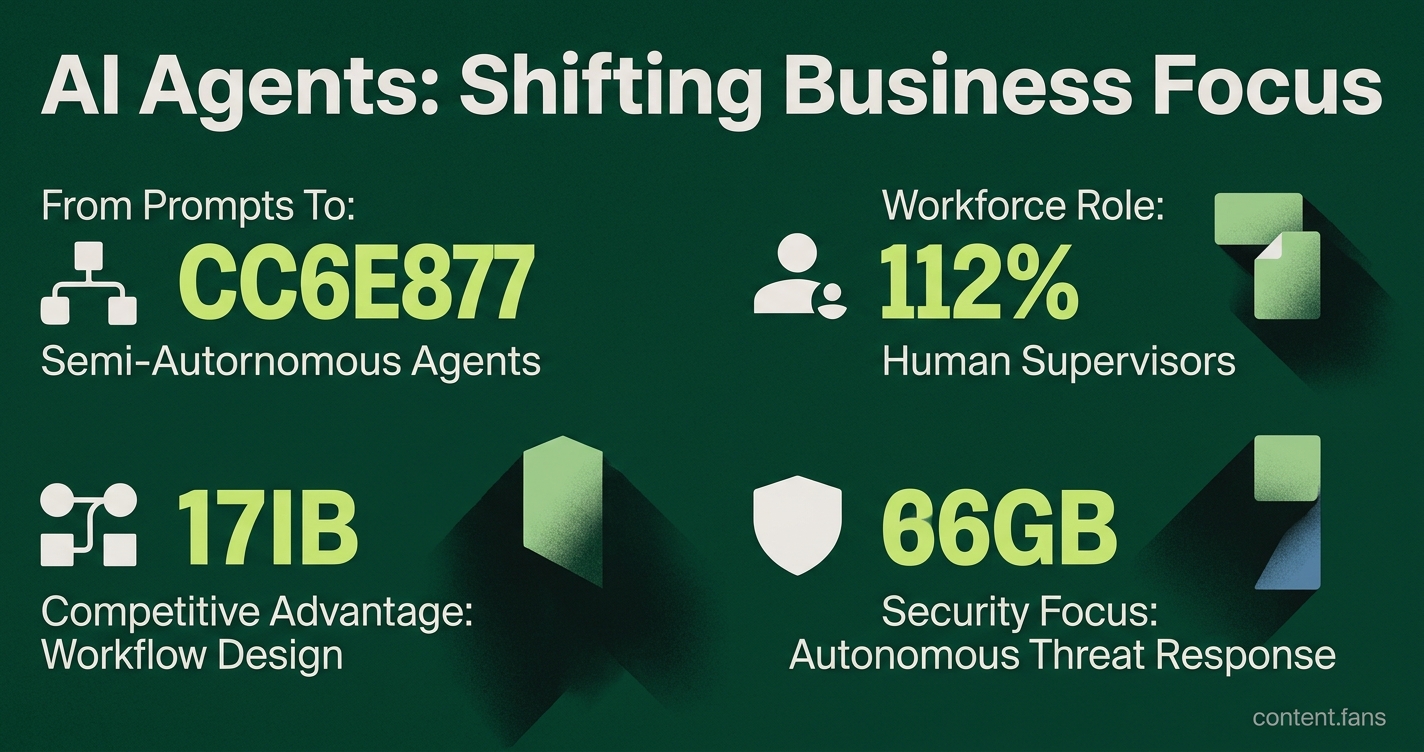
Businesses are moving from single-instruction AI to semi-autonomous agents that operate on intent. This requires a new focus on managing, or orchestrating, these systems and implementing strong governance to control them, shifting competitive advantage from AI model choice to effective workflow design and integration.
The era of simple prompt-based workflows is effectively over. Where businesses once focused on crafting the perfect instruction to an AI, the new standard involves semi-autonomous agents that operate through intent-based computing rather than explicit commands.
Industry trends illustrate the momentum:
| Metric | Finding |
|---|---|
| Time savings | Organizations report significant efficiency gains across code generation, research, documentation, and planning tasks |
| Strategic work | A growing number of organizations expect agents to free employees for more creative and strategic priorities |
| ROI validation | Many early adopters already see positive returns in at least one use case |
| Complex projects | A significant portion plan to move beyond simple automation to sophisticated AI initiatives in 2026 |
The workforce itself is transforming, as every employee becomes a "human supervisor of agents," delegating execution while focusing on judgment and innovation.
What are the five major shifts businesses need to prepare for?
The Google Cloud report identifies five interconnected transformations:
1. Agents for Every Employee
Workers transition from doing tasks to orchestrating agents - managing digital assistants that handle research, scheduling, documentation, and preliminary analysis.
2. Agents for Every Workflow
The rise of the "digital assembly line" - grounded agentic systems that run complex business processes end-to-end, integrating previously siloed functions into seamless sequences.
3. Agents for Your Customers
Evolution from scripted chatbots to "agentic concierges" that remember interaction history, anticipate needs, and execute secure transactions with appropriate human pre-approval.
4. Agents for Security
Security Operations Centers shift from alert-watching to autonomous threat response - agents that identify, assess, and remediate risks in real-time.
5. Agents for Scale
The upskilling imperative: as the half-life of professional skills shrinks, organizations must build "agent orchestrators" capable of managing, governing, and scaling these capabilities responsibly.
These trends are detailed in the report and its corresponding video synopsis on YouTube.
Why is orchestration more important than the underlying AI models?
Competitive advantage in 2026 comes not from model selection but from workflow design. The report emphasizes that workflows now matter more than models for achieving business impact.
This reflects a broader industry evolution from Prompt Engineering to Context Engineering and Process Engineering. Success depends on:
- Designing the AI's environment (tools, memory, data access)
- Building effective multi-step agent collaboration
- Enabling agent-to-agent communication protocols
The foundational protocols enabling this include emerging standards for cross-platform coordination, secure data grounding, and autonomous commerce integration.
Organizations that master orchestration will outperform competitors that may have superior models but inferior integration.
What governance framework should enterprises implement?
Effective AI agent governance lifecycle management requires treating agents as autonomous principals with distinct identities and documented lifecycles. A practical 90-day implementation roadmap includes:
Days 1-30: Discovery & Inventory
- Establish a centralized agent registry documenting every agent's purpose, owner, data scope, and platform.
- Conduct Shadow AI audits to identify unsanctioned deployments.
- Assign clear organizational accountability.
Days 31-60: Identity & Control
- Deploy Non-Human Identity (NHI) management with unique credentials per agent.
- Enforce least-privilege access with dynamic templates.
- Stand up MCP gateways with deny-by-default policies.
Days 61-90: Observability & Certification
- Implement behavioral monitoring with 90-day retention minimum.
- Encode governance as Policy as Code for automated enforcement.
- Build circuit breakers to prevent failure-state loops.
- Map compliance to ISO 42001 and NIST AI RMF frameworks.
Ongoing practices include quarterly governance reviews, red-team testing of guardrails, and explicit agent retirement protocols that mirror employee offboarding procedures.
How should organizations reinvest AI agent ROI?
Smart reinvestment transforms initial efficiency gains into sustainable competitive advantage. Leading practices include:
The Innovation Fund Model
Allocate a significant portion of agent-driven cost savings to a dedicated fund for scaling high-performing use cases, upgrading security infrastructure, and training staff on emerging risks.
GAUGE Scoring
Measure agent performance quarterly using the GAUGE framework, targeting score improvements of approximately 5 points per quarter. Flat scores indicate under-resourced improvement efforts.
Pay-for-Performance Structure
Tie agent budgets to verified business outcomes, reinvesting only when agents meet defined performance thresholds.
Continuous Learning Loop
Feed incident insights back into governance policies through automated compliance checks, reducing future costs and improving returns over time.
The businesses that thrive will be those treating governance not as a compliance burden but as a strategic enabler - building the orchestration capabilities that allow them to deploy agents faster, more safely, and at greater scale than competitors.