
Okta's Q1 Revenue Jumps 11% Amid Agentic AI Identity Demand
Serge Bulaev
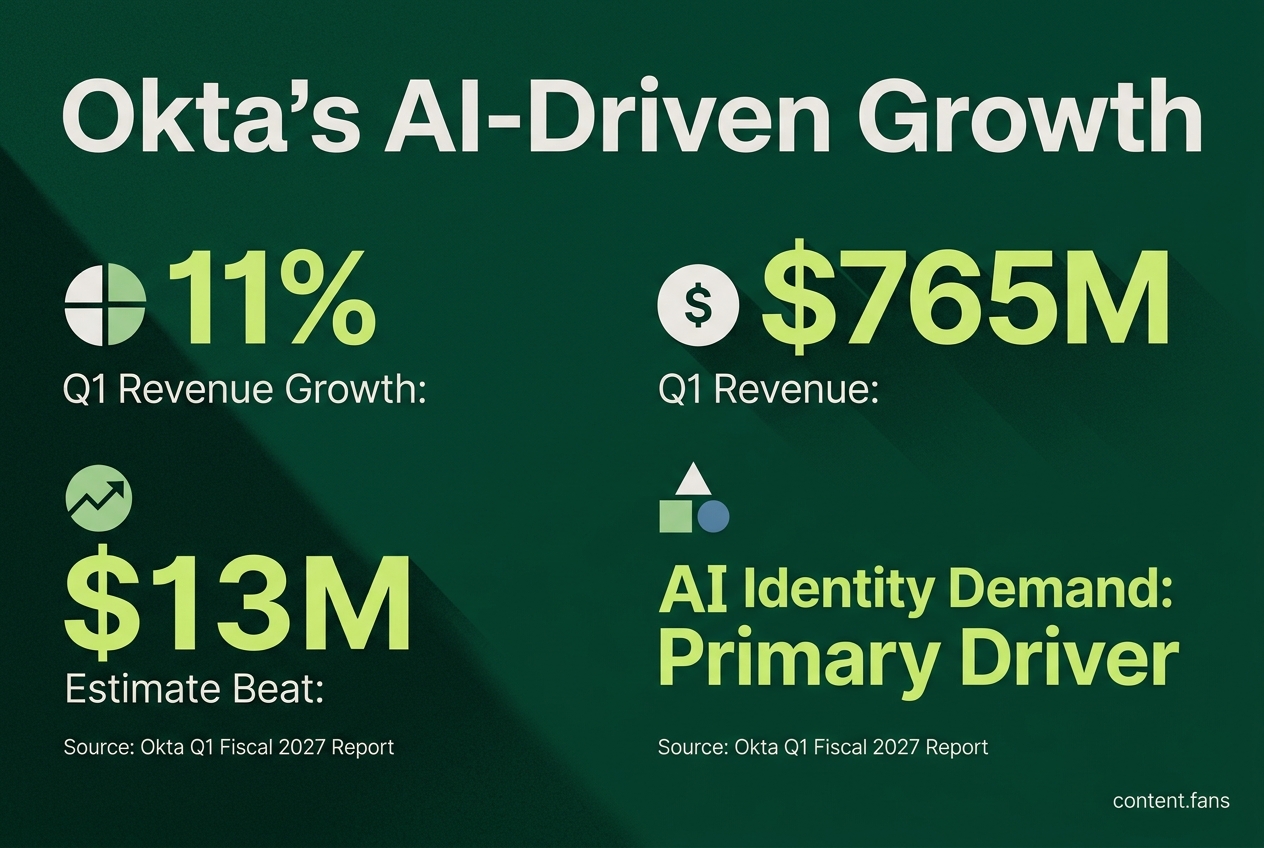
Okta's Q1 revenue rose 11% to $765 million, which beat expectations. Company leaders said this growth may be due to more companies using identity tools for AI agents. Reports suggest that businesses are spending more on systems that manage non-human identities, as AI agents are becoming more common. Some experts suggest that identity checks and real-time monitoring are becoming basic needs as AI agents interact with company data. It appears that while Okta is growing in this area, the overall market competition has not shifted much yet, and traditional factors like cost and integration still matter most.

Okta reported Q1 fiscal 2027 revenue of $765 million, up 11% year over year, and management said agentic AI expansion is driving demand for its identity solutions. Beating consensus estimates of $752 million, the news sent OKTA shares higher in after-hours trading. This growth indicates a clear trend: as companies deploy autonomous AI agents, they are prioritizing identity platforms capable of governing non-human entities at machine speed.
Agentic AI Emerges as a Primary Growth Driver
Okta's revenue growth stems from enterprises requiring robust identity solutions to manage autonomous AI agents. These systems demand advanced security for non-human entities, driving spending on platforms that can provide continuous authorization, detailed audit trails, and machine-speed governance for this new class of identities.
Okta executives directly connected the revenue beat to enterprise projects requiring persistent identities for software agents. Legacy Identity and Access Management (IAM) systems were not designed for this shift, with industry reports highlighting that many organizations lack confidence in older controls for managing agentic AI. The growing scale of non-human identities, which can significantly outnumber human employees according to industry analysis, creates another pressure point. This forces a move away from periodic reviews toward automated discovery, credential rotation, and continuous authorization.
Identity: The New Control Plane for AI Agents
As AI agents gain direct access to production data, traditional security perimeters dissolve, making identity the primary enforcement layer. According to analysts at KuppingerCole, this shift establishes continuous verification, least-privilege access, and auditable ownership as baseline requirements. Consequently, enterprises are prioritizing IAM tools that can:
- Issue unique, time-bounded credentials for each agent.
- Maintain a complete audit trail linking every action to a human owner.
- Enforce just-in-time (JIT) access over standing privileges.
- Monitor agent behavior in real time and automatically revoke access when risk is detected.
In response, vendors are embedding IAM capabilities directly into AI frameworks. AWS's AgentCore, for example, integrates session management and identity orchestration, signaling a potential market shift toward embedded controls over standalone IAM products.
Okta's Growth in a Competitive Landscape
Despite the new demand from AI, the competitive landscape for IAM remains intense. Market guides still position Microsoft Entra ID as a dominant alternative, particularly in Microsoft-native environments. Other key players include Ping Identity for hybrid deployments and SailPoint and Saviynt for specialized governance use cases. Notably, traditional factors like cost, integration capabilities, and governance features still heavily influence purchasing decisions. This suggests the agentic AI trend has not yet fundamentally altered the competitive dynamics, but Okta's strong Q1 results prove that governing non-human identities is a powerful, immediate growth opportunity.
What drove Okta's Q1 revenue surge beyond consensus estimates?
Okta's Q1 revenue reached $765 million, an 11% increase that surpassed analyst expectations. This growth was primarily fueled by surging demand for identity security for agentic AI. As enterprises deploy autonomous systems, they require advanced platforms to manage non-human identities, machine-speed access, and continuous authorization. Industry reports note that many organizations lack confidence in their legacy systems for this task, driving adoption of modern solutions.
Why are agentic AI projects creating an identity security urgency?
Agentic AI systems operate autonomously, initiating actions without direct human intervention. This requires that each agent has a unique, verifiable identity with strictly scoped permissions and time-bounded access. With research showing that non-human identities can significantly outnumber human ones in enterprise environments, organizations that don't manage them as first-class identities risk:
- Lack of accountability: Inability to trace which agent accessed specific data.
- Excessive permissions: Agents retain broad access long after a task is complete.
- Compliance and audit failures: Inability to prove who authorized an action.
How did the market react to Okta's results?
The market responded positively, with OKTA shares rising in after-hours trading. This reflects strong investor confidence in companies providing essential AI security infrastructure. Analysts increasingly see identity management not as a simple cost, but as a strategic control plane for autonomous systems, a view that is boosting valuations for vendors with robust IAM offerings.
Is the agentic-AI identity boom unique to Okta?
No, the trend is sector-wide. Major competitors like Microsoft Entra ID, Ping Identity, and SailPoint are also seeing increased demand for agent lifecycle management and non-human identity governance. Okta, however, often serves as a benchmark due to its extensive integration ecosystem and deep governance features. While competitors may offer lower-cost solutions, Okta's strengths in policy enforcement and privileged access give it an edge in complex enterprise environments.
What new capabilities are enterprises asking from IAM vendors?
Enterprise buyers are now prioritizing IAM features specifically for managing autonomous agents. Key capabilities on 2026 roadmaps include:
- Automated agent onboarding and offboarding workflows.
- Runtime continuous authorization to evaluate permissions for every action.
- Delegated ownership chains to link every agent's action back to a human approver.
- Behavioral analytics to detect anomalous agent activity and revoke access instantly.
- A universal control plane to manage humans, applications, and all non-human identities from a single console.