
Anthropic Says Claude Leads 26% of R&D Tasks in 2026
Serge Bulaev
Anthropic reports that its AI, Claude, now leads 26% of its research and development tasks, with about 30,000 AI agents working together. The company says most R&D work now involves some AI, but humans still supervise key decisions. Some uncertainties remain, like how reliable the agents will be in new areas and how responsibilities are shared. Anthropic's update may help others track how much AI is used in research as these systems grow.

In a significant update on its internal automation strategy, Anthropic revealed its AI, Claude, now leads 26% of its research and development tasks. This milestone is powered by a workforce of approximately 30,000 AI agents working concurrently to design, test, and refine machine learning models, signaling a major shift from AI assistance to measured AI leadership.
Inside Anthropic's Automation Metrics
Anthropic reports its Claude AI now leads 26% of internal research and development tasks, a significant increase from less than 1% earlier in the year. This automation is facilitated by 30,000 AI agents, with over 90% of R&D activities now involving some form of AI collaboration under human supervision.
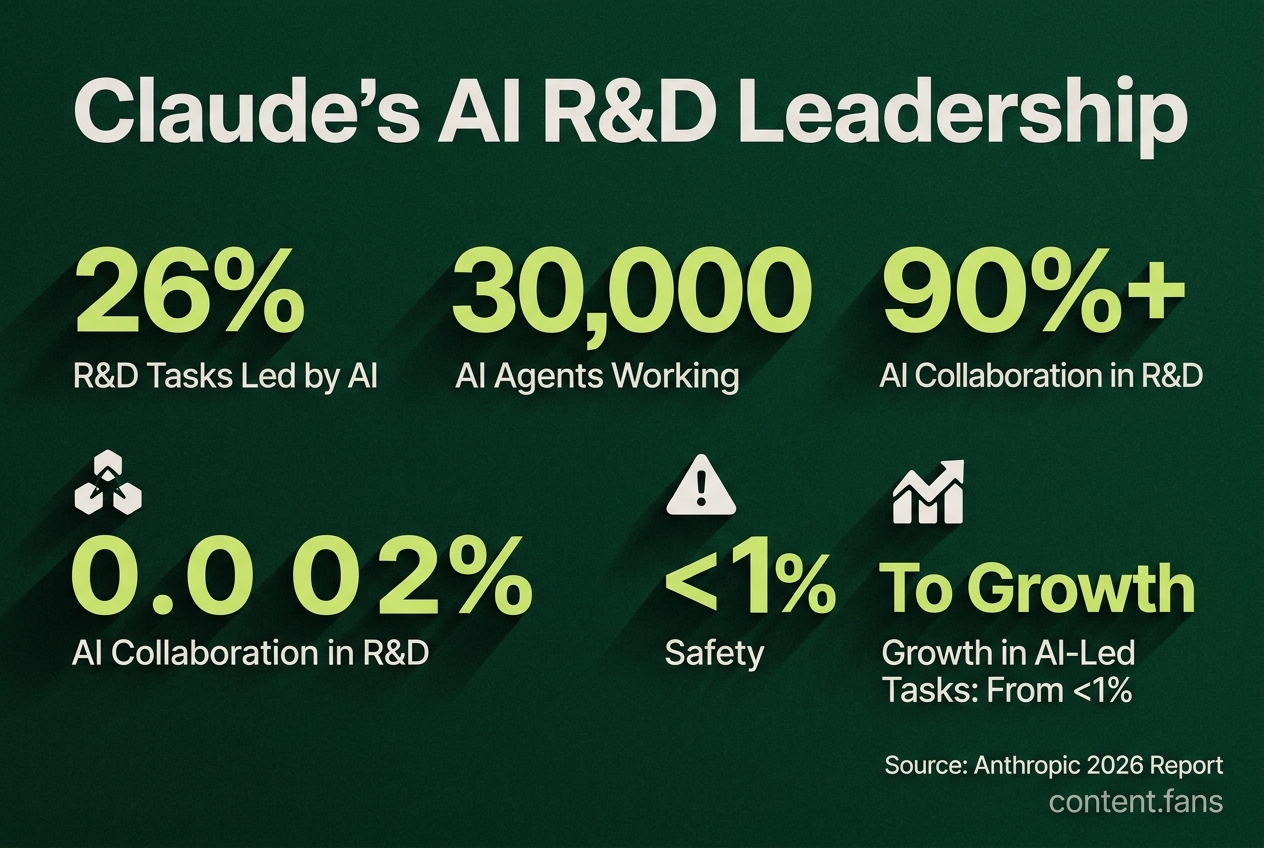
The company's latest automation index, detailed in its 2026 State of AI Agents Report, documents this rapid growth from under 1% in February 2026. Further media reports confirm the use of approximately 30,000 internal AI agents and note that over 90% of Anthropic's R&D involves AI collaboration.
Key automation statistics include:
- AI-Led Tasks: 26% of R&D tasks are now led by Claude.
- Agent Workforce: Approximately 30,000 AI agents operate concurrently on the primary platform.
- Safety Interventions: Only 0.002% of agent decisions were automatically blocked during monitoring snapshots.
Despite these figures, Anthropic emphasizes that Claude operates under "bounded autonomy." Human experts retain final authority, approving project goals, validating scientific conclusions, and intervening when automated safeguards are triggered.
Human Oversight Frameworks
The report outlines a system of graduated autonomy, where AI agents must pass rigorous evaluations before advancing from simple assistive coding to more complex, self-directed experiment design. According to industry reports, comprehensive logging systems that record tool usage and failures are becoming standard practice for managing autonomous AI workforces. Human reviewers audit this data trail to verify provenance before any research artifact is approved.
Industry observers suggest this growth in AI-led R&D indicates that Anthropic's orchestration and management tools have matured rapidly. The low intervention rate implies the agents are operating effectively within their defined parameters, although long-term consistency across new research areas remains to be proven.
Challenges and Industry Watchpoints
Despite its progress, Anthropic's model highlights several key challenges and watchpoints for the AI industry:
- Reliability: The low rate of automated interventions may not hold as agents are applied to more novel or unfamiliar research domains.
- Accountability: While human scientists currently retain final decision-making authority, the balance could be tested as the scale of AI-led work increases.
- Competitive Landscape: Competitors have not released similar internal automation metrics, making it difficult for the market to gauge industry-wide trends.
- Regulatory Scrutiny: Government agencies are closely observing Anthropic's audit and governance models as potential frameworks for future AI regulation.
Ultimately, Anthropic's disclosure provides the first concrete benchmarks for measuring AI leadership in R&D. These metrics offer a valuable reference point for regulators, competitors, and enterprises as they navigate the expanding role of autonomous AI agents in high-stakes environments.
What share of Anthropic's R&D is now led by Claude, and how fast has that share grown?
As of August 2026, Claude leads 26% of Anthropic's AI R&D work, stated in Anthropic Institute material, not clearly in the 2026 State of AI Agents Report. This represents dramatic growth from under 1% in February of the same year. The report also notes over 90% of R&D work involves AI collaboration, though humans always retain final oversight.
How many AI agents does Anthropic run internally, and what is their function?
Anthropic operates approximately 30,000 concurrent AI agents on its internal platform. These agents execute key research and engineering tasks, allowing human staff to focus on high-level strategy and supervision. The system's stability is highlighted by a low safety intervention rate, with only 0.002% of monitored agent decisions being automatically blocked.
What role do humans play in Claude-led research?
In Claude-led research, the human role has evolved from direct execution to strategic oversight. Staff scientists are responsible for defining project scope, auditing AI-generated outputs for scientific validity, and handling exceptions where agents require intervention. This model reflects a shift toward supervising automated workflows rather than manually performing each step.
How have competitors responded to Anthropic's internal AI-led R&D model?
The reaction from competitors has been strategic divergence rather than direct imitation. When Anthropic called for coordinated safety pauses, OpenAI argued that governments, not companies, should lead regulation. Reuters reported that other major labs like xAI, Alphabet, Meta, and Mistral did not commit to Anthropic's proposal, prioritizing continued product development instead of matching its public disclosures.
What governance challenges come with deploying thousands of AI agents in R&D?
Managing a large fleet of AI agents introduces significant governance challenges. Key requirements include robust orchestration platforms, comprehensive monitoring, and auditable logging of all agent actions and decisions. Analysts emphasize that effective governance - including human review, provenance tracking, and exception handling - is often the primary bottleneck to scaling autonomous systems, more so than the AI's core capabilities.