
New Toolkit Helps Companies Audit AI Hiring Tools for Compliance
Serge Bulaev
Regulators around the world appear to be increasing rules on AI hiring tools, with fines that may be significant for companies that do not comply. A new toolkit offers checklists and templates that might help teams audit these tools for bias and ensure they follow different laws. The toolkit groups tasks such as legal checks, bias testing, data privacy, and human oversight, and suggests using a detailed scorecard to evaluate AI vendors. It also provides sample contract clauses to support transparency and regular audits. This toolkit may help companies keep better records and meet requirements that could vary by country or region.

To navigate the complex landscape of AI regulations, companies must audit their AI hiring tools for compliance and bias. With regulators imposing steep fines - NYC Local Law 144 penalties are up to $1,500 per violation, and EU AI Act fines for serious infringements can reach up to 7% of total worldwide annual turnover - proactive governance is essential. This guide provides the frameworks and artifacts needed to vet vendors and build a defensible compliance strategy, addressing the patchwork of laws requiring bias audits, transparency, and human oversight.
Checklist for AI Hiring Compliance and Bias Mitigation
Comprehensive AI audits typically involve bias testing, legal compliance review, transparency measures, and data governance. While specific frameworks vary, organizations commonly focus on several key areas to ensure regulatory alignment.
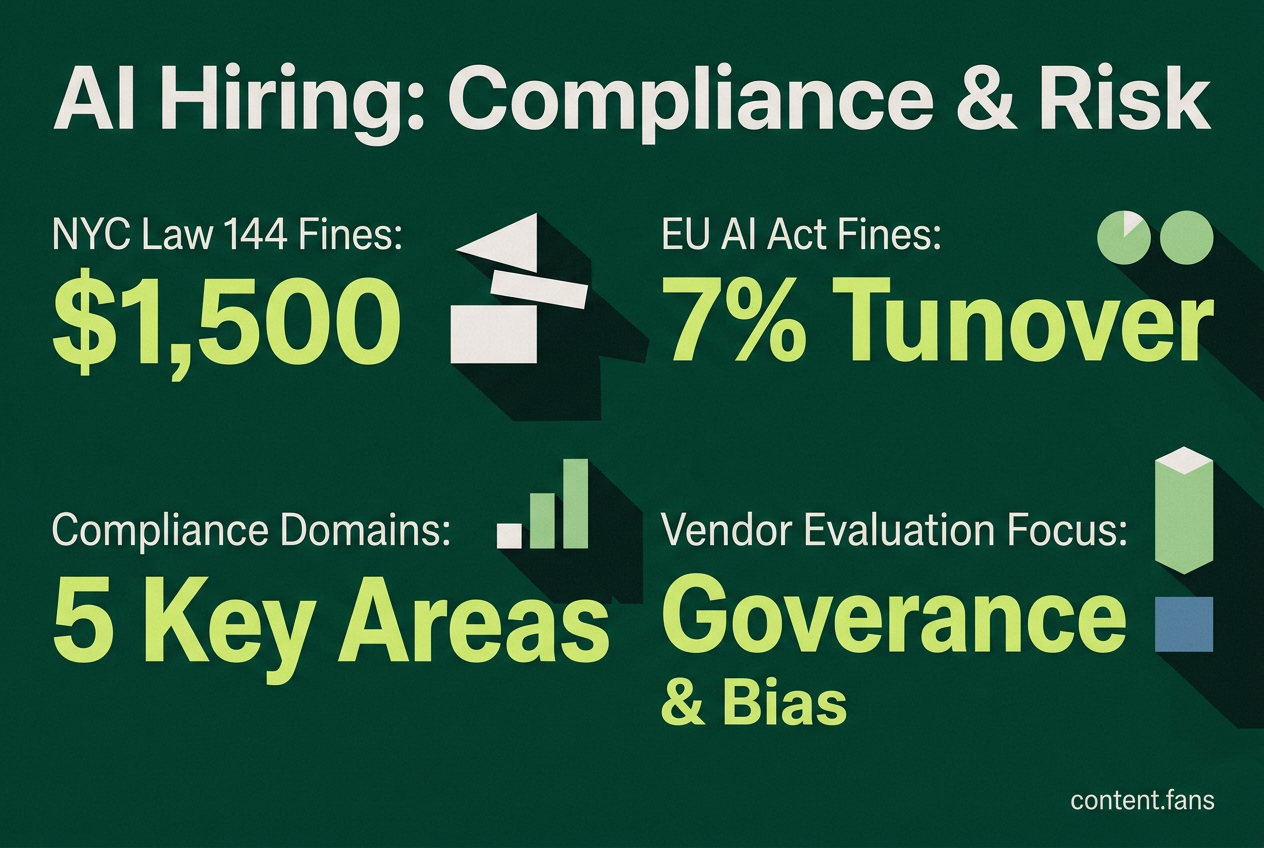
The downloadable toolkit groups essential tasks into relevant compliance domains:
- Legal Alignment: Inventory all Automated Employment Decision Tools (AEDTs), map them to jurisdictional laws, and flag high-risk applications as defined by regulations like the EU AI Act.
- Bias Auditing: NYC Local Law 144 mandates calculating 'impact ratios' (selection/scoring rates) for protected categories, perform statistical validation with appropriate methods, and schedule the annual independent reviews required by applicable laws.
- Candidate Transparency: Develop plain-language notices that detail the AI's data inputs, scoring logic, and the candidate's right to request human review before an evaluation is finalized.
- Data Governance: Verify data protection under GDPR or relevant state privacy laws, enforce clear data retention limits, and maintain active audit logs for all candidate records.
- Human-in-the-Loop Controls: Mandate that trained human reviewers have final override authority, aligning with standards like California's oversight requirements.
Teams can use the pre-filled spreadsheet or import the JSON schema into existing risk-register software to streamline documentation.
Vendor Evaluation Framework and Contractual Safeguards
When selecting vendors, procurement teams can use structured evaluation approaches to prioritize compliance. Industry reports suggest that governance and bias controls represent a significant portion of evaluation criteria, emphasizing that managing regulatory risk is often more critical than product features.
Vendor evaluation for AI tools typically considers validity, fairness, and transparency across multiple dimensions including predictive validity, fairness tooling, transparency, platform capabilities, candidate experience, and implementation support. To aid this process, it includes sample RFP language, such as requiring vendors to provide an exportable rationale for every ranking decision.
To address gaps found during evaluation, the toolkit provides model contractual clauses to build into vendor agreements:
- Algorithmic Transparency: Mandate that vendors provide clear explanations for all AI-driven decisions and prohibit the use of opaque "black-box" models.
- Continuous Bias Monitoring: Require vendors to deliver a remediation plan within a fixed timeframe if adverse impact is detected when selection rate ratios fall below standard thresholds.
- Independent Audit Rights: Secure the right for the client to engage third-party auditors with full access to the vendor's code and system logs.
- Data Portability: Ensure that upon contract termination, all candidate records can be exported in a machine-readable format without incurring extra fees.
- Mandatory Human Review: Prohibit any automated job offer or rejection until an authorized team member has reviewed and confirmed the AI's recommendation.
These resources include a companion bias-audit template that simplifies the calculations and significance testing needed for public disclosures. Teams can integrate these artifacts directly into onboarding playbooks, internal wikis, and vendor management systems.
What regulations should companies prioritize when auditing AI hiring tools in 2026?
Organizations face a patchwork of overlapping regulations that vary dramatically by jurisdiction. In the United States, New York City Local Law 144 requires annual independent bias audits and public disclosure of results, with penalties up to $1,500 per violation. Various state laws mandate candidate consent for AI-analyzed video interviews and explicitly ban discriminatory proxies like ZIP codes. Colorado's AI Act demands annual impact assessments for employers with many employees, while California's SB 53 requires meaningful human oversight with authority to override AI decisions - carrying potential fines up to $20,000 per applicant.
For global organizations, the EU AI Act classifies hiring AI as "high-risk," with compliance requirements and penalties that can reach significant percentages of annual turnover for serious infringements. Regardless of specific jurisdiction, several core obligations apply widely: candidate notification before AI evaluation, annual bias audits, public disclosure of audit results, human-in-the-loop controls, and direct employer accountability (vendors cannot absorb liability).
How should teams conduct effective bias audits beyond basic compliance checks?
Modern bias auditing has evolved from point-in-time checks to continuous monitoring workflows. Standard metrics for adverse impact analysis examine whether demographic groups' selection rates fall below established thresholds, triggering investigation for potential discrimination.
However, leading organizations now implement regular intersectional audits examining proxy variables that correlate with protected demographics, such as ZIP codes that map to racial composition. Statistical validation through appropriate tests identifies significant score distribution differences unexplained by legitimate job factors.
Critically, teams must deploy automated adverse impact calculators that trigger alerts when candidate pools drop below thresholds, enabling detection of model drift before it becomes an enforcement action. Technical teams should generate model cards - structured documentation detailing dataset provenance, performance across subgroups, and known limitations - as standard audit artifacts.
What contractual protections should procurement teams negotiate with AI hiring vendors?
Contracts must transcend standard data privacy clauses to embed algorithmic accountability. Essential provisions include: independent audit rights allowing third-party validation of models and training data; explainability mandates requiring human-understandable rationale for every AI decision with exportable artifacts; and bias remediation timelines committing vendors to specific response periods when disparities emerge.
Data portability clauses ensure talent pools and tracking records can exit without fees or technical barriers. Human-in-the-loop requirements should explicitly prohibit fully automated rejection or offer decisions. Finally, vendors must warrant compliance with EEOC guidelines and specific state laws like NYC Local Law 144 and Illinois BIPA, with immediate notification obligations for regulatory changes affecting model operation.
How can organizations ensure genuine transparency with candidates about AI use?
Transparency obligations now extend well beyond generic disclosure. Candidates must receive clear notification before AI evaluation explaining specifically how tools work, what data is analyzed, and how decisions are made. Best practice includes offering human review options for adverse automated decisions, with staff empowered and trained to override AI recommendations.
Organizations should verify that AI systems can provide decision explanations - specific rationale for individual scores - rather than opaque outputs. This capability supports both regulatory compliance and candidate trust. Documentation of transparency protocols, including sample notifications and escalation procedures, should be maintained as part of audit-ready compliance records.
What evaluation frameworks help procurement teams compare AI hiring vendors meaningfully?
Industry reports suggest that governance and bias controls represent a significant portion of vendor evaluation criteria, displacing traditional metrics like time-to-hire. Comprehensive approaches score vendors across: integrations, data readiness, governance and security, fairness and bias monitoring, explainability, workflow fit, adoption speed, security certifications, and ROI evidence from pilots.
Alternative evaluation methods assess predictive performance validation, fairness mechanisms, compliance transparency, platform capabilities, candidate experience quality, and implementation support. Regardless of framework, evaluation should prioritize audit log completeness for every candidate decision, willingness to share bias testing methodologies, and demonstrated remediation responsiveness when disparities appear across demographic groups.