
Moonshot AI unveils Kimi K3, a 2.8T-parameter model with 1M-token context
Serge Bulaev
Moonshot AI has announced the Kimi K3 model, which uses 2.8 trillion parameters and can handle up to one million tokens at a time. The model may be the first in its size class with open weights, though these weights are expected to be released publicly on July 27. K3 appears to outperform other models on coding tasks but is slightly behind on some office-related tasks and reasoning benchmarks. Running K3 will likely require large GPU clusters, and the cost per task is lower than some competitors. Experts suggest K3 could become important for research, but its real impact depends on how accessible it is after the weight release, and some adoption questions remain.
Kimi K3 is a 2.8T-parameter MoE model with a 1M-token context window, released July 16, 2026, currently accessible via API and apps; full open weights are scheduled for July 27, 2026. The model can process text and images, demonstrating powerful capabilities before its weights become public.
Kimi K3: Technical Specifications and Architecture
Kimi K3 is a 2.8 trillion-parameter Mixture-of-Experts model from Moonshot AI featuring a one-million-token context window. It processes both text and visuals, positioning it as a frontier model for complex tasks. Its full weights are slated for public release according to industry reports.
Benchmark Performance
On industry benchmarks, Kimi K3 establishes itself as a top-tier performer, particularly in coding domains. According to industry reports, it performs competitively against leading models, with its specialized engineering prowess evident in several key tests:
- SWE Marathon: 42.0
- Program Bench: 77.8
- DeepSWE: 67.5
- FrontierSWE: 81.2
- Terminal-Bench 2.1: ≈88.3
These results place Kimi K3 ahead of closed competitors on multiple coding tasks, though it remains slightly behind on office workflows like OfficeQA Pro.
Cost and Hardware Requirements
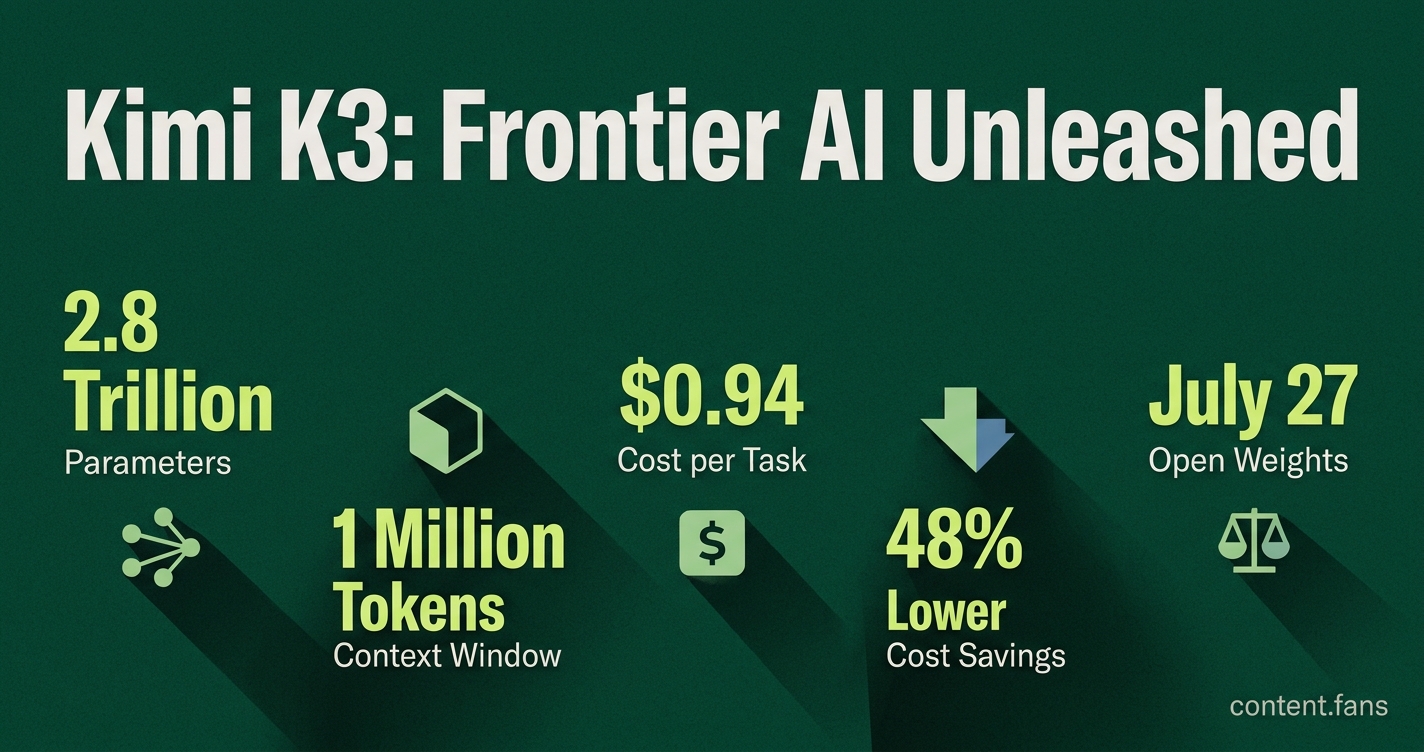
Despite its massive scale, Kimi K3 is positioned as a cost-effective solution. Kimi K3 costs $0.94 per Intelligence Index task, which is 48% lower than Opus 4.8 ($1.80), and the comparison includes GPT-5.6 Sol ($1.04) and Fable 5 ($2.75) as well. However, deploying the model locally is a significant undertaking according to industry reports; its weight package demands substantial GPU infrastructure. API access is currently priced at $3 per million input tokens.
Open-Weight Release and License
Moonshot AI has committed to a public release of Kimi K3's weights by July 27, 2026. According to industry reports, the model will be available through major platforms. If this schedule holds, analysts believe K3 could become a foundational model for open research, though its ultimate influence hinges on the practical accessibility of its weights.
Industry Implications
The arrival of Kimi K3 signals a potential narrowing of the gap between proprietary and open-source frontier models. Its ability to compete closely with the best closed systems, combined with a vast context window, could unlock new workflows for long-horizon research and coding. However, its significant hardware requirements and performance gaps in certain reasoning tasks mean its long-term adoption patterns are still uncertain.
What is Kimi K3 and when did Moonshot AI release it?
Moonshot AI launched Kimi K3 on July 16, 2026, positioning it as a large open-weight AI model with 2.8 trillion parameters. The model features native vision capabilities and a 1,000,000-token context window - enabling it to process approximately 750,000 words or entire large codebases in a single pass. Moonshot AI has committed to publishing the full model weights by July 27, 2026, making it a significant addition to openly available models.
How does Kimi K3 perform compared to leading closed models like Claude Fable 5 and GPT-5.6 Sol?
K3 ranks second only to Claude Fable 5 and GPT-5.6 Sol on company testing, outperforming on Frontend Code Arena but trailing on general benchmarks.
What makes Kimi K3's architecture technically distinctive?
Two novel mechanisms enable K3 to deploy its massive scale practically:
- Kimi Delta Attention (KDA): A hybrid linear attention mechanism delivering faster decoding at 1M-token contexts with significant KV-cache memory reduction
- Attention Residuals: Selective pulling of representations from earlier blocks, yielding training efficiency gains with minimal extra compute overhead
These innovations translate to better compute-to-intelligence conversion compared to Kimi K2.6. The model uses Mixture-of-Experts architecture with 896 experts and 16 active per token, employing MXFP4 4-bit quantization to manage its total size.
What are the cost and deployment implications of Kimi K3?
Kimi K3 offers substantial cost advantages over proprietary alternatives:
- Indexed cost: $0.94 per Index task vs. $1.80 for Claude Opus 4.8
- Pricing is $3 input/$15 output per million tokens; cost per task is ~$0.94 vs Opus 4.8's $1.80
However, deployment requires substantial GPU infrastructure according to industry reports. This infrastructure requirement means most users will initially access K3 via API or wait for the July 27 weight release to explore self-hosting options.
What real-world applications does Kimi K3 enable that were previously impractical?
The 1-million-token context window combined with native vision unlocks several frontier capabilities:
- Entire codebase reasoning: Hold large amounts of code in context to write coordinated changes across large repositories without losing track of dependencies
- Visual software engineering: Combine screenshots with code for frontend debugging, game development, and CAD workflows
- Long-horizon autonomous agents: Execute sustained engineering tasks with minimal supervision, coordinating terminal tools, debugging, and iterating against logs/tests
- Deep document analysis: Process complete technical libraries, legal contracts, or research corpora in single sessions
These capabilities represent a shift from "competitive" open-source AI to genuinely frontier-capable open intelligence.