
Meta unveils custom AI chip, targets 14 GW compute by 2027
Serge Bulaev
Meta plans to start making its new AI chip, called Iris, in September 2026, and aims to reach 14 gigawatts of computing power by 2027. Meta may spend $40 billion to expand its Louisiana data center, more than doubling its capacity. The company's in-house chips could make it less dependent on other suppliers, but it might still need to buy some parts. Meta has hired an AWS executive to help build its new cloud service, Meta Compute, which may let other companies use Meta's AI power. Experts say Meta's fast chip release schedule could affect supplies for others, but it is not certain if Meta can keep up with rising energy needs.

Following news that Meta is unveiling its custom AI chip, new details show the company will target substantial compute expansion by 2027. An internal memo outlines plans for its "Iris" AI processor to enter production in September 2026, part of a strategy that includes Meta's plans to deploy 7 gigawatts of computing infrastructure in 2026 and double total capacity to 14 gigawatts by 2027 globally, with projected AI infrastructure spending of up to $145 billion in 2026. These moves signal a coordinated effort to vertically integrate hardware and power supplies, positioning Meta to sell surplus capacity through a proposed Meta Compute cloud service.
Inside the Iris program
Meta is developing a custom AI chip, codenamed "Iris" (MTIA 400), to reduce its reliance on external suppliers like Nvidia and control its hardware roadmap. Production is set to begin in September 2026, with an aggressive six-month refresh cycle planned to support its massive infrastructure needs.
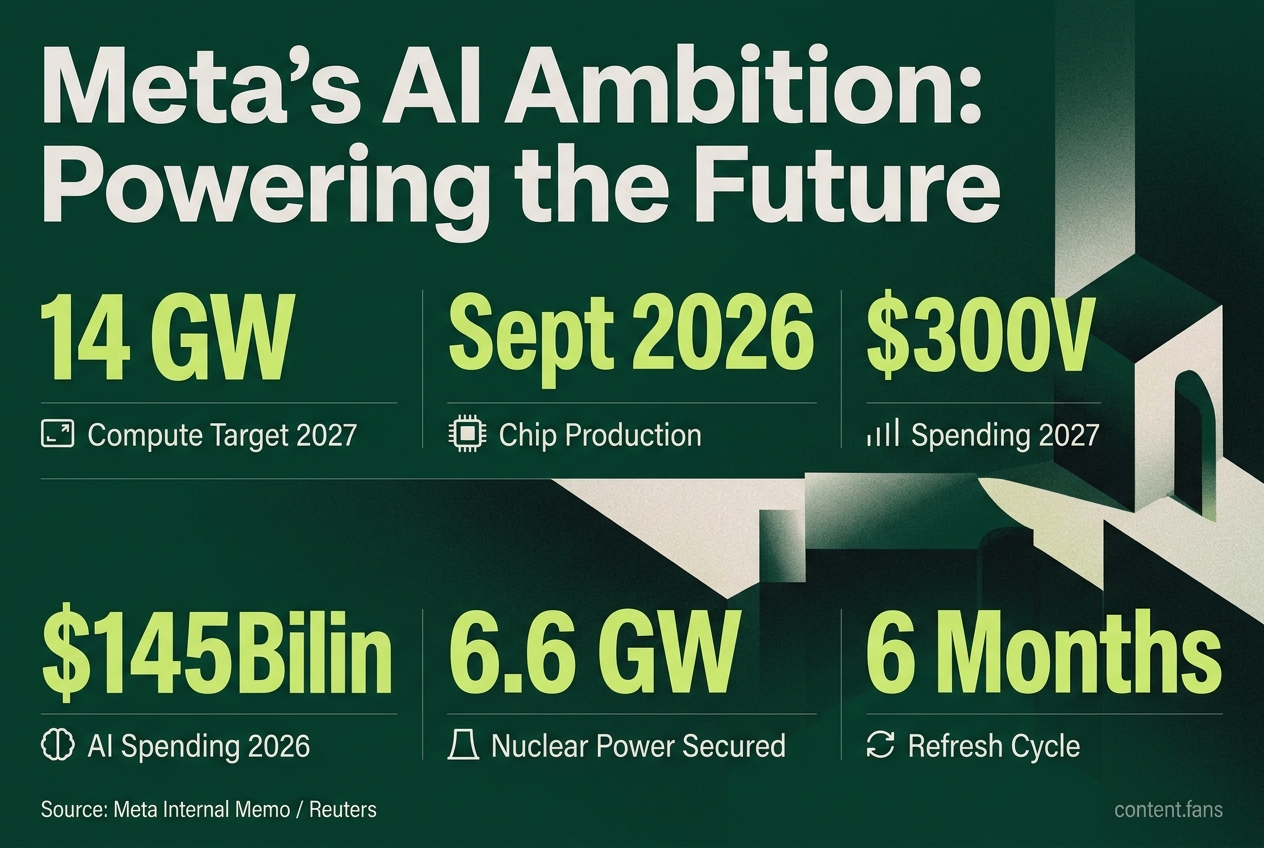
The internal memo reviewed by Reuters confirms Iris (MTIA 400) cleared its bug-testing phase in roughly six weeks without significant problems. The original Reuters report is at https://www.reuters.com/world/asia-pacific/meta-put-ai-chip-into-production-september-it-looks-double-computing-capacity-2026-07-09/. Developed under the Meta Training and Inference Accelerator (MTIA) initiative, the chip is fabricated by TSMC with design assistance from Broadcom. Meta plans an aggressive six-month refresh cycle through 2027, a pace that could outstrip the industry's standard annual releases.
Key reported specifications:
- MTIA 400 (Iris) provides performance on par with top commercial offerings; MTIA 450 has double the high-bandwidth memory of MTIA 400
- Enhanced high-bandwidth memory for generative AI inference
- Liquid-cooled variant sized for multi-rack deployments
- Expected operational lifespan of five or more years
By focusing on in-house accelerators, Meta aims to reduce its dependence on Nvidia and AMD GPUs and lower its long-term cost per inference. However, experts note the company will likely remain reliant on external suppliers for critical components like memory and optical networking gear, which face ongoing shortages.
Gigawatt-scale infrastructure and power agreements
Achieving massive compute scale requires immense power. To meet this demand, Meta secured 20-year agreements with three nuclear energy firms (Vistra, Oklo, TerraPower) to secure up to 6.6 GW of nuclear power by 2035, supporting its AI infrastructure goals. Meta targets 7 gigawatts of total computing capacity by end of 2026 and 14 gigawatts by end of 2027 globally, with projected AI infrastructure spending of up to $145 billion in 2026. According to industry reports, Meta's capital expenditures represent a significant portion of the substantial investments Big Tech will make in AI infrastructure.
Dave Brown joins to build Meta Compute
To spearhead this expansion, Meta has hired veteran AWS executive Dave Brown, who led Amazon's EC2 and machine learning services for nearly two decades. Reporting to head of global infrastructure Santosh Janardhan, Brown is tasked with overseeing the massive data center build-out and establishing Meta Compute. This prospective cloud service would offer external customers access to Meta's AI capacity, capitalizing on what CEO Mark Zuckerberg described as weekly requests from companies to use Meta's hardware.
Industry analysts suggest that Meta's entry as a new hyperscaler will intensify competition for high-bandwidth memory, fiber optics, and power contracts. The accelerated six-month release cycle for Iris could further strain the supply chain for other tech firms. While it remains uncertain if Meta can sustainably manage its ambitious roadmap and soaring energy demands, the planned September start for Iris production shows its first major goal is on track.
What is the new custom AI chip that Meta is manufacturing?
Meta is manufacturing a custom AI chip code-named "Iris" (officially the MTIA 400), which represents the fourth generation of its Meta Training and Inference Accelerator program. According to industry reports, the chip was designed in collaboration with Broadcom and will be manufactured by TSMC, with production slated to begin in September 2026. Testing has been completed with no major bugs reported, positioning Meta to accelerate its silicon release cadence significantly faster than the industry-standard cycle.
How much computing capacity is Meta targeting and by when?
Meta aims to scale its total computing capacity substantially by 2027 - a goal that would double its planned 7 GW deployment in 2026. To put this in perspective, this level represents electricity consumption equivalent to small cities or entire nations, requiring Meta to build gigawatt-scale AI data centers and secure 20-year power agreements with nuclear facilities like Vistra. The company is also making substantial investments to significantly expand compute capacity at its data center footprint.
Why is Meta developing its own AI chips instead of relying on external suppliers?
Meta's custom silicon strategy serves three interconnected objectives: optimizing performance-per-dollar for its specific AI workloads, reducing operational costs at massive scale, and decreasing dependence on external chip suppliers like Nvidia and AMD. While Meta will continue purchasing GPUs from these vendors - including substantial AMD Instinct MI450 processors - the Iris chip is purpose-built for Meta's ranking/recommendation algorithms and generative AI inference needs. This vertical integration allows Meta to control its technology roadmap and ship new chips significantly faster than typical industry timelines.
Who is Dave Brown and what role will he play in Meta's infrastructure expansion?
Dave Brown, a veteran of Amazon Web Services where he served as Senior Vice President of Compute and Machine Learning Services, is joining Meta's infrastructure organization. He will report directly to Santosh Janardhan, Meta's Head of Global Infrastructure, and will oversee the company's multi-billion-dollar data center build-out while constructing "Meta Compute" - a new initiative to rent AI infrastructure to external customers. Brown's expertise traces back to the earliest days of AWS EC2, making him instrumental in Meta's potential entry into the cloud services market.
What broader industry implications do observers see from Meta's compute expansion strategy?
Industry analysts anticipate that Meta's moves will reshape cloud and hardware supply dynamics in several ways. The company's aggressive capacity targets and multi-year supply agreements for memory chips, flash storage, and fiber-optic equipment are likely to tighten component availability and potentially trigger price pressures for competitors. Perhaps most significantly, Meta's plan to sell surplus capacity through "Meta Compute" positions it as a new hyperscaler competitor to AWS, Azure, and Google Cloud - a shift that has caused significant market reactions for specialized neoclouds like CoreWeave when Bloomberg first reported the plans.