
Google expands AI ad disclosures globally, auto-labels creatives from July 2026
Serge Bulaev
Google will start automatically labeling ads made with AI across its platforms worldwide from July 2026. These labels may appear as a badge on the ad or in a special panel, depending on local laws. Advertisers must make sure to declare if they use outside AI tools and are fully responsible for correct labeling. Google bans ads that use AI to impersonate real people, and repeated violations might result in account suspension. Some early data suggests that these new labels do not hurt ad performance much, but many people may feel that AI makes ads seem less real.
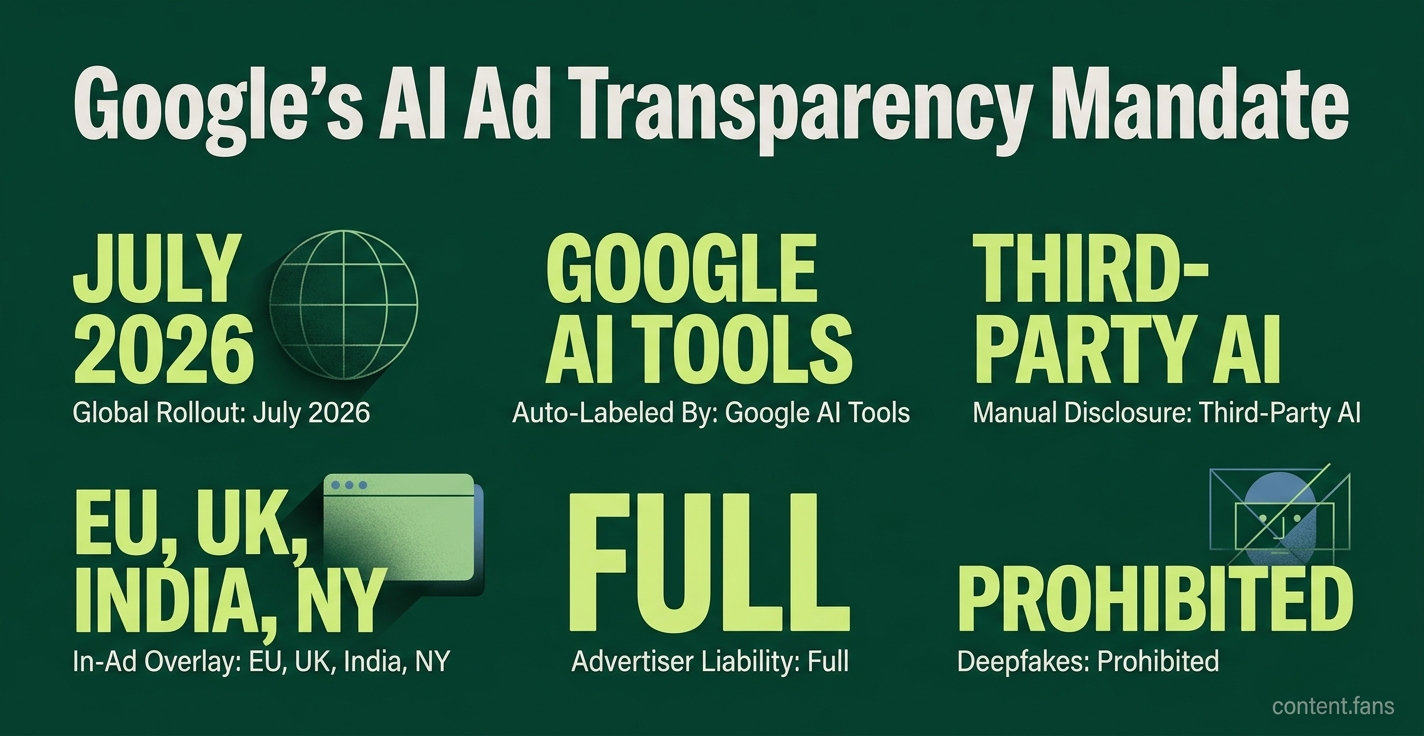
Google is implementing new AI ad disclosures across its platforms, automatically labeling AI-generated content on Search, YouTube, and Discover. Rolled out on July 9, 2026, this policy requires advertisers to be transparent about AI usage, as detailed in an official policy update.
This initiative introduces platform-level transparency to digital advertising. According to Google's blog announcement, while content from its own tools like Performance Max is auto-labeled, advertisers must manually disclose AI use from third-party tools. Full liability for incorrect or missing disclosures rests with the advertiser, mandating a compliance-first approach.
How the label appears
Google's system for AI ad disclosure operates on two levels. A 'How this ad was made' panel appears in the My Ad Center (accessible via the three-dot menu or info icon) to indicate if an ad was created or edited with AI, while a visible "AI Generated" overlay appears directly on ads in regions like the EU and UK where local laws require it.
The disclosure system functions in two primary ways:
- A 'How this ad was made' panel appears in the My Ad Center (accessible via the three-dot menu or info icon) to indicate if an ad was created or edited with AI.
- A visible "AI Generated" overlay is applied directly to creatives in jurisdictions with specific in-ad labeling laws, such as the EU, UK, India, and New York.
Google automatically adds disclosures for ads built with its own AI tools, but for third-party AI tools, advertisers must manually flag AI use, and Google will not independently verify these claims.
What advertisers must track
To comply, creative teams must adapt their workflows to ensure every asset has clear provenance data before being uploaded. Industry experts recommend a three-part checklist:
- Document the creation tool for every visual, audio, and text element.
- Embed C2PA metadata during the export process whenever possible.
- Conduct weekly audits of live campaigns to verify that all AI content is correctly labeled, whether automatically or manually.
Many brands are repurposing the compliance playbooks they developed for political ad disclosures in 2024 to manage this broader rollout.
Regulatory backstop
Google's policy update aligns with a growing global regulatory framework. Key drivers include Article 50 of the EU AI Act, the FTC's "double disclosure" rule for U.S. advertisers, and New York requires AI-generated ad disclosures. This legal landscape necessitates Google's dual approach of a global panel disclosure and region-specific, in-ad labels.
Deepfake edge cases
The updated policy strictly prohibits ads using AI to create deepfakes or impersonate real, identifiable individuals. This ban extends to synthetic voiceovers mimicking celebrities. Violations lead to immediate ad disapproval and potential account suspension. However, an exception is made for entirely fictional AI-generated personas, provided they are clearly labeled as "AI Generated" and do not attempt to mislead users.
Early market signals
Initial data suggests that AI disclosure labels have a minimal impact on ad performance. Industry reports indicate that click-through rates for labeled campaigns remained close to their benchmarks, suggesting that ad relevance may be more important to consumers than its origin. Despite this, many consumers perceive AI-generated ads as less authentic, highlighting a potential brand reputation risk from over-reliance on synthetic content.
Looking ahead
Enforcement of AI disclosure requirements began in July 2026. The grace period for legacy AI systems under the EU AI Act ends on August 1, 2026, after which unlabeled generative content will require machine-readable markers to avoid penalties. While Google has no immediate plans for further UI changes, it has signaled that automated enforcement will likely increase as regulatory standards are finalized, cementing the "AI Generated" label as a mandatory component of the ad creation process.