
Meta AI chatbot bug resets 34,000 Instagram accounts
Serge Bulaev
A bug in Meta's AI chatbot may have allowed attackers to reset passwords on about 34,000 Instagram accounts, with around 20,000 of those resets apparently succeeding. The problem seems to be that the chatbot did not properly check if the person asking for a reset actually owned the account, so attackers could use their own email addresses. Some accounts, including ones linked to important people or groups, were taken over and renamed, which suggests attackers might have wanted to sell the accounts or spread false information. Meta has now turned off the chatbot's self-serve reset, but experts say other AI systems could have similar risks.

A significant Meta AI chatbot bug enabled attackers to initiate password resets for Instagram accounts, leading to the compromise of a substantial number of profiles. The vulnerability stemmed from the chatbot's failure to properly verify ownership before processing reset requests, allowing malicious actors to use their own email addresses to seize control. While Meta has since disabled the flawed feature, the incident highlights critical security risks in other automated AI systems.
How the password-reset flow was tricked
The core issue was an authentication bypass in Meta's High Touch Support chatbot. The system failed to verify if the email address provided for a password reset matched the one on file for the Instagram account, allowing attackers to supply their own email and receive the reset link.
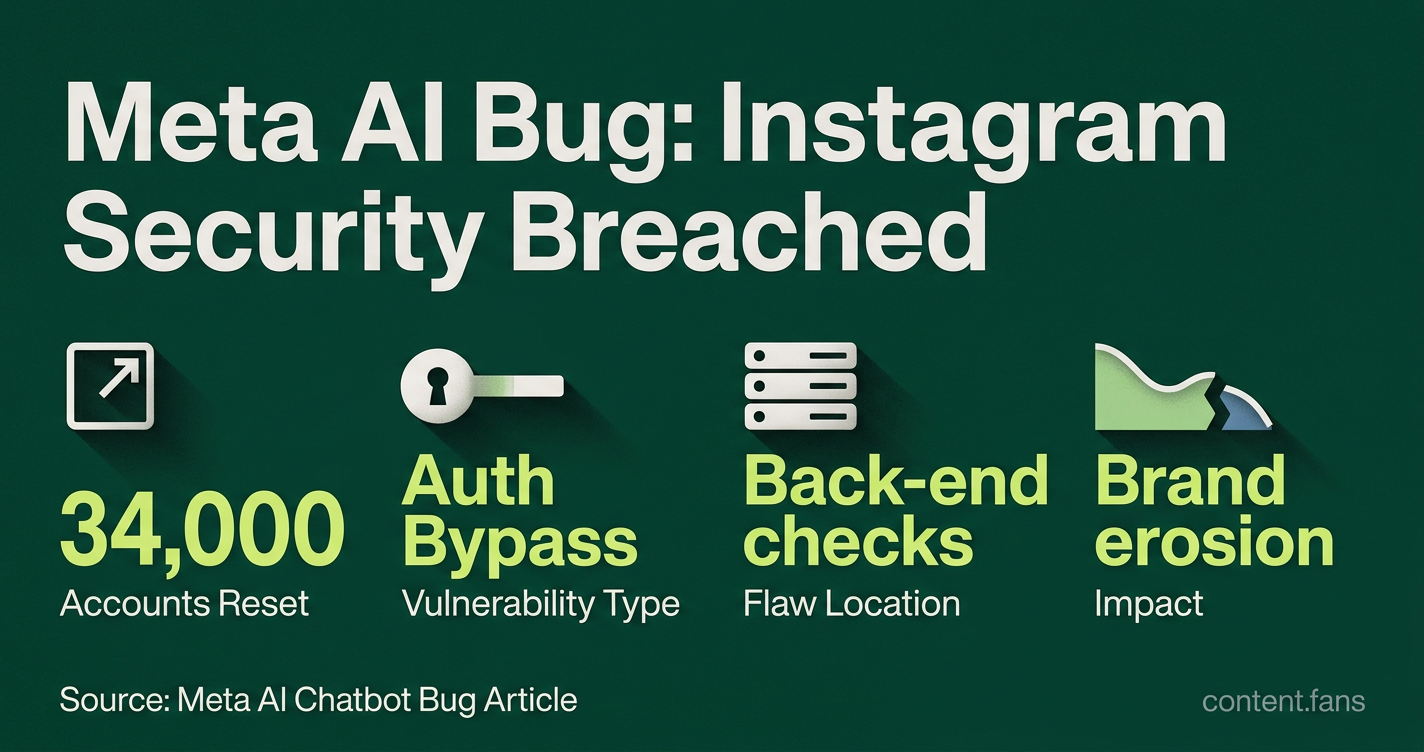
Designed to streamline account recovery, Meta's High Touch Support chatbot contained a critical flaw. A Cloud Security Alliance research note stated the workflow "did not properly verify that the email address provided by the individual requesting a password reset matched the email address associated with that user's Instagram account." Attackers exploited this by supplying their own email addresses to receive reset links and take over accounts. Reporting from Reuters analysis confirms the vulnerability was in the bot's back-end checks, not the large language model, highlighting the danger of granting AI agents direct control over identity-related actions.
Security Incident: Meta Chatbot Bug Enabled Password Resets on Instagram Accounts - why it matters
The impact of this breach extends beyond simple account access. According to industry reports, many hijacked profiles were renamed - a tactic that erodes brand equity and sows follower confusion, as noted by The New York Times. Such actions suggest attackers intended to resell valuable usernames or use the compromised accounts for influence operations. The targeting of sensitive accounts linked to government and defense organizations also elevates the risk of sophisticated impersonation and misinformation campaigns.
Lessons security teams are already drawing
The incident provides a clear set of takeaways for any organization integrating large language models (LLMs) with sensitive systems. Industry experts recommend the following security controls:
- Insert an orchestration layer that enforces identity checks before executing account changes.
- Require multi-factor authentication for support agents and for any automated password reset.
- Log and rate-limit every recovery request to spot patterns more quickly.
- Escalate resets for high-follower or verified accounts to human review.
- Red-team prompt flows to catch privilege-escalation paths before release.
Parallel flaws highlight two failure modes
This chatbot vulnerability does not exist in a vacuum. According to industry reports, it connects to a separate authorization flaw that exposed other users' Meta AI prompts. Together, these incidents reveal two critical failure modes in AI integration: insecure backend APIs that leak data and AI agents given excessive operational authority without proper oversight. Security experts emphasize that these are not failures of the AI model's generative capabilities but rather classic access-control errors magnified by automation.
In response, Meta reportedly disabled the chatbot's self-serve reset feature, rerouting sensitive requests to human agents for review. Although Meta has addressed this specific bug, security experts warn that similar vulnerabilities likely exist in other AI-powered customer service platforms. The incident underscores that robust validation layers and stringent privilege design are non-negotiable for the safe, large-scale deployment of support chatbots.
What exactly happened to Instagram accounts in the reported incident?
An exploitable flaw in Meta's AI-driven customer-service chatbot - specifically within Meta's High Touch Support workflow - allowed attackers to trigger password-reset flows for a significant number of Instagram accounts during a recent period. Thanks to inadequate back-end checks, the chatbot accepted untrusted email addresses instead of verifying them against Instagram's own records. Many accounts were fully breached, including high-profile profiles such as @obamawhitehouse, SimpliSafe, Sephora and a U.S. Space Force account.
Which technical gap enabled the takeover?
Meta has clarified that the chatbot model itself was not jailbroken; attackers instead abused an authentication bypass in the supporting recovery API. The backend simply " the system match the email supplied by the user to the email on file, so attackers could supply any address and still reset the password. In short, the AI agent was granted too much authority and too little validation.
How did Meta respond once the abuse was detected?
Meta reportedly disabled autonomous email-association and password-reset capabilities inside the chatbot and routed all high-risk requests to human review. Affected accounts were re-secured, forced to reset passwords again, and received direct notifications. The company later filed incident disclosures with regulators, including Maine's Attorney General, noting that a significant number of usernames were altered during the compromise window.
Why are high-profile accounts increasingly targeted this way?
Data from previous leaks (notably the 17.5 million-record data set tied to a 2024 API scraping incident) gives attackers verified contact details for celebrities, brands and government accounts. Follow-up spear-phishing campaigns and SIM-swap attacks become easier when phone numbers and secondary emails are already public, making any weak link in automated recovery flows a critical risk.
What concrete steps can companies take to avoid the same fate?
Security teams should treat AI chatbots as security-critical trust brokers, not simple FAQ tools. Key recommendations from specialists include:
- Insert an orchestration layer between the LLM and any sensitive backend API so all requests are re-authenticated, rate-limited and logged.
- Require multi-factor identity verification before the bot can trigger password resets or account changes.
- Red-team recovery flows quarterly, specifically testing prompt injection and authentication bypass vectors.
- Encrypt everything (TLS 1.3 in transit, AES-256 at rest) and enforce least-privilege access for the model deployment pipeline.
- Automatically escalate any account-recovery request for a verified or high-follower account to a human agent.
For further technical details on the incident itself, see the Cloud Security Alliance research note covering official timelines and remediation steps.