
Klarna, others integrate AI to boost comms workflow, speed
Serge Bulaev
Some companies like Klarna have started using AI in communications to speed up their work and may have seen faster campaign results. Experts suggest clear steps for AI use: set clear instructions, define your audience and tone, and provide background information. Teams are building libraries of prompts and templates to keep messages consistent, and humans still review AI drafts for accuracy and style. Training and tracking key results, like draft speed and message consistency, may help teams know if AI is helping without hurting their brand voice.

Integrating AI to boost comms workflow is moving from experiment to standard practice for leading firms. Following Klarna's reported success in increasing campaign velocity with generative AI, communications leaders are now focused on building repeatable systems. The key is to establish reliable steps, create reusable prompts, and train staff to ensure all AI-generated content is consistently on-brand and compliant.
Core prompt principles every comms team can adopt
Effective AI integration relies on establishing clear, repeatable processes. Teams should start by defining core prompt principles, building a library of role-based templates, and creating a structured workflow with human oversight. This ensures AI-generated content remains accurate, on-brand, and compliant with company standards.
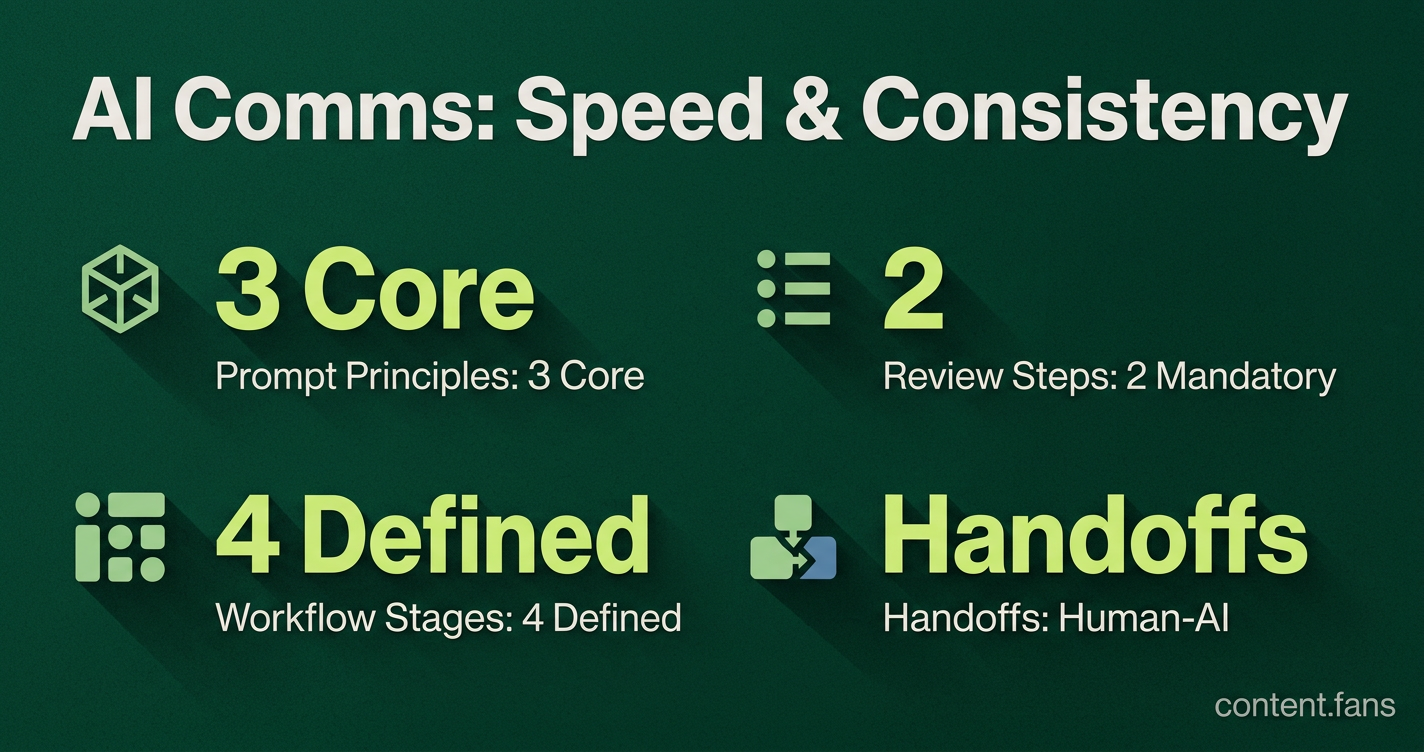
Industry best practices point to three core principles for effective prompts. First, be explicit with commands like "condense to 100 words" for predictable results. Second, define the target audience and tone within every prompt - specifying "for the executive board" versus "for a customer" prevents costly rewrites. Third, provide essential background context, such as meeting notes or relevant documents, to ground the AI's output in reality.
Building a role based prompt library
To create a role-based prompt library, begin by auditing your highest-performing content, such as press releases and social posts. Catalog each asset by its audience, objective, and tone. Use this analysis to engineer standardized prompt templates with clear fields for role, task, context, constraints, and format. A well-organized, searchable library of these templates ensures that even new team members can consistently adhere to brand guidelines.
- Role: "Act as a Senior PR Analyst."
- Task: "Draft a 150 word earnings call summary."
- Context: Paste key financial data.
- Constraints: "Use formal tone. Cite no confidential numbers."
- Format: "Return a bulleted list."
Human AI handoffs inside the workflow
A successful workflow requires a clear handoff between AI and human reviewers. Specify output requirements like format and length directly in the prompt. Once the draft is generated, implement a mandatory two-step review process: first, a fact-check for accuracy, followed by a brand-check for tone and style. This 'human-in-the-loop' guardrail is critical for preventing brand voice drift. A swim lane chart can clearly define ownership at each stage:
| Stage | Actor | Tool |
|---|---|---|
| Source gathering | Human | Internal CMS |
| Draft generation | AI model | Prompt library |
| Quality review | Human | Style checklist |
| Approval | Manager | Compliance portal |
Training modules that lock in consistency
Effective training is essential for locking in consistency. Professional development programs for PR now commonly bundle standard operating procedure (SOP) creation with advanced prompt engineering skills. Training emphasizes that mastering prompts is key to achieving predictable, repeatable outputs. Leading courses provide structured adoption frameworks and 90-day roadmaps to guide communications teams from initial pilot programs to full-scale integration.
Measuring success without hype
Measuring the ROI of AI integration requires focusing on concrete operational metrics, not hype. Organizations implementing AI in communications should track KPIs such as draft turnaround times, approval cycle lengths, and message consistency scores. This data provides clear evidence of whether AI is enhancing efficiency without compromising your brand's unique voice. For context, Klarna typically updates purchase power within 4 - 8 business hours, demonstrating the kind of operational efficiency that AI integration can support across various business processes.