
IAB Unveils Agentic Roadmap for AI Advertising Measurement in 2026
Serge Bulaev
The IAB is creating new rules to help measure how AI assistants affect shopping decisions, since these agents may influence what people buy before any clicks happen. Many consumers now use AI helpers for finding products or checking prices, but it is harder to track which ads or content led to a purchase when an AI makes the choice. The IAB's plan suggests new tools and standards to improve trust, measure agent actions, and protect privacy, but some details and methods may still change. Advertisers are being told to get ready by making their product info easy for machines to read and by tracking AI-driven activity separately. Ongoing talks may lead to more standards about measuring true ad impact and handling fake or non-human activity.

The Interactive Advertising Bureau (IAB) is redefining AI advertising measurement with its agentic roadmap for 2026. This new framework addresses the critical challenge of tracking how AI assistants influence consumer purchases - an activity that occurs before any traditional clicks, fundamentally changing how ad effectiveness is measured. The plan introduces new standards and tools to build trust, quantify agent actions, and safeguard privacy in this new ecosystem.
Why AI Agents Disrupt Traditional Ad Attribution
AI agents disrupt attribution because they make purchasing recommendations before a user clicks an ad. When an AI assistant selects the best product, traditional models like last-click or view-through fail, making it impossible for advertisers to measure campaign effectiveness and return on investment accurately.
This disruption is already underway as shopping assistants increasingly research prices, compare product specifications, and even place orders. A growing number of consumers are using AI for product discovery, and this trend breaks conventional attribution logic. The key challenges include:
- Opaque Models: Ranking algorithms hide which inputs influenced an agent's final choice.
- Complex Journeys: Consumer paths now cross multiple surfaces, from chat to voice and in-app experiences.
- Blended Content: Sponsored results are often indistinguishable from organic AI-generated answers.
- Uneven Performance: Different agents prioritize different metadata, causing inconsistent campaign lift.
Inside the IAB's Proposed 2026 Framework
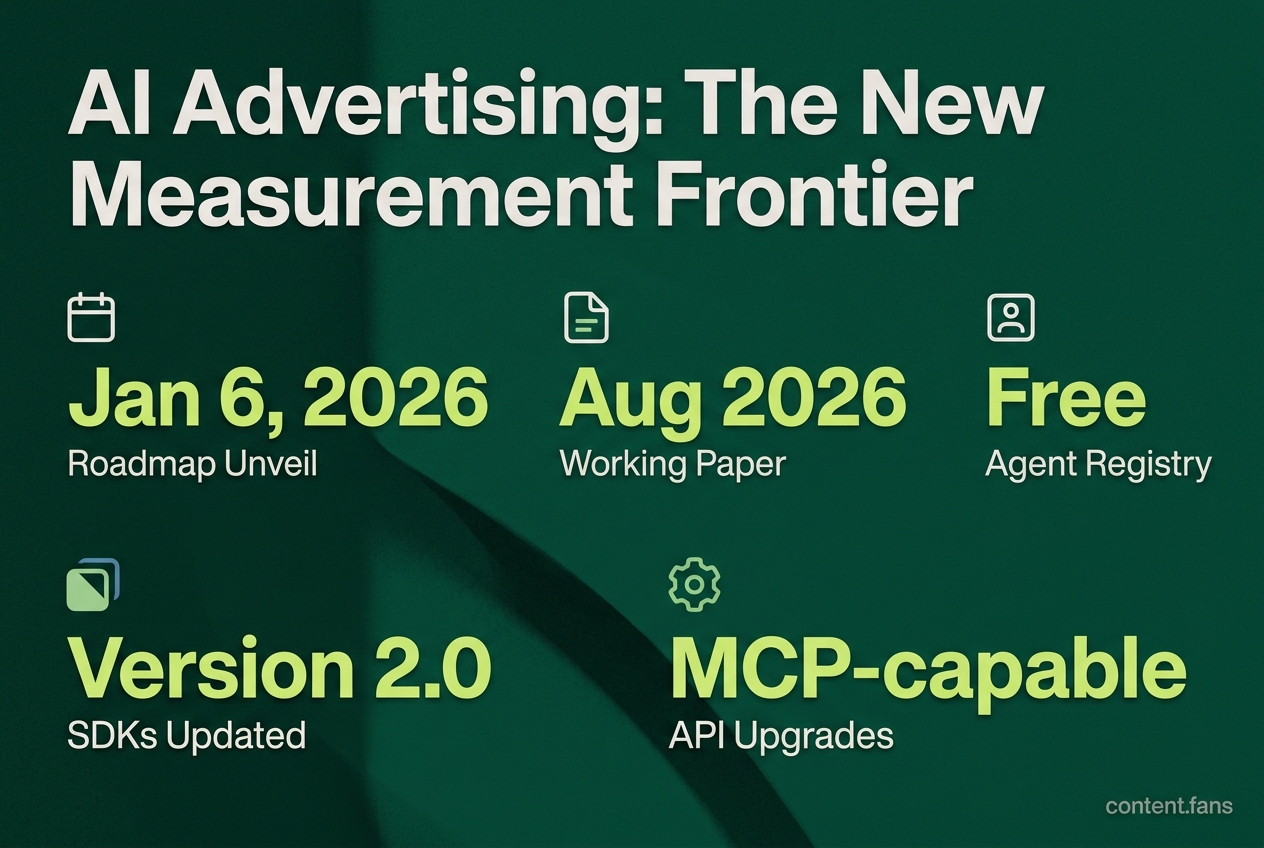
The IAB Tech Lab will unveil its Agentic Roadmap for Digital Advertising on January 6, 2026. This initiative extends existing standards into an "agentic execution layer" featuring signals for trust, provenance, measurement, and transaction integrity. A public webinar will detail how standards like OpenRTB and VAST will be updated with agent-aware fields.
The roadmap features several core deliverables:
- Agent Registry: A free registry for buyers and sellers to register agent profiles.
- Updated SDKs: Version 2.0 SDKs for buyer and seller agents with new measurement hooks.
- API Upgrades: MCP-capable enhancements for OpenDirect, AdCOM, and the Deals API.
A separate working paper, "Measuring Visibility in the AI Era," will be released in August 2026. It will propose a shared vocabulary and disclosure rules for tracking brand citations in AI search responses, emphasizing data validation and transparent error reporting.
Core Pillars: Technical and Privacy Standards
Interoperability is the foundational requirement of the new framework. To ensure outcome data aligns with existing metrics, agent decisions will be logged using protobuf messages. Provenance tags will create an auditable chain documenting which creative, bid, or prompt influenced an agent's action.
Privacy obligations remain anchored to the Global Privacy Platform (GPP) and TCF. The visibility framework will mandate that measurement vendors disclose their data access methods, whether via official API, licensed feed, or automated scraping. It also requires that results from different retrieval settings are not merged without explicit disclaimers to prevent bias.
Furthermore, providers must publish details on panel-based observation and report hallucination rates for each platform, distinguishing genuine brand exposure from model errors.
How Advertisers Can Prepare for Agentic Measurement
To prepare for this shift, advertisers should focus on five key actions:
- Audit product data to ensure it is machine-readable and contains verifiable claims.
- Begin tracking AI-referred sessions separately in all analytics platforms.
- Identify the primary AI agents their customers use and test for ranking fluctuations.
- Demand disclosure of data access methods from all visibility measurement vendors.
- Align privacy consent flags with GPP to ensure agent-level logs remain compliant.
Further industry dialogue is anticipated at the IAB Measurement Leadership Summit, where new standards for measuring incrementality and managing non-human traffic are also under review (summit recap).
The advertising industry is preparing for a fundamental shift in how value is measured and attributed. As AI agents increasingly participate in consumer decision-making, traditional measurement models are struggling to capture influence that happens inside opaque recommendation systems. The IAB has responded with a comprehensive roadmap to address this emerging challenge.
Agentic Measurement FAQ
What Problem Does the IAB's Agentic Framework Solve?
Current advertising attribution models cannot track influence when AI agents mediate consumer purchases. When an AI assistant filters products or makes recommendations, the traditional ad-to-conversion click-path breaks. The IAB framework creates standards for crediting ad influence in agent-mediated journeys, assigning value when an ad shapes an AI's recommendation rather than a direct human click.
Research shows this is an urgent problem. A significant portion of consumers use AI for product discovery, and industry reports suggest generative AI will influence a substantial amount of consumer spending in the coming years.
What Are the Key Milestones of the IAB's 2026 Roadmap?
The IAB Tech Lab has a phased implementation plan for 2026:
- January 6, 2026: Unveiling of the Agentic Roadmap for Digital Advertising, focusing on trust, provenance, and measurement signals.
- January 28, 2026: Public webinar to review the new standards and applications.
- March 3, 2026: Launch of the Agent Registry and release of Buyer/Seller Agent SDKs v2.0.
- Q2 2026: MCP-capability targets for standards like Agentic Bid and Agentic Mobile.
- August 2026: Publication of the Measuring Visibility in the AI Era working paper on disclosure and quality standards.
How Does the Framework Ensure Technical Interoperability?
The IAB is extending existing advertising standards like OpenRTB, AdCOM, and VAST into an "agentic execution layer." This approach uses standardized agent profiles and Protocol Buffers to ensure that buyer and seller agents can transact and report results consistently across different platforms.
The framework is built on:
- Measurement continuity across both human- and agent-driven workflows.
- Standardized trust signals to verify agent actions and outcomes.
- Open-source tooling to ensure cross-platform compatibility.
Foundational standards like the IAB's critical taxonomies for ad products, privacy, and content remain central to this interoperable system.
What Privacy Protections Are Included?
Privacy compliance is treated as core infrastructure. The framework is aligned with the Global Privacy Platform (GPP) and Transparency and Consent Framework (TCF). The visibility measurement standards will require providers to disclose their data collection architecture, panel governance details, and any methodological limitations. Critically, the framework mandates that results gathered under different retrieval configurations cannot be combined without disclosure, addressing a major source of measurement bias.
What New Measurement Signals Does the Framework Introduce?
The IAB recognizes that as familiar signals become less visible, new indicators are gaining importance. The 2026 Measurement Leadership Summit highlighted this shift:
| Declining Visibility | Rising Importance |
|---|---|
| Clicks, sessions, page views | Inclusion in AI responses |
| Last-touch attribution | Citation share and agent access metrics |
| Cookie-based tracking | Provenance and transaction-integrity signals |
The framework also introduces hallucination reporting, requiring platforms to disclose false citations instead of hiding them in aggregate scores. This is vital, as industry data shows AI-referred visitors demonstrate significantly better conversion rates - making accurate, separate attribution for AI-assisted discovery essential.