
Google's AI Max Doubles Invalid Clicks for Retail Ads, Study Finds
Serge Bulaev
A recent study suggests that Google's AI Max upgrade for retail ads may be causing about 72 percent more invalid clicks compared to standard search campaigns. While Google says its tools filter out most invalid traffic, third-party sources indicate that some suspicious clicks may still get through. Marketers also appear to be losing visibility into who is clicking ads and if those actions are real. Experts recommend watching for warning signs of invalid traffic and using independent verification tools to check ad quality. Overall, there may be more need for outside checks to make sure ad data is trustworthy.

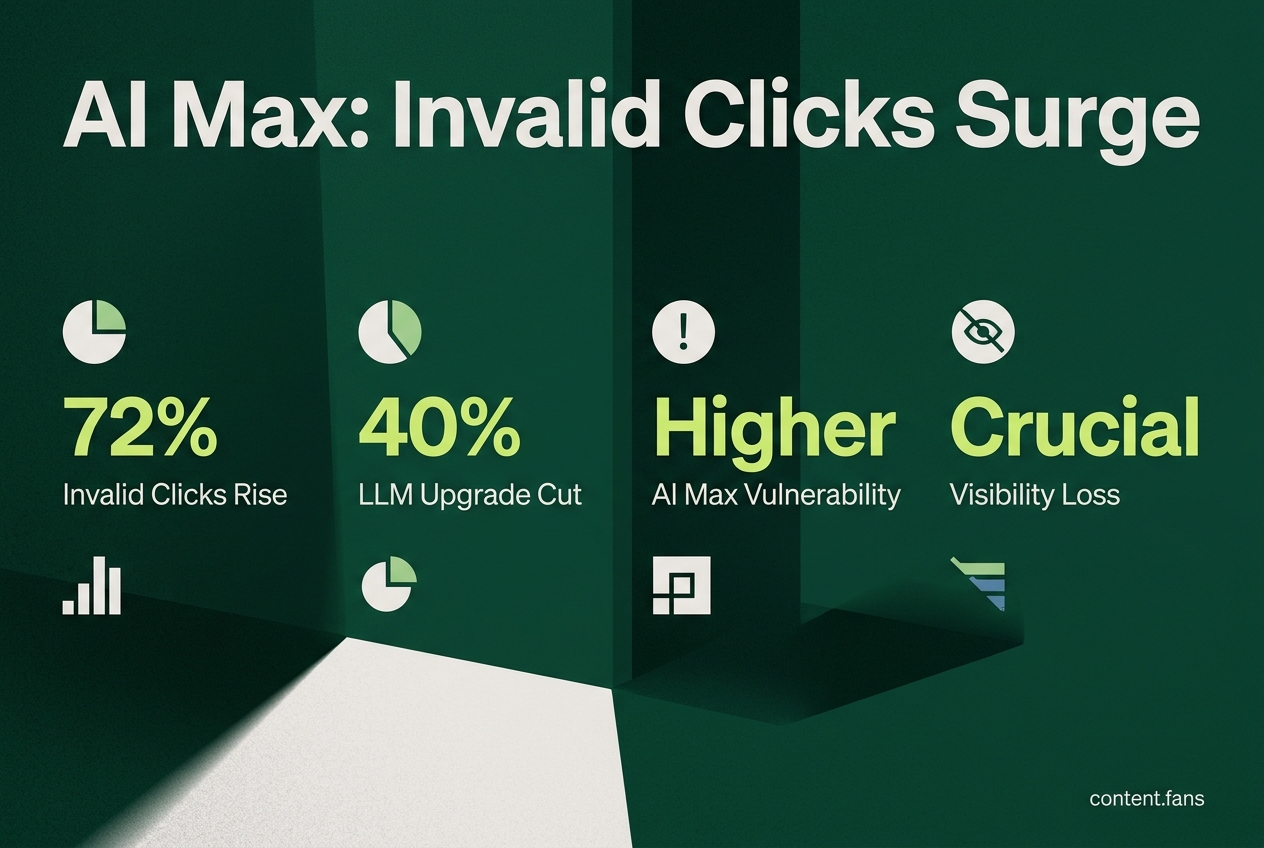
Recent findings show Google's AI Max upgrade for retail advertising may be driving a significant increase in invalid clicks, with one study reporting a 72% rise compared to standard campaigns. This surge in questionable traffic is forcing advertisers to re-evaluate their reliance on automated bidding and platform-reported metrics as spend rises without a corresponding return.
The issue highlights a growing tension between automation and accountability. As platforms expand powerful AI-driven tools, marketers are losing crucial visibility into click origins, conversion validation, and how much of their budget is wasted on traffic that slips past automated filters.
Why Invalid Traffic Threatens AI Max Campaigns
Google's AI Max campaigns appear more vulnerable to invalid traffic due to their automated nature, which can be exploited by sophisticated bots. While Google claims its defenses are robust, third-party studies show a significant gap, with AI Max attracting more fraudulent clicks than manually managed search campaigns.
While Google states its layered defenses filter most invalid traffic and that new LLM upgrades cut deceptive activity by 40 percent (Google Blog), third-party monitoring suggests otherwise. A Lunio study, featured in PPC Land, discovered that retail search campaigns using AI Max were exposed to approximately 72 percent more invalid clicks than standard Search campaigns (PPC Land).
To identify potential issues, experts advise looking for these red flags:
- Sudden click-through spikes without matching conversions
- High bounce rates or session lengths under a few seconds
- Repeated clicks from similar IP ranges
- Traffic from countries outside your targeting parameters
- Consistent ad spend with zero downstream sales
Google's own guidance recommends adding the "Invalid clicks" column to reports, applying IP exclusions, and filing a Click Quality Form for persistent discrepancies.
Attribution Gaps Widen in an Automated World
The challenge of invalid clicks is compounded by widening attribution gaps across the industry. As platforms like Google automate more, they also become more opaque. Privacy rules and emerging formats like CTV and retail media further obscure the customer journey, making it difficult for marketers to verify platform-reported conversions against their own data.
This suggests that marketers relying on last-click or default GA4 models may be misattributing channel value. The practical solution is a hybrid measurement stack: using platform reports for daily operations, warehouse reconciliation for source-of-truth analysis, and incrementality tests to measure causal lift.
The Growing Need for External Ad Verification
With platform data becoming less transparent, independent ad-verification vendors are becoming essential. These services offer an external layer of accountability for advertisers concerned about fraud, viewability, and brand safety. Leading options include DoubleVerify, Integral Ad Science (IAS), and HUMAN Security.
These partners help advertisers address specific risks. For example, HUMAN excels at bot detection, while IAS blends verification with contextual targeting. This trend indicates a strategic shift toward always-on, third-party measurement running in parallel with platform automation, rather than auditing campaigns only after problems arise.
For marketers navigating the AI Max transition, the path forward requires proactive vigilance. The consensus playbook involves establishing baseline invalid traffic (IVT) rates before migration, implementing daily monitoring for behavioral anomalies, and layering in independent verification to ensure data integrity. In an era of increasing automation, trust must be earned through multiple, independent checkpoints.