
Google Unveils Gemini Robotics, Gemini Robotics-ER Models for Advanced Robot Control
Serge Bulaev
Google has introduced new AI models, Gemini Robotics and Robotics-ER, which may help robots learn tasks more safely and efficiently by using simulation before real-world testing. These models might let developers move from virtual training to live machines faster and with less risk. Experts suggest that early uses could be in factories and warehouses, possibly lowering failure rates and making human-robot interactions safer. Some analysts believe future models may allow robots to predict the results of their actions, but challenges like safety, reliability, and data efficiency still appear to exist.

Google has unveiled its new AI models, Gemini Robotics and Robotics-ER, to help robots learn complex tasks more efficiently. By leveraging advanced simulation, these models let developers move from virtual training to real-world deployment faster and with less risk, with early applications focused on factories and warehouses.
From Simulation to Reality: A New Robotics Stack
Google's new models, Gemini Robotics and Robotics-ER, push robot learning beyond simple scripted control. Gemini Robotics provides direct camera-to-motor control, while Robotics-ER acts as a planner, feeding safe trajectories to existing controllers. This layered approach accelerates the transition from simulation to live hardware.
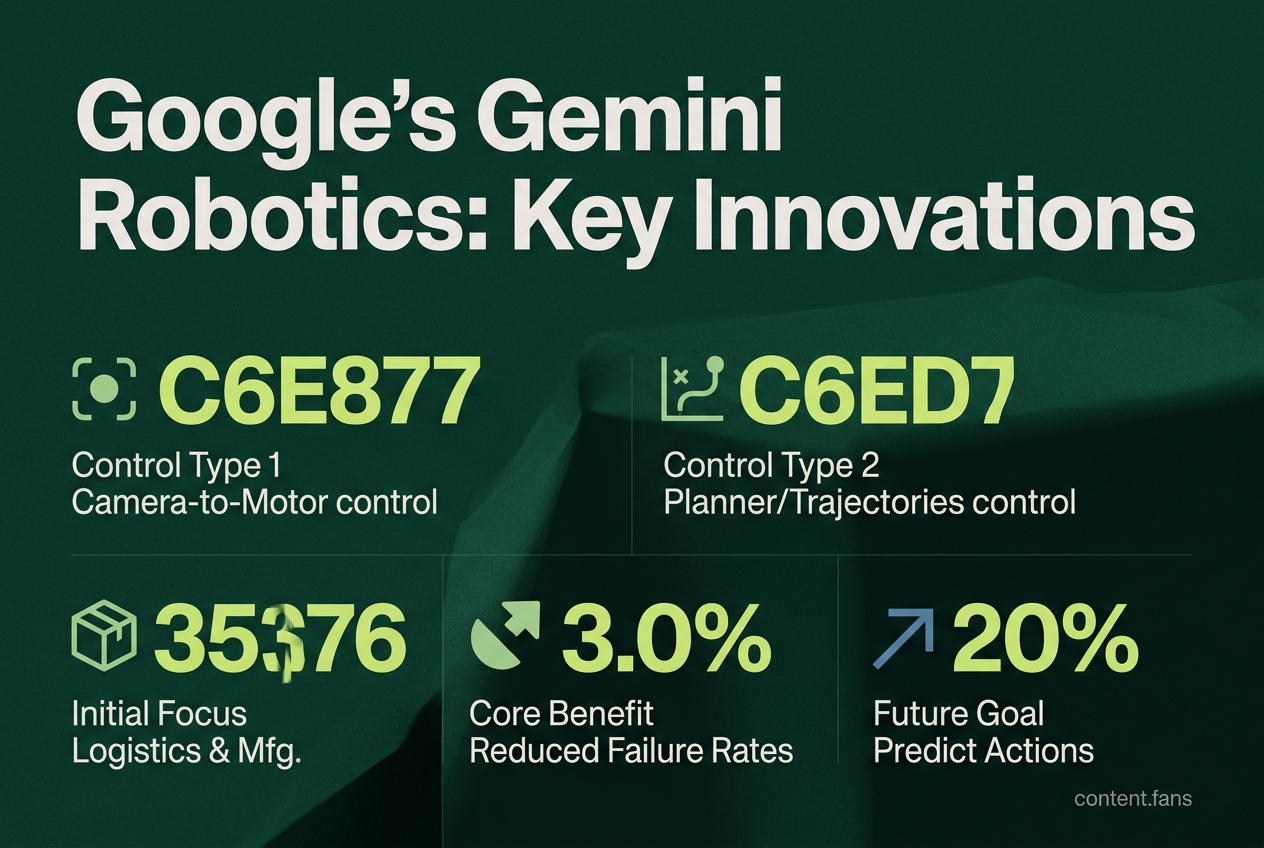
The core of Google's new stack is this layered approach that separates high-level reasoning from low-level control. Gemini Robotics provides direct camera-to-motor control, enabling a robot to perform delicate tasks like folding origami. Its counterpart, Robotics-ER, functions as an advanced planner that generates safe trajectories for embedded controllers. This allows teams to validate code extensively in simulation before attempting costly physical trials.
Initial Applications in Manufacturing and Logistics
Google is reportedly testing these models on both humanoids and traditional factory machines, with initial commercial applications targeting logistics and manufacturing. While integration and cybersecurity remain challenges, embodied reasoning helps overcome them by predicting collisions and managing contact forces within a digital twin.
Industry analysts highlight four primary benefits of this simulation-first approach:
- Reduced prototype failure rates from rehearsing tasks in simulated physics.
- Shorter commissioning windows, with industry reports suggesting significant time savings on integration.
- Safer human-robot collaboration through integrated force and collision limits.
- Improved cross-platform adaptability, which lowers the software cost per robot.
The Future: World Models and Predictive Robotics
Looking ahead, the evolution of this technology points toward comprehensive "world models." Industry analysis describes concepts like advanced AI systems envisioned as single platforms capable of simulating audio, text, video, and 3D environments. Such models would empower robots to predict the results of their actions before execution, dramatically enhancing operational safety and efficiency.
Key Challenges and Industry Hurdles
Despite the promising advances, industry observers caution that significant challenges remain. Key hurdles include ensuring reliability in unstructured environments, improving data efficiency for tactile learning, and achieving real-time inference on power-constrained edge hardware. Furthermore, experts emphasize that safety must be an integral design feature, and progress may be hindered without the establishment of common cybersecurity standards.
What exactly are Gemini Robotics and Gemini Robotics-ER?
Google now offers two new models built on Gemini 2.0:
- Gemini Robotics - the company's most advanced vision-language-action (VLA) system that can directly control real robots from natural-language commands and camera images.
- Gemini Robotics-ER - an embodied-reasoning variant that developers can plug into their own code; it supplies spatial understanding, planning, and code generation while letting the user keep their trusted low-level controllers for safety.
Both are designed to work across robot types - from factory arms to humanoids - and already show 2-3× higher success rates than Gemini 2.0 on industry benchmarks.
How do "world models" lower robot-training costs?
World models let a robot imagine the future - predicting how objects will move, what collisions might occur, or whether a grasp will slip - before it ever moves a motor. By turning expensive real-world trial-and-error into cheap in-memory simulation, Google says the approach can:
- significantly reduce integration costs
- compress deployment cycles from months to weeks
- reduce prototype failures and hardware wear, a crucial saving when downtime in a logistics hub can be extremely costly
Which near-term applications are ready first?
Early adopters are focusing on controlled industrial tasks:
- warehousing: autonomous pick-and-pack, pallet shuttling, dynamic path planning around humans and forklifts
- manufacturing: machine tending, part inspection, assembly assistance with variable components
- service sectors: folding origami or sealing snack bags - demos that stress fine motor control, visual feedback, and material understanding
Because the environment is structured yet highly repeatable, these sectors offer the fastest return on investment while the models mature.
What hurdles still stand in the way?
Experts point to five sticking points:
- Reliability & safety - Lab breakthroughs don't always survive dusty, cluttered, human-filled facilities
- Transfer across bodies - A policy learned on one robot may not generalize to another with different joints or sensors
- Data scarcity - Physical interaction data is costly; text or images can't capture tactile forces, friction, or 3-D collisions
- Real-time performance - Edge hardware has strict latency budgets; large models must shrink without losing capability
- Uneven commercialization - Most early revenue will stay inside warehouses and factories, not homes or public spaces
When will broader industry feel the impact?
Market watchers forecast a significant increase in industrial robot installations by 2026, driven partly by AI advances. Google says it is already working with trusted testers and manufacturing partners, so first commercial pilots using Gemini Robotics or Gemini Robotics-ER could appear within 12-24 months. For SMEs, lower component costs plus software-first models may finally make automation economically accessible outside of giant corporations.