
Anthropic CEO Warns AI Could Decimate Entry-Level Jobs
Serge Bulaev
Anthropic CEO Dario Amodei warns that AI may eliminate many entry-level white collar jobs in the next few years, possibly causing a large rise in unemployment. Some research suggests that young workers and entry-level roles are most at risk, with AI likely to automate repetitive tasks first. Early studies find employment drops among young people in jobs exposed to AI, and experts say up to half of U.S. jobs could be changed by AI soon. There are suggestions for support like training and apprenticeships, but it is not clear if these efforts will keep up with how fast companies adopt AI. If job support does not match AI adoption, Amodei's prediction of big job losses may come true for many starting their careers.

The warning from Anthropic CEO Dario Amodei that AI could decimate entry-level jobs is gaining traction as evidence mounts. In recent interviews, Amodei argued that generative AI may erase the first rung of the white-collar career ladder within a few years, forcing a conversation about the future of work. This article examines his specific claims, the supporting data, and the policy responses under discussion.
What Amodei actually said
Anthropic CEO Dario Amodei predicts that artificial intelligence could eliminate a significant portion of entry-level white-collar jobs within the next one to five years. He also warned this rapid automation could create substantial unemployment increases, creating an "unusually painful" economic shock.
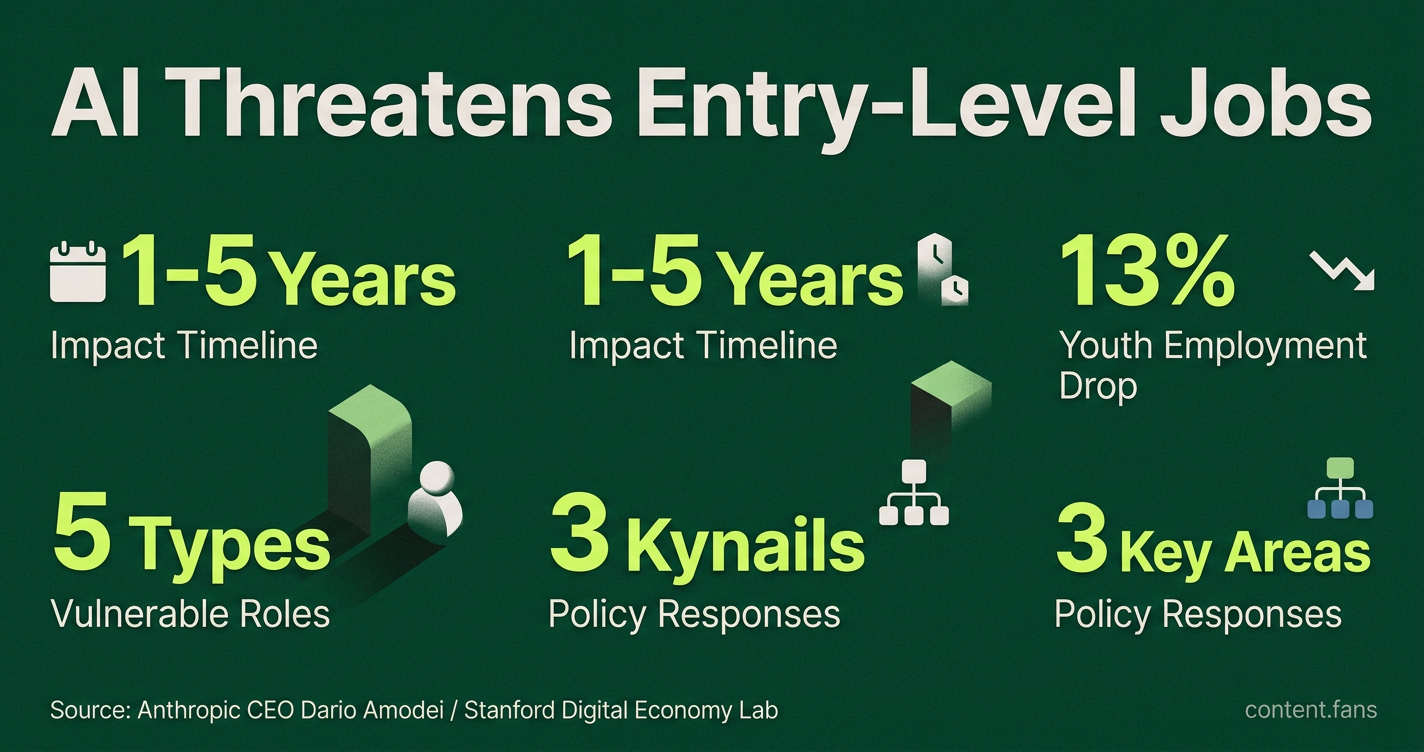
Speaking in recent interviews, Amodei forecasted that advanced AI could substantially impact entry-level white collar positions and drive significant unemployment increases in just one to five years. He urged against "sugar-coating" the outlook. He later described the impending labor market disruption as "unusually painful" and more significant than previous technology shocks.
A possible substantial unemployment jump
While Amodei's forecast of substantial unemployment increases is higher than most macroeconomic predictions, some economists find it plausible under rapid AI adoption scenarios. For comparison, industry reports suggest significant worker displacement over the coming decade, similarly highlighting that younger employees and those in early-career roles face the greatest risk.
Why the bottom rung matters
Amodei's concern centers on AI's proficiency at automating structured, repetitive tasks - the building blocks of many entry-level positions. The roles he identifies as most vulnerable include:
- Junior developers
- Customer service representatives
- Data entry clerks
- Basic content writers
- First-year law firm associates
The elimination of these roles threatens the traditional career pipeline, as new workers would lose the primary pathway for gaining the experience needed for advancement.
Early evidence from researchers
Emerging data appears to support Amodei's focus on early-career roles. A paper from the Stanford Digital Economy Lab identified a 13% relative drop in employment for 22- to 25-year-olds in occupations with high AI exposure. Research from industry analysts further suggests that while AI may reshape a significant portion of U.S. jobs rather than replace them, entry-level positions remain "more exposed to automation in the short term."
Policy and corporate responses under debate
With job security now a top concern for a growing number of entry-level workers according to industry surveys, policymakers and corporations are debating solutions. Key proposals include:
- Subsidized apprenticeships to create new learning pathways.
- Widespread AI literacy training to empower junior staff.
- Wage insurance programs for displaced workers.
Consulting firms and academics from Harvard Business School advocate for proactive reskilling and upskilling, enabling junior employees to manage and refine AI systems rather than be replaced by them.
The central question is whether support programs like reskilling and apprenticeships can keep pace with the rapid speed of corporate AI adoption. If a gap emerges, analysts agree that Amodei's more severe predictions for entry-level job loss could become a reality.
What exactly did Anthropic CEO Dario Amodei predict about entry-level jobs?
In recent interviews, Amodei said AI could substantially impact entry-level white-collar positions and create significant unemployment increases within one to five years. He has called the coming shift "unusually painful" and larger than any previous tech-driven labor shock.
Which roles are in the direct line of fire?
Coverage lists junior software developers, customer-service reps, data-entry staff, basic content writers, entry-level analysts, administrative assistants, junior paralegals and first-year law associates as the most exposed. The common thread is structured, repetitive knowledge work that large-language models can already perform at low cost.
Why focus on entry-level jobs rather than the whole workforce?
Amodei's argument is that AI attacks the bottom rung of the career ladder first. If companies automate the tasks used to train rookies, pipeline for mid- and senior-level talent dries up, slowly hollowing out entire professions. Stanford data show 13 percent relative employment drop for 22-25-year-olds in highly exposed occupations during 2024-2025, supporting the idea that young workers act as "canaries in the coal mine."
Are other forecasts as severe?
Industry reports suggest significant worker displacement over a decade, but stress that people in their 20s entering knowledge sectors face the steepest short-term risk. Research projects that a substantial portion of jobs will be reshaped, not eliminated, yet notes "the volume of entry-level jobs may decrease" before new hybrid roles appear. IMF research adds that vacancies demanding AI skills pay more, but overall employment does not rise and youth hiring often falls.
What responses are companies and policymakers testing?
Corporations are rolling out three parallel tracks:
- Reskill & redeploy - firms like IBM and Salesforce cut routine support roles while training staff to supervise AI or handle exceptions.
- Embed AI literacy - industry analysts urge building "broad-based AI fluency" so junior hires manage models instead of being replaced by them.
- Apprenticeship subsidies - governments and NGOs experiment with paid AI-augmented apprenticeships to keep a learning pathway open when traditional tasks disappear.
Bottom line: the shock Amodei warns about is not science fiction; early evidence and multiple forecasts agree entry-level hiring is already softening in automatable fields. The next two years will show whether reskilling pipelines and policy cushions can match the speed of model improvement.