
Google Unveils Antigravity, Gemini Omni at I/O 2026 for AI Loop
Serge Bulaev
Google introduced two new AI tools, Antigravity and Gemini Omni, at I/O 2026 to help speed up how research becomes products. The company says these tools may make it easier for engineers to use AI models and update products faster, while still keeping control. Antigravity lets agents plan and run code in a managed environment, and Gemini Omni helps with world modeling. Google suggests that these tools could make work more efficient, but some claims about big productivity gains have not yet been fully confirmed. Analysts note that more proof is needed to support these claims.

At I/O 2026, Google unveiled Antigravity and Gemini Omni, two cornerstone AI technologies designed to create a high-speed "research-to-product loop." This strategic reorganization aims to close the gap between laboratory ideas and the features experienced by users, establishing a continuous cycle of innovation, deployment, and refinement.
Antigravity: The Agent-First Development Platform
Google's Antigravity is an agentic development platform that provides a managed runtime for AI models to execute complex tasks. It allows agents to plan, write code, and maintain state across sessions, moving beyond simple code completion to full workflow automation in isolated, persistent environments.
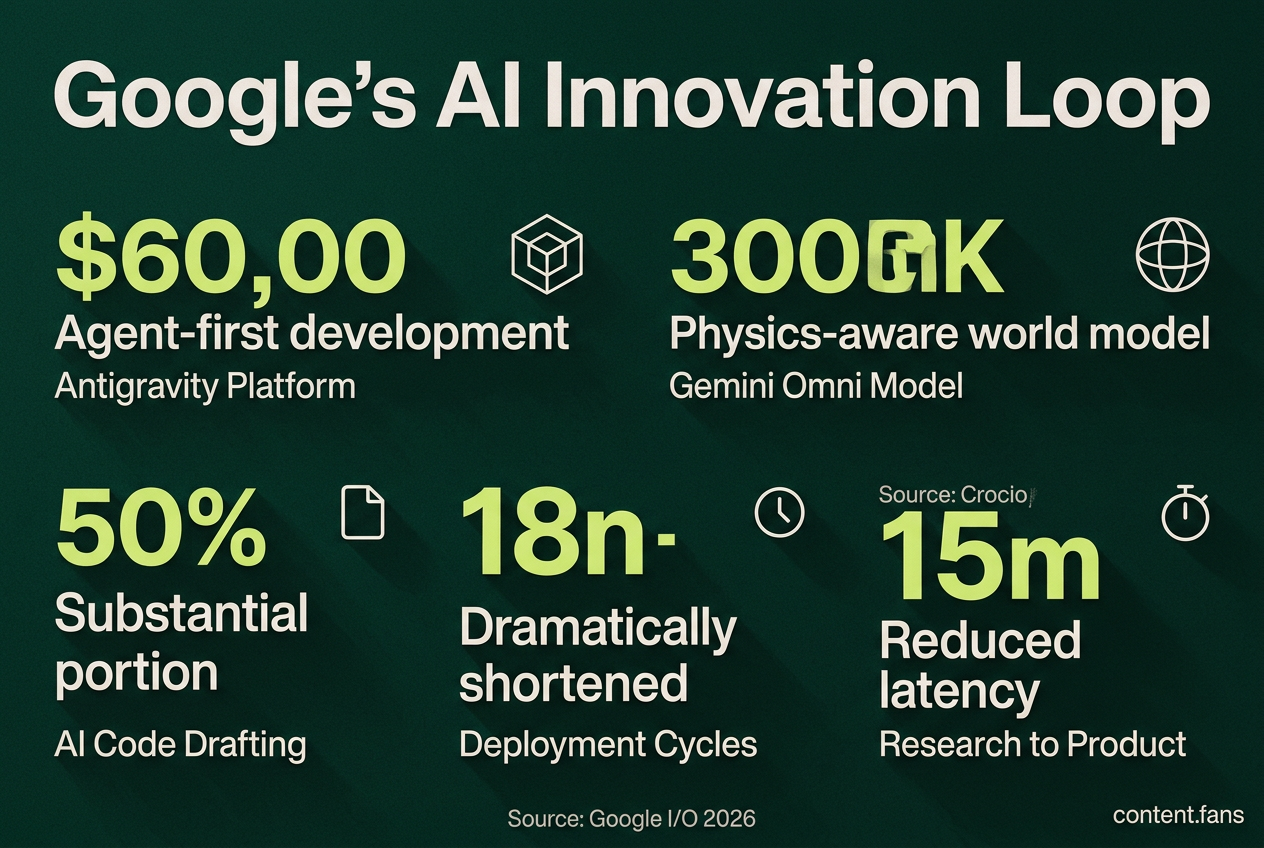
Antigravity provides an agent-first development platform where agents can plan, execute, and verify tasks across the editor, terminal, and browser. Described as a "new agent-first interface" rather than a simple editor ([https://developers.googleblog.com/build-with-google-antigravity-our-new-agentic-development-platform/]), it lets engineers move from single-shot code suggestions to full workflow automation. The platform enables AI agents to reason, write code, run tests, and preserve state across multiple calls. Accessible via a desktop app, CLI, or SDK, Antigravity treats agent capabilities as core infrastructure.
Gemini Omni: A Physics-Aware World Model
Gemini Omni is presented as a multimodal "world model" capable of ingesting text, images, and video to generate new video content that respects real-world physics like gravity and fluid dynamics. This allows for conversational video editing, the generation of synthetic training data for robotics, and the creation of simulation environments where robots can learn safely before interacting with physical hardware, according to its DeepMind product page.
Internal Impact and Performance Gains
Internally, Google reports significant efficiency gains from these new agentic workflows. While public statements haven't confirmed specific speed increases, the company notes that AI now drafts a substantial portion of all code characters, with human engineers focusing on design and review. According to industry reports, new features address a significant portion of code-review comments and can even predict fixes for build failures, underscoring the shift toward AI-driven development.
Why the New AI Loop Matters
This iterative pipeline, which connects novel research directly to user feedback, is designed to dramatically shorten deployment cycles. Google positions Antigravity and Omni as key enablers that:
- Reduce latency between research breakthroughs and product releases.
- Provide persistent, multi-turn agent sessions for complex development tasks.
- Supply physics-aware generation for media and simulation.
- Centralize governance and safety through new components like Agent Gateway and Model Armor (Futurum).
- Unify development tools under the Antigravity platform, replacing older Gemini CLI extensions (InfoWorld).
This unified strategy may allow Google to innovate more rapidly while maintaining strict safety and oversight protocols. However, analysts advise that claims of major productivity leaps require independent verification.
What is Antigravity and why is it described as an "agentic development platform"?
Antigravity is Google's newly unveiled agentic development platform that lets engineers move from single-shot code suggestions to full workflow automation. Instead of just completing the next line, Antigravity provides an agent-first development platform where agents can plan, execute, and verify tasks across the editor, terminal, and browser. According to industry reports, engineers can orchestrate multiple agents in parallel to update services, refactor tests, and roll back on failure - all from a single prompt.
How does Gemini Omni go beyond "video generation" to become a "world model"?
Gemini Omni is marketed as a multimodal world model that ingests text, images, audio, and video, then outputs video that respects gravity, kinetic energy, fluid dynamics, and lighting consistency. In practice this means the model can:
- Edit videos conversationally - change camera angle, swap backgrounds, or alter object motion while keeping physics intact
- Generate synthetic training scenes for robotics that obey real-world constraints
- Embed user likenesses via its Omni Flash tier, water-marked by SynthID for provenance
The DeepMind product page (Gemini Omni - Google DeepMind) stresses that the same backbone will power simulation environments where robots learn before touching physical hardware.
What concrete performance gains did Google report after rewriting internal tools?
Public disclosures stop short of confirming specific speed-up claims, but according to industry reports, Google has seen significant improvements:
- A substantial majority of surveyed Googlers say AI enhanced personal productivity
- Many reported higher code quality after adopting AI-driven workflows
- A significant acceptance rate for AI suggestions in production code bases
- A substantial portion of all code characters are now written by AI and reviewed by humans
These gains stem from replacing siloed scripts with unified agent runtimes that can plan, execute, and self-correct.
How does the new "research-to-product loop" actually work inside Google?
Google reorganized so every layer - chips, data centers, models, deployment pipelines, and user feedback - feeds a continuous loop:
- Research teams ship fresh Gemini weights nightly
- Antigravity harness spins up agents that auto-port the weights into Search, Ads, YouTube, and Workspace
- Live traffic experiments collect billions of implicit signals (dwell time, click-through, thumbs-up/down)
- Telemetry is piped back to researchers within hours, not months
- Model is fine-tuned, pushed again tomorrow
The loop is protected by new Agent Gateway and Model Armor services that gate every tool call and code change (Futurum Analysis).
When can outside developers start using the Antigravity harness and Gemini Omni?
According to industry reports, the Antigravity SDK is in testing phases and the Gemini API is exploring Managed Agents functionality. Legacy Gemini CLI and Code Assist IDE extensions are expected to transition to newer platforms over time. Gemini Omni Flash features are being piloted in various Google Labs environments, with watermarking and likeness features remaining opt-in during the testing phase.