
Google TPUs update AI chip battle with Nvidia through 2026
Serge Bulaev
Google TPUs and Nvidia GPUs offer two different approaches to AI computing, each with strengths that may suit different needs. Google's TPUs focus on large-scale matrix multiplication and work best inside Google Cloud, but might be less portable than Nvidia GPUs. Nvidia's chips remain popular because they are flexible and support many software tools researchers use, making them easier to use across different projects. Custom AI chip shipments may grow faster than Nvidia's GPUs in 2026, but Nvidia still appears dominant for research that requires broad support. The choice between these chips depends on workload type, software needs, and cost, and no single chip fits every situation.

Google TPUs and Nvidia GPUs remain important competitors in AI infrastructure, with their different approaches to matrix computation significantly impacting infrastructure costs and deployment strategies for enterprises building large language models. This analysis provides a detailed comparison of their architectures, performance, and market positions to guide hardware selection.
Architectural Focus
Google TPUs excel at large-scale matrix multiplication using specialized systolic arrays, making them ideal for specific AI tasks within Google Cloud. In contrast, Nvidia GPUs offer greater versatility with general-purpose CUDA cores, supporting a broader range of AI and high-performance computing (HPC) workloads across various platforms.
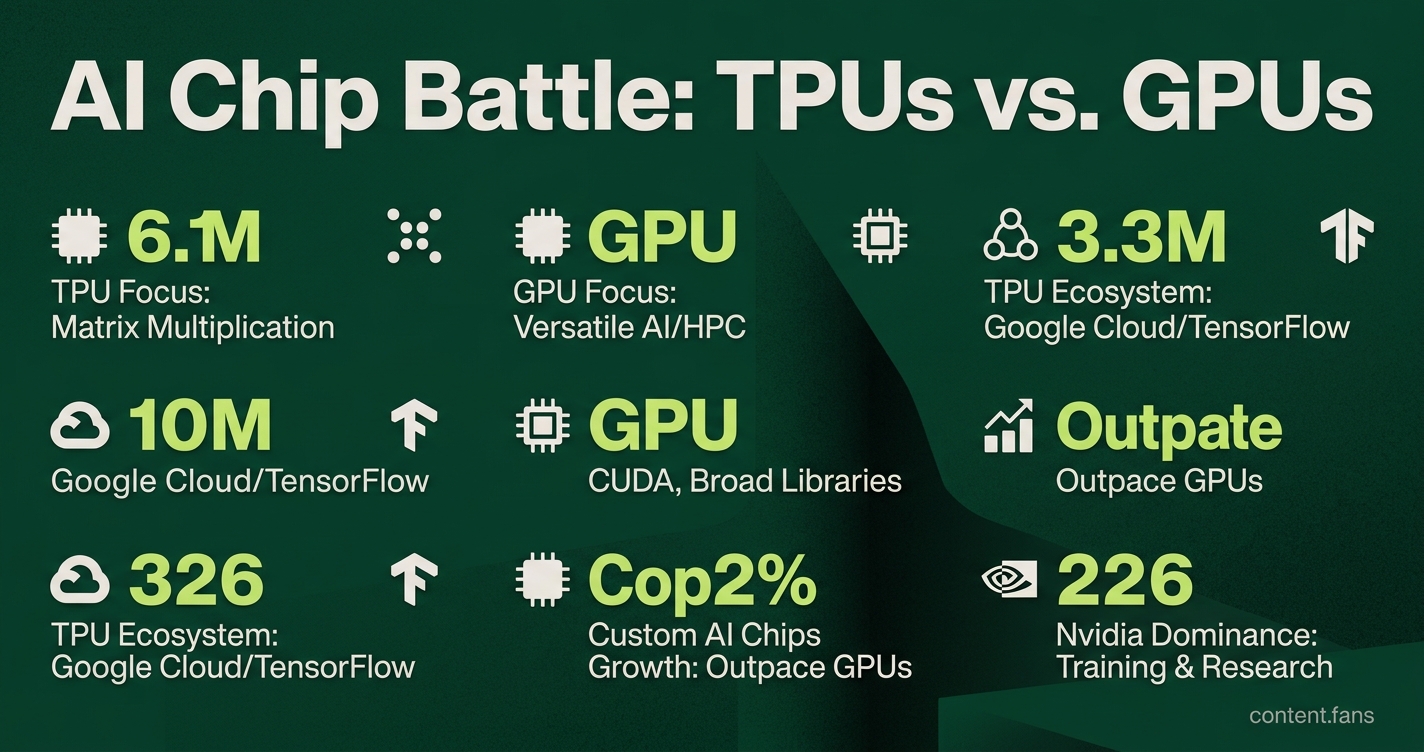
Google's Tensor Processing Unit (TPU) line is built on dense systolic arrays, specializing in large-scale matrix multiplication. According to industry reports, future TPU iterations are expected to maintain on-package High Bandwidth Memory and proprietary interconnects for scaling within Google Cloud pods. Conversely, Nvidia's Hopper architecture uses a combination of general-purpose CUDA cores, tensor cores, and its NVLink fabric. This design provides greater flexibility for mixed AI and HPC tasks, a key reason research teams prefer it for experiments that involve switching precision formats or software frameworks.
Performance Snapshots: 2024-2026
While direct, universally accepted benchmarks remain scarce, performance differences emerge when evaluating specific use cases and total cost of ownership.
Ecosystem and Software Support
Nvidia's primary advantage lies in its mature software ecosystem, including CUDA, cuDNN, and an extensive library stack that supports PyTorch, JAX, and custom kernels. In contrast, Google TPUs are primarily integrated with Google Cloud and TensorFlow, which can limit portability for multi-cloud strategies, according to Yahoo Finance Will Google TPUs dethrone Nvidia? - Yahoo Finance. While Google has improved JAX support, the prevalence of CUDA-based containers in edge deployments means migration costs are a key factor in TCO calculations.
Market Positioning and Procurement
Market trends indicate a strategic divergence. According to industry reports, custom AI chips are projected to see significant shipment growth, substantially outpacing growth for merchant GPUs, as reported by Tech Times citing TrendForce Custom AI Chips Outpace Nvidia GPU Growth in 2026 - Tech Times. Hyperscalers like Google, AWS, and Microsoft are increasingly deploying their custom silicon for predictable, high-volume inference tasks. However, Nvidia maintains its dominance in the broader training and research market, where broad software and framework support are paramount.
Decision Framework: Matching Accelerator to Workload
- High-Volume Inference: For steady, large-scale inference workloads within Google Cloud, TPU pods often deliver a lower cost-per-token.
- Flexible Research & Training: For research involving mixed-precision training or multi-cloud deployments, Nvidia's Hopper GPUs (or successors) minimize migration friction.
- On-Premise & Edge Inference: Both options require rigorous benchmarking, as real-world latency depends more on memory bandwidth and the specific runtime stack than on theoretical TOPS.
- Variable Workloads: For jobs with uncertain utilization, cloud provider discounts and committed-use models can have a greater impact on TCO than raw hardware pricing.
Ultimately, no single accelerator is universally superior. The choice between Google TPUs and Nvidia GPUs from 2024 to 2026 depends less on headline FLOPS and more on a holistic assessment of your specific workload patterns, existing software investments, and long-term strategic goals.
What makes Google's TPU architecture different from Nvidia's GPU stack in 2025-2026?
Google TPUs are purpose-built tensor processors optimized for matrix-heavy AI training and inference, while Nvidia GPUs remain general-purpose accelerators with broad CUDA ecosystem support. According to industry reports, TPUs may deliver significantly better performance per watt for large Transformer models, yet Nvidia retains the flexibility crown thanks to mature support for PyTorch, JAX, and multi-cloud toolchains.
How will custom AI chips from Google, AWS, and Microsoft affect Nvidia's market share?
Hyperscalers are selectively displacing Nvidia only in predictable, high-volume inference scenarios. According to industry reports, custom AI chip shipments are expected to surge significantly, substantially outpacing the growth rate for merchant GPUs. Despite this, Nvidia still holds a significant share of the overall AI accelerator market, because training and research workloads favor its open, portable software stack.
Which workloads are most cost-effective on Google Cloud TPUs versus Nvidia GPUs?
Google Cloud TPUs tend to win on throughput-per-dollar when four conditions are met: workload is TensorFlow or JAX native, sustained utilization stays high, model sizes are large, and the deployment is Google Cloud exclusive. Conversely, Nvidia GPUs justify their premium when flexibility and portability matter more, such as cross-framework research or multi-cloud inference.
What hidden costs should procurement teams watch for in 2025 TCO comparisons?
Google Cloud AI hardware can incur vendor lock-in costs if future migration is likely, while Nvidia GPUs may carry higher raw infra pricing offset by simpler staffing and shorter time-to-production. According to industry reports, significant idle time erodes TPU price-performance, making committed-use discounts and utilization monitoring important levers for TCO.
How should enterprises choose between TPU and GPU for AI deployments?
Use a three-step filter:
1. Workload maturity - if the model architecture and data pipeline are stable, TPUs often win on cost.
2. Team skillset - CUDA experience and PyTorch/JAX code portability favor Nvidia.
3. Cloud strategy - multi-cloud or hybrid requirements default to Nvidia; GCP-only projects give TPUs a clear edge.
According to industry reports, newer TPU generations may deliver significantly better price-performance than current GPU offerings on specific benchmarks, but such gains may diminish if additional engineering effort is needed to port legacy CUDA code.