
Google rolls out August 2026 spam update, targets thin content
Serge Bulaev
Google began rolling out a new spam enforcement update on August 18, 2026, and finished by August 21, 2026. This update mainly targets websites with thin content or those using tactics like keyword stuffing and manipulative links, but sites that follow Google's rules should not see much change. Early data suggests that some pages may lose rankings suddenly if they break spam policies, while longer, compliant content stays stable. Experts say it may take months for affected sites to recover and advise checking Search Console data after the update to understand any changes. The update applies worldwide and in all languages.

Google released the August 2026 spam update, which applied globally and to all languages, and it finished rolling out on August 21, 2026; the targeted issue categories were not specified in the official source. This global enforcement action aims to demote low-quality pages, while sites compliant with Google's spam policies should remain unaffected. SEO experts advise auditing Search Console data for impact, as recovery from penalties can take months.
Google confirmed the rollout on its official Search Status Dashboard entry, classifying it as a ranking event. This means that while no new spam policies were introduced, the update enforces existing rules more strictly. Websites employing spam tactics like thin content, keyword stuffing, or manipulative link schemes are most likely to see negative ranking changes.
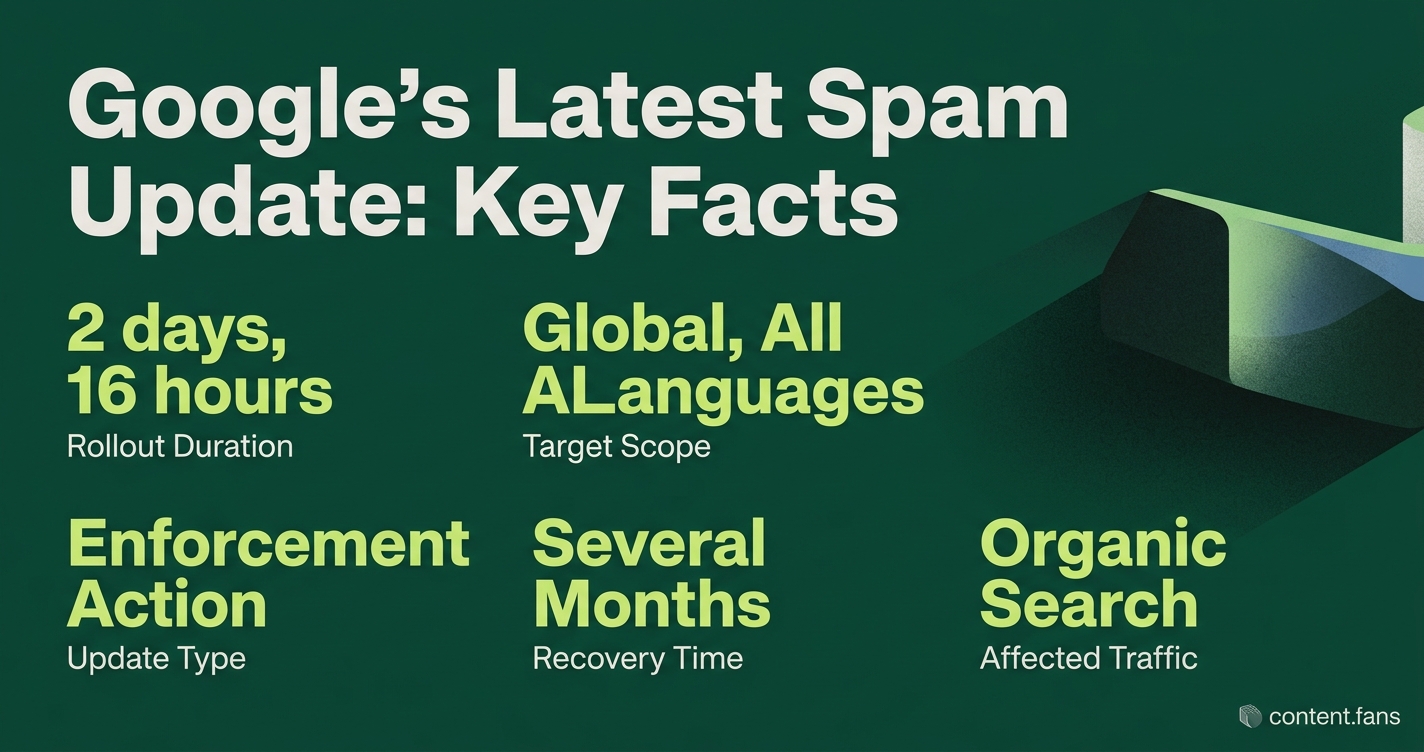
Scope and timing
The update's rollout began at 09:27 PDT on August 18 and concluded at 01:49 PDT on August 21, 2026. The 2 day, 16 hour duration is documented in Google's Search Status Dashboard and ranking history, not verified here through the Search Engine Journal timeline as an original source. Google confirmed the update was global, affecting all languages and regions simultaneously.
The August 2026 spam update is a global enforcement of Google's existing spam policies, designed to better identify and penalize low-quality websites. It specifically targets manipulative tactics such as thin content, doorway pages, and unnatural links, rather than introducing new rules for webmasters to follow.
What early data indicates
Commentary compiled by industry experts suggests pages flagged by Google's SpamBrain system may experience sudden ranking drops or complete de-indexing. Initial traffic analysis during the rollout highlights three distinct patterns:
- Sudden ranking loss in clusters built for search demand rather than user value
- Stable performance on long-form, policy-compliant content
- Volatility confined to organic search, with Discover traffic largely unaffected
To avoid misattribution, analysts are advised to segment organic search data from Google News and Discover traffic when evaluating impact.
Assessing impact after 21 August
To accurately assess the impact of this update, webmasters should wait for ranking volatility to settle and analyze Search Console data from after August 21. Key steps include reviewing changes in clicks, impressions, and average position, and auditing pages that utilize mass-produced content or questionable link-building tactics. Google's official guidance emphasizes that recovery from a spam action can take several months of sustained compliance.
According to industry reports, Google's August 2026 spam update represents another spam-related enforcement action of the year. Unlike core updates that reshape ranking systems broadly, this update tightens existing spam detection without introducing new policy categories.
Below is a structured FAQ addressing what site owners need to know.
When did the August 2026 spam update start and finish?
The August 2026 spam update officially started on August 18, 2026, at 09:27 PDT and finished rolling out on August 21, 2026, at 01:49 PDT. The timeline, confirmed on the Google Search Status Dashboard, spanned 2 days and 16 hours - longer than many previous spam updates. Google labeled this as a ranking incident, meaning measurable position shifts were expected.
Is this a new spam policy or enforcement of existing rules?
This update is strictly an enforcement of existing rules, not a change in policy. As Search Engine Journal reported, no new spam policies were introduced. Instead, the update enhances the ability of Google's SpamBrain system to detect and act on violations of current guidelines.
Which sites are most at risk from this update?
Websites with the highest risk are those that rely on tactics violating Google's spam policies, such as thin content, doorway pages, keyword stuffing, unnatural links, and low-quality mass-produced AI content. Violating sites may be demoted in rankings or removed from search results altogether. Recovery is a lengthy process, often taking months of demonstrated compliance.
How should site owners measure the update's impact on their traffic?
Site owners should wait until after August 21, 2026, for rankings to stabilize before assessing the impact. Search Engine Journal recommended using post-rollout Search Console data for the most accurate analysis.
To assess impact accurately:
- Compare clicks, impressions, and average position before and after August 21
- Isolate organic search traffic from Google Discover and News to avoid misattribution
- Check whether losses cluster around templated pages or content built primarily for search demand rather than user value
How does this spam update differ from a core update?
The distinction matters for diagnosis and recovery strategy:
| Aspect | Spam Update | Core Update |
|---|---|---|
| Scope | Policy enforcement only | Broad ranking system changes |
| Target | Specific violations (thin content, links, etc.) | Overall quality and relevance assessment |
| Recovery path | Fix violations, wait for re-crawl | Broad quality improvements across site |
| Typical duration | Few days rollout | Often 2+ weeks |
As noted in industry coverage, this update's global application across all languages means its effects are not confined to specific regions. For any site that saw a significant ranking drop between August 18-21, the immediate priority should be a thorough audit against Google's published spam policies, rather than focusing on the broad quality improvements associated with core update recovery.