
Google Report: The era of simple AI prompts is over by 2026
Serge Bulaev
The Google report suggests that by 2026, simple AI prompts may no longer be enough, as companies move toward using agents that handle complex, multi-step tasks across different teams. Surveys show that these AI agents might improve things like customer service, security, and task speed, but also require changes in how people work and new types of skills. The report highlights that managing security, control, and oversight will be important for trust in these systems. It also appears that focusing on workflow goals and having good monitoring tools could help companies get more value from AI agents. Overall, the trend points to a shift from basic AI chats to more powerful, integrated agents throughout organizations.

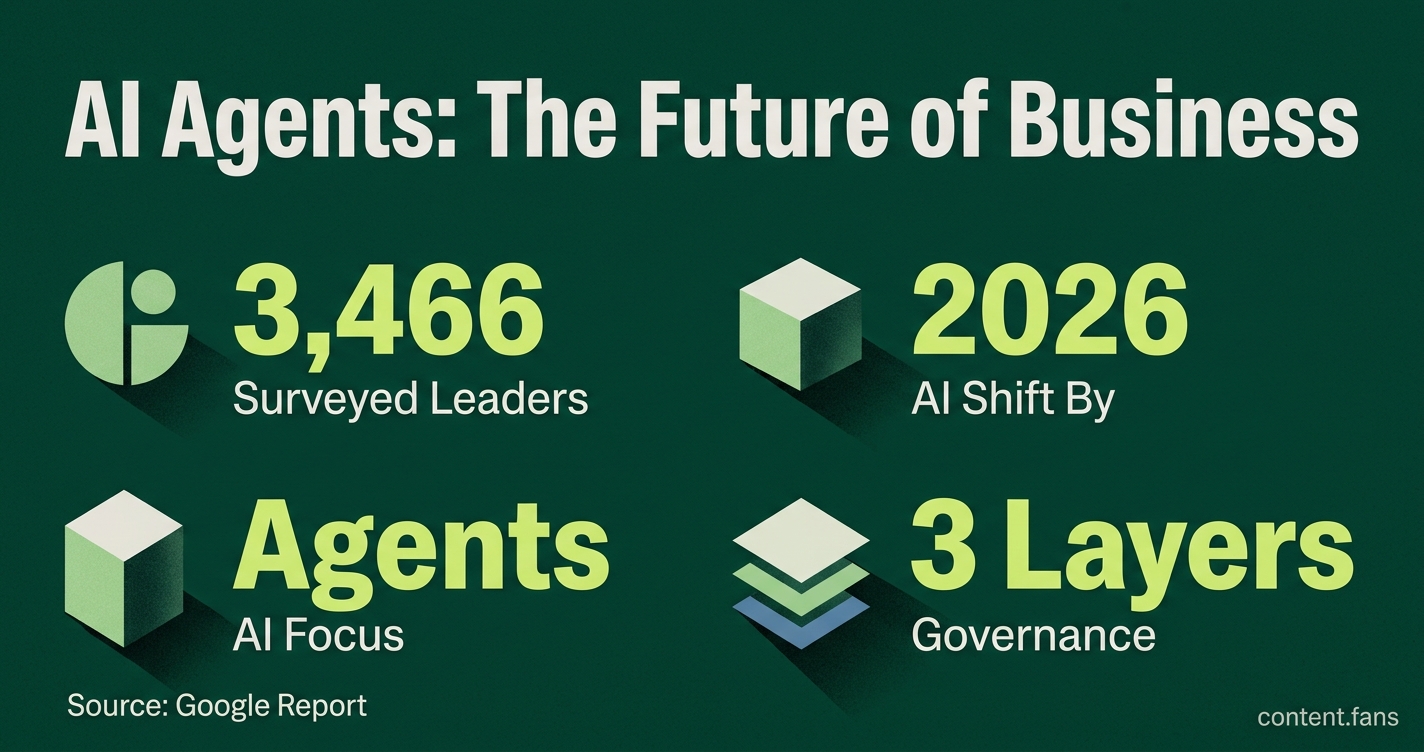
A landmark Google report signals that the era of simple AI prompts is over by 2026, marking a pivotal shift from isolated chat interactions to systemic business transformation. The report is based on a survey of 3,466 senior leaders of global enterprises and focuses on AI agents and business value. The findings argue that competitive advantage will no longer come from prompt tinkering but from deploying orchestrated AI agents. These agents are designed to plan, execute, and monitor complex, multi-step workflows across entire departments, fundamentally reshaping how organizations operate.
Five Emerging Trends for 2026
The core takeaway is that businesses must evolve from using AI for simple tasks to integrating sophisticated AI agents into end-to-end systems. These agents will manage complex, cross-functional workflows, demanding new strategies for governance, security, and workforce skills to unlock true business value and maintain a competitive edge.
- From Tasks to Systems: AI agents are embedding into end-to-end business workflows, moving beyond discrete tasks to become integral operational systems, according to the Google Cloud report.
- Cross-Functional Automation: Silos are breaking down as automation projects increasingly span multiple teams. Industry reports indicate that a significant portion of planned AI initiatives involve cross-departmental collaboration.
- Elevated Customer Experience: The standard for customer service is rising, with agents evolving from reactive chatbots to proactive systems that orchestrate the entire service journey.
- Enhanced Security Operations: AI agents are poised to strengthen security by rapidly triaging alerts, contextualizing incidents, and accelerating response times for security teams.
- Accelerated Workforce Redesign: With many organizations expecting faster task completion, a major push toward reskilling and redesigning roles is underway to support an AI-augmented workforce.
Governance, Security, and Operationalization
As AI agents become more autonomous, establishing robust governance is non-negotiable. Best practices converge on a three-layer framework of policy, control, and assurance. This requires treating agents like managed identities and applications, subject to rigorous security protocols.
Key controls for building trust and mitigating risk include:
* Inventory Discipline: Maintain a complete inventory of all production and "shadow" agents, each with a designated owner, risk classification, and an emergency kill switch.
* Least-Privilege Access: Implement service accounts with the minimum necessary permissions to perform their functions, reducing the potential attack surface.
* Runtime Guardrails: Deploy controls to sanitize sensitive data like PII and prevent unauthorized actions during operation.
* Continuous Monitoring: Extend SIEM and observability tools to cover agent activities, including tool calls and agent-to-agent communications, ensuring full visibility and logging.
Measuring ROI and Talent Shifts
Successfully deploying AI agents requires a new approach to measuring return on investment (ROI) and cultivating talent. While early data suggests many deployments achieve payback within a year, realizing value depends on looking beyond simple productivity gains. A comprehensive ROI framework must pair cost per task with metrics for throughput, quality, and direct business outcomes.
This operational shift also drives significant changes in talent demand. Anthropic's 2026 State of AI Agents Report says 56% are planning to implement agents for research and reporting over the next year. The most critical skills are moving beyond prompt engineering to include:
* Workflow Design
* Telemetry and Instrumentation Engineering
* Evaluation and Quality Assurance (QA)
* Governance and Process Ownership
Experts note that delays in capturing value often stem from gaps in these operational and governance areas, not from the AI model's capabilities.
Overall, industry analysis suggests that enterprises planning for 2026 should align agent investments with clear workflow objectives, unit-economics dashboards and a control plane built for continuous oversight. For enterprises planning for 2026, industry experts indicate that success with AI depends on a strategic transition from simple prompts to integrated agentic systems. This requires aligning investments with well-defined workflow objectives, implementing a robust control plane for continuous oversight, and building a workforce equipped with the skills to design, measure, and govern these powerful new tools. The "agent leap" is as much an organizational challenge as a technical one.