
Google Developer forum unveils early user feedback on Vertex AI features
Serge Bulaev
The Google Developer forum shares early user feedback on Vertex AI features, showing real questions and issues developers face as they try new tools. Users discuss topics like cost, training restarts, and how to use new features such as Gemini 1.5 Flash and context caching. Some posts suggest that features like Imagen 3 may still be improving, as users see mixed results. Advice from the forum may help others avoid problems and shows that some best practices, like saving frequent checkpoints, might help jobs recover from interruptions. Security and cost concerns also appear as common discussion points, and the forum seems to act as an early alert for issues before they show up in official Google documentation.

The Google Developer forum offers a direct window into early user feedback on Vertex AI features, capturing the real-world questions and challenges developers encounter with new tools. Discussions cover critical topics like cost management, training job stability, and practical application of features like Gemini 1.5 Flash and context caching. The forum serves as an early-warning system for platform issues, often before they are addressed in official Google documentation.
Discussions on the forum provide a living log of developer experiences with Google Cloud's AI stack, from fine-tuning code to troubleshooting unexpected costs from job restarts. As users frequently reference release notes, these conversations also function as an informal, real-time changelog that complements official documentation.
Forum Snapshot: Gemini, Imagen 3, and Grounding
Discussions in the Google Developer forum reveal practical developer insights on new Vertex AI capabilities. Active threads focus on implementing features like Gemini 1.5 Flash with context caching, troubleshooting grounding with third-party data, and benchmarking the performance and evolving quality of the new Imagen 3 model.
Recent threads explore using Gemini 1.5 Flash with the public preview of context caching, with users discussing implementation experiences mentioned in the official Vertex AI release notes. Another recurring topic is grounding models with third-party data, a feature ZDNet reported as being in testing for selected customers.1 Forum moderators also direct users to generative media updates from the Cloud Next post, including previews for Imagen 3 and Lyria. Many users share benchmarks suggesting Imagen 3's capabilities are continuing to evolve, with discussions around various aspects of image generation quality.
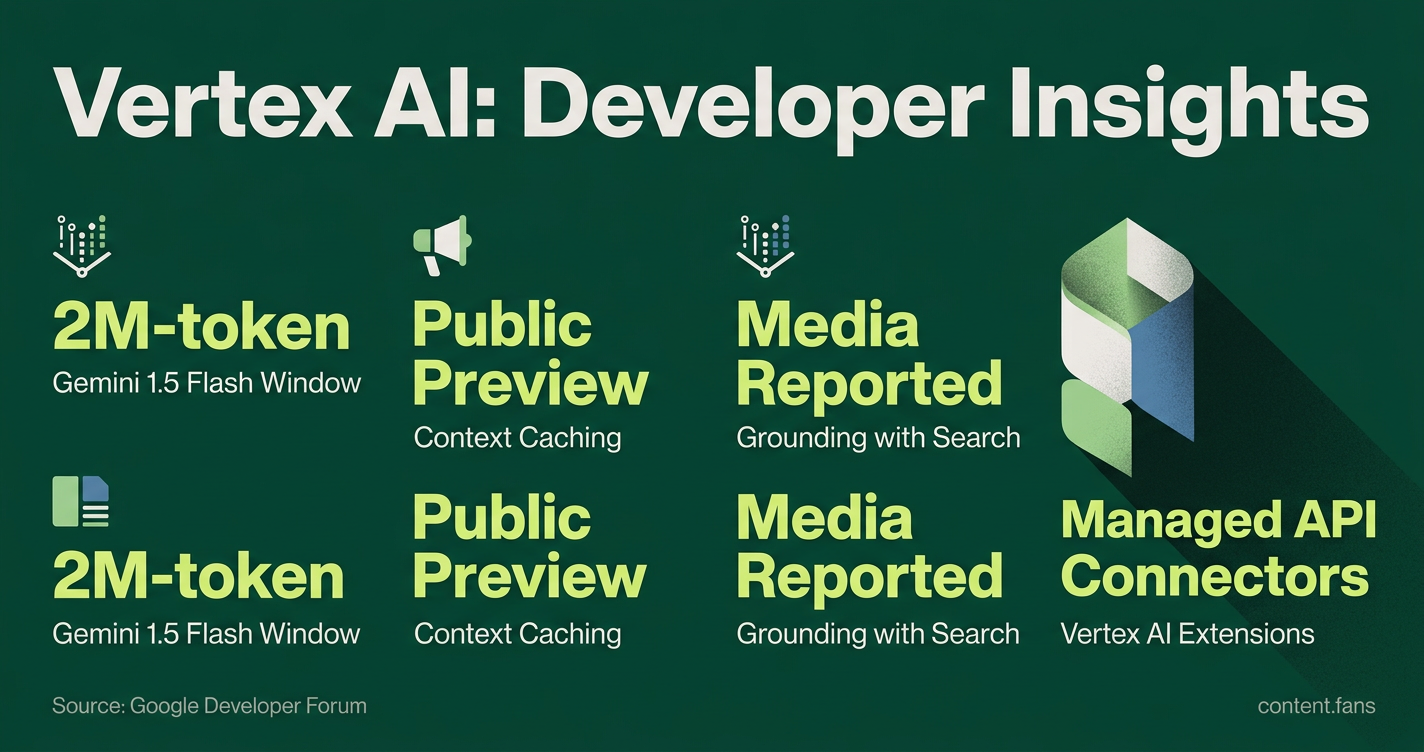
Key Vertex AI Features in Forum Discussions
| Capability | Current status in sources | Typical question on forum |
|---|---|---|
| Gemini 1.5 Flash 2M-token window | Public preview, per ZDNet1 | "Does the quota apply per chunk or total prompt?" |
| Context caching | Public preview, TechRepublic says | "Why do repeated calls still bill full tokens?" |
| Grounding with Search | Mentioned in media reports1 | "Any ETA for non-English sites?" |
| Vertex AI Extensions | Described as managed API connectors | "Can an Extension call internal REST endpoints?" |
Forum discussions often reinforce established best practices for custom training, such as packaging code in a supported container, saving checkpoints frequently, and exporting models to the $AIP_MODEL_DIR. These practices align with Google's official guidance for ensuring job resiliency.
Practical Takeaways for Custom Training
A synthesis of top-voted community advice produces a practical checklist:
- Read data from Cloud Storage, write artifacts back, and never depend on local disk.
Contributors note this pattern keeps jobs portable across Spot instances, a practice endorsed in Google's best-practice documents for cost control. One engineer noted that a four-GPU PyTorch job recovered cleanly from a preemptible interruption because checkpoints were saved at 30-minute intervals, indicating the guidance is effective in real-world workloads.
Several threads propose starting with AutoML Tables for classification and switching to custom training only when feature engineering demands deeper control. That advice tracks with documentation that positions AutoML as a tool for establishing a rapid baseline.
Emerging Integration and Security Topics
Popular discussions are increasingly focused on integrating Vertex AI with services like BigQuery Vector Search for retrieval-augmented generation (RAG). Developers are building applications that embed documents and route them to Gemini 1.5 Pro, reporting improved accuracy but noting cost concerns at high query volumes (over 50,000 calls daily). Security and governance are also prominent, with users sharing workflows for redacting sensitive data via Pub/Sub - a pattern that reflects Google's own responsible AI architectural guidance.
Why the Forum is a Critical Resource
While official announcements highlight major launches, the Google Developer forum reveals the practical friction points that emerge during implementation. Access to real-world error logs, workarounds, and user benchmarks allows development teams to anticipate challenges and plan deployments more effectively. The forum is an essential early-warning system for any organization leveraging Google's managed AI services.
What new generative-media capabilities are now in preview on Vertex AI?
Recent generative media previews on Vertex AI include Lyria for text-to-music, Veo 2 for cinematic video, Imagen 3 for advanced image generation and inpainting, and Chirp 3 Instant Custom Voice for rapid voice cloning. These updates are detailed in the official Google Cloud Next gen-AI summary.
How can I train my own model on Vertex AI without building everything from scratch?
Follow Google's recommended pattern for custom training:
1. Package code in a supported container and push it to Artifact Registry.
2. Use Cloud Storage for training data and artifacts, not local disk.
3. Export models to the $AIP_MODEL_DIR environment variable for automatic registration.
4. Use command-line flags for hyperparameters to enable Vertex AI's tuning service.
5. Start with AutoML as a baseline before advancing to fully custom models.
This process is detailed in the Custom training beginner's guide.
What are the top integration pain points when adding generative AI to Google Cloud services?
Key integration challenges include:
- Grounding models to prevent hallucinations and connect them to enterprise data.
- Managing scattered data across documents, APIs, and databases.
- Enforcing security and governance for compliance.
- Controlling cost and latency at scale.
- Addressing model drift as data evolves over time.
Google Cloud's solution is a retrieval-augmented generation (RAG) architecture using services like BigQuery Vector Search, Gemini 1.5 Pro, and Vertex AI grounding. See the real-world gen-AI architecture guide for details.
Which Gemini models are generally available in Vertex AI as of mid-2024?
As of mid-2024, Gemini 1.5 Pro was in public preview on Vertex AI and Gemini 1.5 Flash was in public preview, not generally available. Both models support context caching in public preview to reduce cost and latency.
Has Vertex AI been rebranded to "Gemini Enterprise Agent Platform"?
Despite some speculation, there has been no official announcement from Google confirming a rebrand of Vertex AI to 'Gemini Enterprise Agent Platform' or a 'Vertex AI 3.0' launch. Until an update appears in the official Vertex AI release notes, such claims should be treated as unverified.